Burial sites at the Unterbarmer cemetery
Dr Doris Lehmann / Art history
Photo: Private
The impressive variety of representative graves
Art historian Dr Doris Lehmann on graves in the Unterbarmer cemetery
Mrs Lehmann, Germany has a cemetery culture. This refers to cemetery design, burial practices and mourning and remembrance rituals. Today, cemeteries are images of a pluralistic society. With the industrialisation of the 19th century, the original cemetery culture changed considerably. This can be clearly seen in the old gravestones, which often had standardised forms but were now increasingly individualised. Each gravestone should not only contain basic information about the deceased, but also reflect their personality. More and more different materials were used, although natural stone and granite continued to be popular. A well-known example of historical gravestones from this period is the Père-Lachaise cemetery in Paris, where numerous artistically designed gravestones made of granite, marble and other natural stones can be found. Many of these graves are decorated with impressive sculptures and ornate inscriptions. But Wuppertal also has a number of remarkable graves from the period in the Unterbarmer cemetery. What is special about them?
Doris Lehmann: The Unterbarmen cemetery is a wonderful example of the impressive variety of representative graves. Visitors to the Unterbarmen cemetery, which was inaugurated in 1822, embark on an exciting and moving journey back in time to Wuppertal's glorious past. Around 1900 in particular, financially strong clients outbid each other here with tomb designs, some of which are truly spectacular as monuments and unique in the area. With the technical expertise of the Kölner Dombauhütte and the openness to a wide range of creative possibilities, historical tombstone art was created for the local industrialists and their families, which not only documents the self-image of the individual people, but also makes the economic, social and urban history of Barmen, which was still independent at the time, visible in various facets. The fact that this juxtaposition of such different ideas is still preserved and can be experienced in the landscape makes the Unterbarmer cemetery famous even beyond the city limits. A visit is worthwhile and reveals a very special character, especially in comparison with the Old Cemetery in Bonn, the Melaten Cemetery in Cologne or the Golzheim Cemetery in Düsseldorf.
Let's talk about a few examples: The grave of Friedrich Engels' parents can be found there. The sandstone gravestone was extensively restored in 2019. Sandstone is very fragile because it erodes and is susceptible to frost, as we know from Cologne Cathedral. Why was it used anyway, and why is the Engels tombstone an important historical monument?
Doris Lehmann: These are both very exciting questions and you could write a book about the first one. If we take a closer look, the first thing we realise is that around 50 types of stone have been used in Cologne Cathedral since the foundation stone was laid in 1248. It was not until the 19th century that different types of sandstone were used in Cologne Cathedral as an alternative to the trachyte from the Drachenfels quarry, which was closed in 1828. The loss of substance known today was not foreseeable at the time and does not only affect sandstone components. The Obernkirchen sandstone, from which the towers and floor slabs of Cologne Cathedral, for example, were made, is even considered to be very resistant to weathering. Ultimately, therefore, it depends on several factors: although the quality is directly related to the conditions under which the stone layer was formed, it is also relevant how and for what purpose the stone was used. Depending on the function, different types of stone are suitable for different tasks. A stone that is very suitable and durable for indoor use can weather badly if it is used unsuitably outdoors and may need to be replaced. You have to look individually at what the problem is in each case and then realise that not all sandstone is the same. Even if it sounds unbelievable, ashlars from the same quarry can differ greatly from one another. And then it also makes a difference which external factors such as positioning, weather, materials or environmental pollution can damage the stone. In the 19th century, there were various practical considerations in favour of sandstone as a material, which were also relevant for the construction of a gravestone: These included availability, cost and transport. Sandstone was also valued in practice as a comparatively soft material, which made filigree, i.e. small-scale carving very easy. This made the work of stonemasons and sculptors much easier and should not be underestimated. If we consider the simultaneity of the projects, i.e. the completion of Cologne Cathedral on the one hand and the tomb for Friedrich Engels senior on the other, the proximity in terms of design and location is just as striking. The tomb of the Engels family has the shape of a Gothic pinnacle, i.e. an ornamental tower decorated with tracery, the top of which ends with a finial. This makes it similar not only to Cologne Cathedral, but also to the high cross in Bonn-Bad Godesberg, which was restored in 1859 and was even discussed as a possible model. Until the renewal of this wayside cross, which was made by the Cologne cathedral builders in 1349-1362, it had been crowned by a cross. The decision to make the tombstone in the neo-Gothic style shows the client's express wish to be perceived as Christian, which fits in with Friedrich Engels senior's commitment to the united Protestant church community. As a monument, the tomb design represents the ideals of its time.
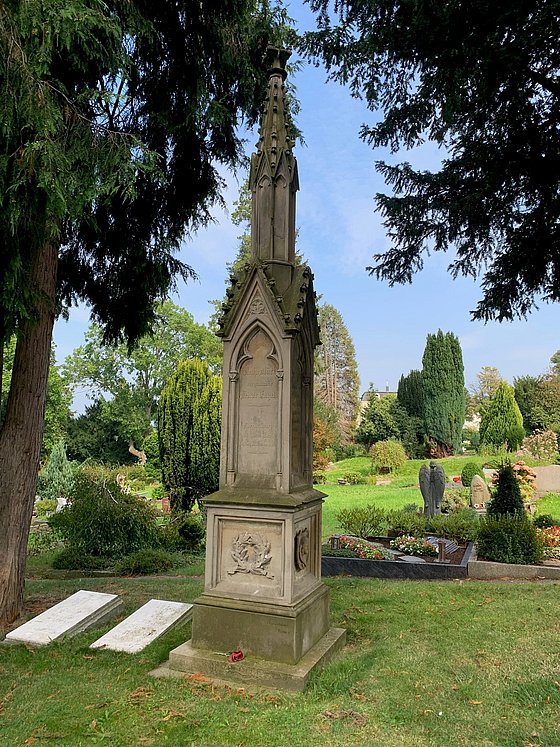
Grave of the Engels family
Photo: UniService Third Mission
There is a special path in the Unterbarmer cemetery, which the people of Wuppertal also call 'Millionenallee'. Why is it called that?
Doris Lehmann: The name "Millionenallee" refers to a magnificent avenue of graves that must have cost an enormous amount of money - the proverbial million - to build. Unfortunately, I don't know when the people of Wuppertal started calling their "Millionenallee" by this name, but it is clear that even the citizens of the late Gründerzeit were aware that only wealthy patrons could afford such elaborate architectural and sculpturally designed tombs. And the dense collection is an additional peculiarity that must have aroused admiration as well as probably a little more or less affectionate mockery here and there from those who took a critical view of the wealth on display. In the early days, trillionaires and even billionaires were not yet an issue, nor did the numerical words Fantastillion or Fantastilliarde, invented for Scrooge McDuck, exist as a reference to wealth that was perceived as immeasurable. The term "Million Avenue" is probably familiar to some people here in the neighbourhood from a similar context: there is also one at the Melaten Cemetery in Cologne, where a lot of money was also invested in posthumous fame.
In 1911, the Düsseldorf sculptor Josef Hammerschmidt (1873-1926) created a remarkable gravestone with Egyptian flair on the aforementioned Million Avenue. A sphinx in Unterbarmen is quite unusual, isn't it?
Doris Lehmann: Yes, a sphinx in a cemetery seems unusual when expectations are characterised, for example, by the depictions of angels on Christian graves that were popular between 1885 and 1920. A good example of this would be the electroplated angel on the Reinhold Maus family grave in the Cronenberg cemetery on Solinger Straße. But in my view, the special and beautiful thing about the long 19th century is precisely the diversity and the coexistence of very different ideas. And the aforementioned sphinx, some would also say "the sphinx", is indeed a remarkable example of this. In this tomb, the Christian symbol is hidden in the cross-shaped ground plan on which the imposing mythical creature rests. In terms of content, the sphinx, which Hammerschmidt combined with a mourning male figure and completed in 1911, fits very well with a funeral: like a guardian, the sphinx separates the realms of life and death. Around 1900, sphinxes were an important theme in art. They were part of the enigmatic imagery of Symbolism. The Egyptomania triggered by Napoleon's campaign still lingers in the sculpture of the Düsseldorf sculptor: This enthusiasm for Ancient Egypt is known to have led to numerous artefacts being transported to Europe. To this day, the bust of Nefertiti, which was found in 1912 and exhibited in the Berlin Museum, is a crowd-puller and the subject of restitution debates. And the latter is not only about works of art, but also about the human remains, the mummies, which were then reclassified as objects for collection and exhibition.
To return to Hammerschmidt's sphinx and its special features, its design is not based on the artist's own imaginative design. This sphinx not only looks like an ancient Egyptian monument, it is a recognisable copy of a famous sculpture that has been in the Louvre in Paris since 1826: The original is known as the Sphinx of Tanis. The rose granite model is damaged in some places, which the Düsseldorf sculptor did not copy faithfully. Like other large-format copies of the Sphinx of Tanis, the Belgian granite tomb shows no flaws on the ear, the left paw or the lower part of the king's beard. So it is not only the transfer of the famous sphinx to today's Wuppertal and a cemetery that is exciting and raises many questions, but also the fact that there are other older copies of the same model: Six concrete copies still adorn steps to the terrace in Crystal Palace Park in London, for which they were made in 1852. At that time, the Crystal Palace was moved here after the first Great Exhibition. Knowledge of tomb art in the Rhineland is therefore not enough to categorise the tomb for the Grote family of textile manufacturers.
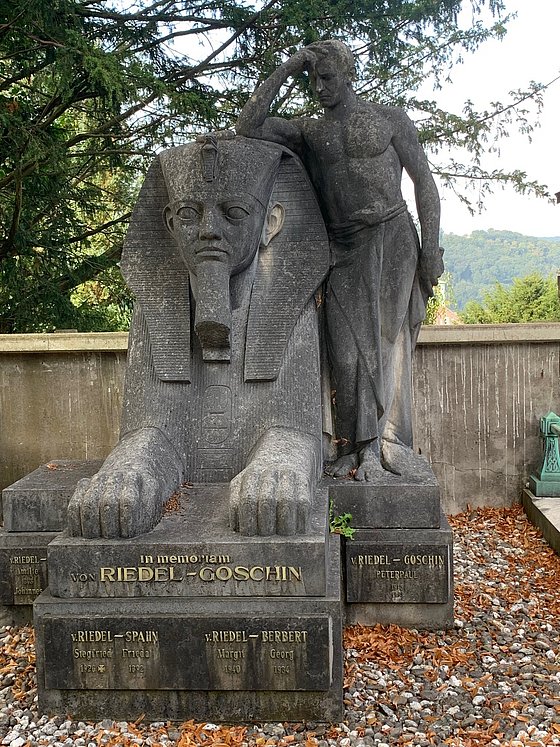
Grave Riedel/Goschin
Photo: UniService Third Mission
This section of the cemetery is also home to Wuppertal's only preserved columbarium, designed with life-size figures. What's it all about?
Doris Lehmann: It's really worth taking a closer look at this architectural tomb. Then we can recognise with our own eyes that a change of function has taken place here and that the columbarium was only installed inside the burial chamber at a later date. Columbaria are walls divided into niches that are used to store several urns. The word "columbarium" comes from the Romans, who originally associated it with the dense overlapping and underlapping in a dovecote. The burial complex at Unterbarmen cemetery, which today houses a columbarium, was built in 1904 on behalf of the entrepreneur Claus Toelle as his mausoleum. This name also comes from antiquity and reminds us of one of the seven wonders of the world: the famous tomb of Maussolos in Halicarnassus, now Bodrum. Toelle's tomb consists of a funerary monument containing two rooms, one above the other: the upper floor is a room for worship, with a crypt below as the actual burial place. As a mausoleum, the tomb still contains Carl Toelle's urn and his portrait relief. From the outside, the tomb stands out due to the monumental figure decoration that dominates the lines of sight at the fork in the road. Like the sphinx, the two figures in Toelle's tomb were created by the Düsseldorf sculptor Josef Hammerschmidt, but they were created in 1904, somewhat earlier than the tomb discussed above. The artist himself called the pair of figures "Hagen and Volker on guard". They depict two heroes of the Nibelung saga guarding the entrance to the former mausoleum. Hagen of Tronje, armed with a drawn sword, stands upright, while the minstrel Volker of Alzey sits beneath the protection of his mighty shield, immersed in deep mourning. His lyre rests unused on his left knee. For the silenced singer, the sculptor chose an expression of extreme grief that cannot be depicted by artistic means, a trick that has been famous since antiquity. This makes it possible to reconcile emotion and dignity in the work of art: The singer hides his face and thus his facial expressions in his right hand. The effect of the veiled face, which becomes a projection screen for the viewer's feelings and is intended to move them inwardly, is named in art history after the legendary inventor of this pictorial solution: Timanthes. Veiled or invisible faces of mourning figures are therefore often found in cemeteries.
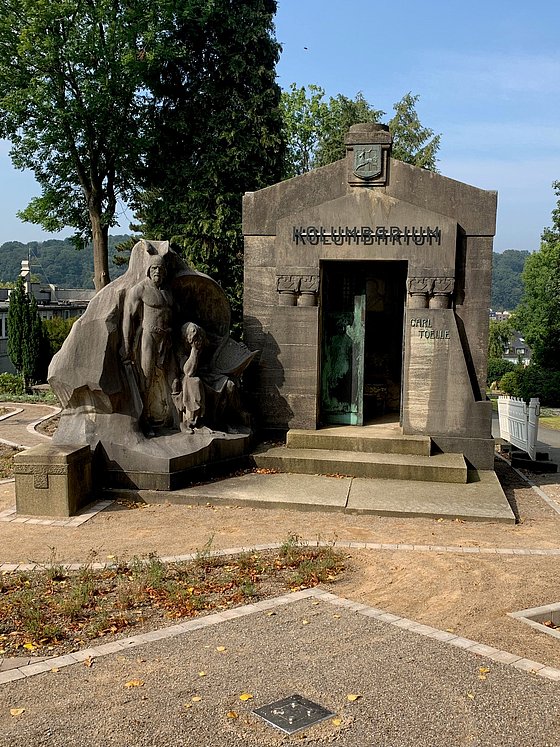
Columbarium
Photo: UniService Third Mission
The tradition of artistic gravestone design is a very old one. Where did it all begin?
Doris Lehmann: The first examples of figurative reliefs can be found in prehistory and early history. Tombstones showing the deceased surrounded by their families are known from ancient Greece and Roman burial roads. However, the artistic diversity of design possibilities already went beyond gravestones in antiquity and included architecture, sarcophagi and sculptural grave figures, such as the well-known archaic kuroi and koren. In the Middle Ages, gravestones were not only found in churchyards or on church walls and pillars; more common at that time were the grave slabs set into the floor of churches, sometimes decorated with figures, or the more sculptural variant of a tumba (sarcophagus-like tomb, the top plate of which is usually decorated with a carved stone portrait of the buried person, editor's note) with a reclining figure. It was not until the 18th century that the upright gravestone became established.
Ancient depictions can also be found in the Unterbarmer cemetery. Where did they suddenly come from again in the middle of the 19th century?
Doris Lehmann: This shows once again that the coexistence of historicism allowed artists and patrons to pick up on whatever they liked for decades. In this case, however, "antique" or "pseudo-antique" is more appropriate than "antique", because the depiction of the Albert Villbrandt family, for example, would certainly not be mistaken for an antique tomb relief. The clothing is indeed antique, as is also the case with the older Niebuhr tomb in the Old Bonn Cemetery. There, the historicising recourse refers to the appreciation of Barthold Georg Niebuhr as a scholar of antiquity. In contrast, the combination of long-sleeved tunic, cloak and bare feet on the Villbrandt tomb stands in stark contrast to the fashionable bearded costume of the deceased, who is at the centre of the relief. In particular, the distinctive twisted moustache, which has fans again today, certainly has no analogue in antiquity. This beard style only came into fashion at the end of the 19th century. The anachronism was deliberate; the aim was to strike a balance between recognisability and timeless dignity. In Villbrandt's case, the decision against contemporary clothing has a special appeal: the commemoration here is for the successful producer of braces.
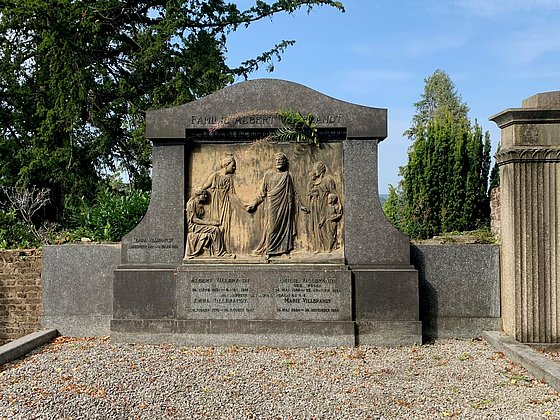
Historicism and antiquity
Photo: UniService Third Mission
Ancient depictions can also be found in the Unterbarmer cemetery. Where did they suddenly come from again in the middle of the 19th century?
Doris Lehmann: This shows once again that the coexistence of historicism allowed artists and patrons to pick up on whatever they liked for decades. In this case, however, "antique" or "pseudo-antique" is more appropriate than "antique", because the depiction of the Albert Villbrandt family, for example, would certainly not be mistaken for an antique tomb relief. The clothing is indeed antique, as is also the case with the older Niebuhr tomb in the Old Bonn Cemetery. There, the historicising recourse refers to the tribute paid to Barthold Georg Niebuhr as a scholar of antiquity.
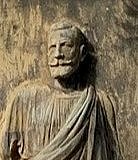
Historicism and antiquity - excerpt from Zwirbelbart Photo: UniService Third Mission
In contrast, the combination of long-sleeved tunic, cloak and bare feet in the Villbrandt tomb stands in stark contrast to the fashionable beard of the deceased, who is at the centre of the relief. In particular, the distinctive twisted moustache, which has fans again today, certainly has no analogue in antiquity. This beard style only came into fashion at the end of the 19th century. The anachronism was deliberate; the aim was to strike a balance between recognisability and timeless dignity. In Villbrandt's case, the decision against contemporary clothing has a special appeal: the commemoration here is for the successful producer of braces.
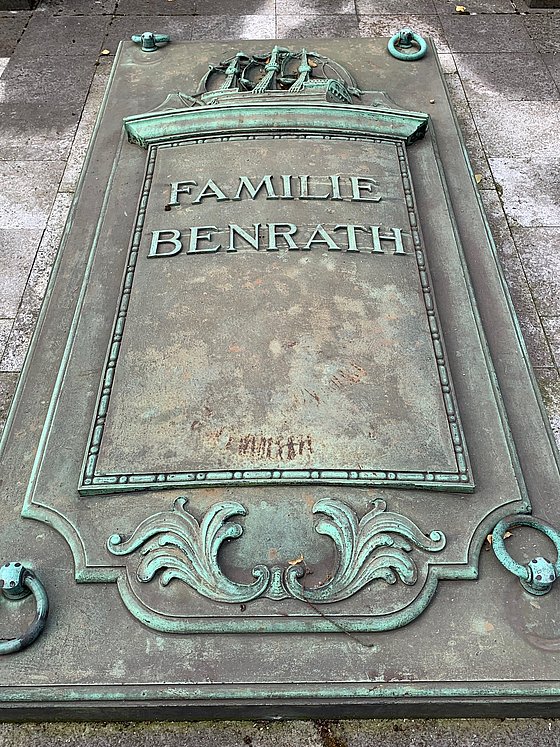
Benrath family grave
Photo: UniService Third Mission
Complete, skilfully crafted bronze floor slabs can also be found in the cemetery. So a gravestone can be designed not only vertically but also horizontally?
Doris Lehmann: Yes, it is possible to adapt the grave decoration to its surroundings horizontally or vertically and also to utilise the surrounding space in different ways. More than one grave can be hidden under a ground slab in a cemetery; there may be access to an underground and accessible crypt. Very few of them probably look like something out of a Dracula film. In fact, after 1900 there were plans to modernise the cemetery culture in Germany. The architect August Thiersch developed a corresponding idea for Munich in 1907, inspired by Roman catacombs. Thiersch argued in favour of underground burial chambers for one to 36 coffins. The individual and collective crypts were to be accessible from a beautifully designed park with a temple city and ceremonial entrances. His proposal included electric lighting, metal doors and windows. The plan, which became nationally known in 1913, went down in art history as a failed cemetery utopia because, although it was publicly praised, it was never realised. What we usually see in a cemetery like the one in Unterbarmen is the expansion of a complex in height, but not in depth.
Just how monumental a grave can be can also be seen in the example of the Kruse family. A life-size female figure with an urn in her hand stands in front of a wrought-iron gate, surrounded by a huge archway. These are real dioramas that also tell a story, aren't they?
Doris Lehmann: Yes, and there are also more elaborate depictions with several figures, such as the tomb "Mother Earth", which Simatscheck created in 1912 for the Dernen - von Wittgenstein family and which can be seen in the castle cemetery in Bad Godesberg. Here, however, the single figure symbolises a moment of transition, farewell and immortalised grief. In front of us stands a mourner with an urn of ashes on the threshold between life and death, which we have already mentioned in the example of the sphinx and which the guards at the entrance to the mausoleum also protect. What some call the gateway to eternity is staged here as a huge portal with an empty space behind it. As the gate behind the wrought-iron door seems to lead into nothingness from the perspective of us living people, symbolically referring to the afterlife, the tomb seems to have been removed from time and place. The scene therefore takes place in a sphere of its own. It is also irrelevant whether it really refers to an urn burial or a coffin burial. Raptured, we see a young woman in antique garb, which is intended to emphasise once again that time no longer has any meaning for the deceased or for what we are seeing. The bronze figure is shown both striding and static, as if frozen, on the steps of a staircase, her right hand resting on the door handle. The mental cinema begins: Where is she coming from? Where is she going? This invites us to linger and reflect on death.
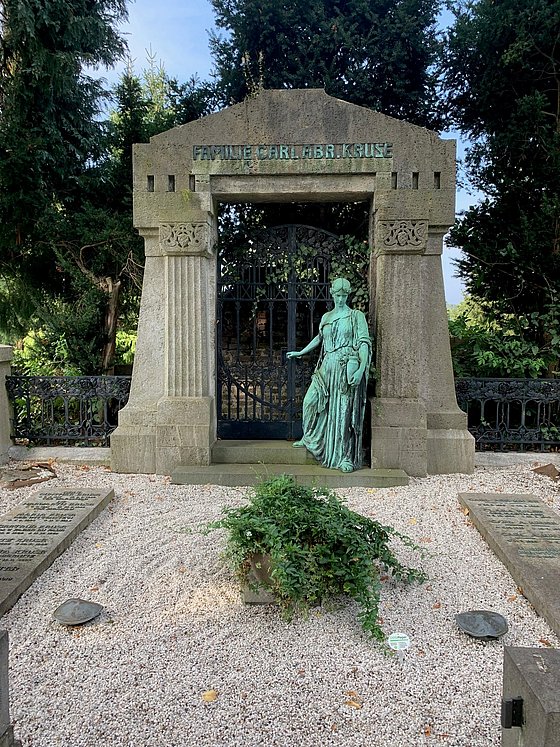
Kruse family grave
Photo: Third Mission UniService
Gravestones, formerly also known as headstones, have always been artistically crafted. Is that why they are also works of art in public spaces today?
Doris Lehmann: Necropolises or burial grounds, i.e. burial sites, were popular places long before cemeteries such as the Unterbarmer Friedhof came into being and were present outside of residential areas. This also applies to burials in churches and churchyards: graves and crypts were part of this. For centuries, people have been remodelling graves into places of remembrance. The desire to counteract oblivion and create long-lasting or even permanent attention and appreciation is a powerful driving force. Ever since there have been legends about the creation of the first works of art, they have been linked to the idea of preserving and visualising memories of loved ones. Death and life have always belonged together and ultimately there has never been a separation. We may temporarily suppress this, like our own death, but ultimately it is like Wolf Erlbruch's wonderful illustrations in Duck, Death and Tulip. Death is there, whether we see it or not. And so it is with the art around us.
There is great interest in the history of these graves, and guided tours are regularly organised in Wuppertal. Which stone design appeals to you personally the most?
Doris Lehmann: Because of my personal relationship with Cologne Cathedral, I like the pinnacles in the Gothic style, with details such as tracery and crabs. I am also fascinated when sculptors succeed in making stone appear soft or light. But when I go to a cemetery, I always enjoy the impressive variety and the differences.
Uwe Blass
Dr Doris H. Lehmann is a trained photographer and studied art history, classical archaeology, provincial Roman archaeology and Latin philology at the University of Cologne, where she received her doctorate in 2005. In 2018, she habilitated at the Rheinische Friedrich-Wilhelms-Universität Bonn with a thesis on the dispute strategies of visual artists in modern times and has been a private lecturer ever since. She has been teaching art history at the University of Wuppertal as a research assistant since October 2018.