The economic importance of independent welfare organisations
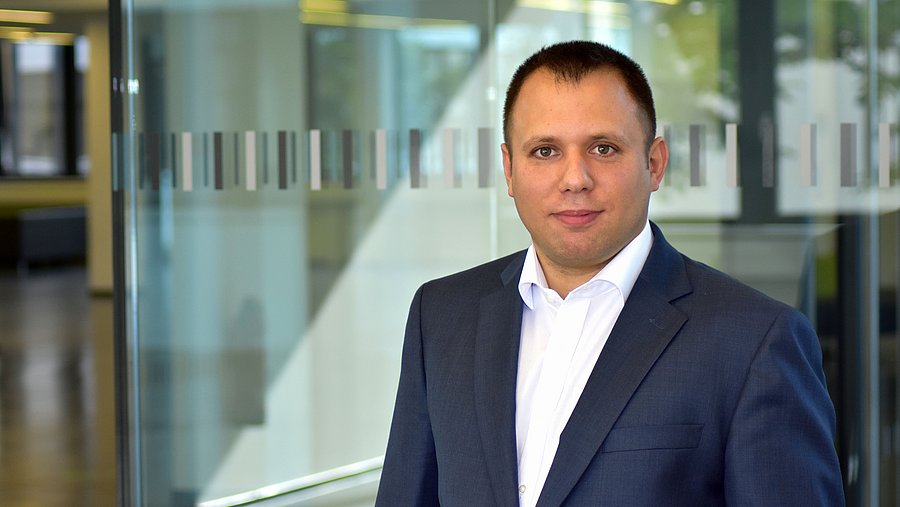
Dr Markus Doumet / Economics
Photo: Sylvie Doumet
The success of non-profit welfare organisations becomes visible in society
Dr Markus Doumet on the economic significance of non-profit organisations
The Chair of Finance and Corporate Governance at the University of Wuppertal actually deals with sector analyses of private companies. The economic barometer project with the Bergisch city savings banks is a well-known example of this. "We look at the structures and developments in the sectors nationwide, but also with a special focus on the Bergisch city-triangle," explains Markus Doumet, senior academic advisor at the chair. The enquiry from the Association of Independent Welfare Organisations was therefore a particular challenge, which then led to a new project, because "when we as an institute looked at what independent welfare organisations actually do, we quickly realised that what we usually work on here doesn't work there," says the economist. "After all, these are not classic, privately organised companies that primarily act with the intention of making a profit. That's why we needed a different analytical approach here." The project entitled 'The economic significance of non-profit welfare organisations in the Bergisch city-triangle' was launched with six leading non-profit welfare organisations in the Bergisch city-triangle (AWO, Caritas, Der Paritätische, Deutsches Rote Kreuz, Diakonie, Wohlfahrtsverband der jüdischen Kultusgemeinde).
Non-profit organisations provide added value for society
All of the organisations and sponsors examined in the project are non-profit and committed to the common good. "They do not make a profit, but rather provide added value for society. They cover social needs in the social sector," explains Doumet. For this reason, the success of independent welfare organisations cannot be measured in terms of business figures, as the services provided and their impact are not visible in the company, but are reflected in society.
Special status of non-statutory welfare organisations due to the principle of subsidiarity
The principle of subsidiarity (subsidiarity is a principle that states that a superordinate unit should only intervene if a subordinate unit cannot fulfil a task independently, editor's note) gives independent welfare services a special position in the fulfilment of welfare state tasks. Doumet comments: "The principle of subsidiarity in itself is a basic principle that we have in a federal state, and it makes particular sense. It's about finding a local solution to a local need or problem. And that is advantageous in the first instance because it encourages citizens to take responsibility for themselves. It leads to a customised solution being found for the specific local problem." Conflicts could only arise if the objectives varied at federal and state level, but the legislator has the option of enacting federal or state laws.
Independent welfare organisations also enjoy priority in the allocation of services, another aspect of the subsidiarity principle. When it comes to the question of whether a local authority commissions a service from a private-sector provider or from non-profit organisations, it is historically and politically desirable for the state to give priority to non-profit organisations. "However, this does not mean that independent welfare organisations can do what they want, but rather that there is a legal framework within which they operate. In addition, not all costs are always covered." Doumet uses the example of a daycare centre to illustrate this. "In the case of daycare centres, this is based on the number of children, the age of the children and the scope of care. And the municipal and state funds that go into it are clearly limited. Independent welfare organisations have no choice but to work according to economic principles because otherwise they would not be able to cover their costs." In addition, in the last 10 years, due to changes in legislation, attempts have been made to promote competition between independent organisations and private sector organisations wherever possible.
Voluntary commitment is declining
Two key tasks of the independent welfare sector are the representation of the interests of socially disadvantaged groups and the mobilisation of voluntary work. While the first group is growing, the commitment of the second group is shrinking, especially in traditional organisations. "First of all, it is fundamentally true that volunteering at club level is on the decline," confirms the researcher and says: "The nature of volunteering has changed. There is less long-term involvement in organisations; young people in particular tend to get involved on a short-term, project-related basis." This, in turn, is a challenge for non-statutory welfare organisations because they are traditionally more reliant on long-term volunteering. "They therefore have to reinvent themselves to a certain extent, adapt to this new form of engagement and try to develop other, new programmes, especially for young people."
Independent welfare organisation of the state of North Rhine-Westphalia
Logo of the federal association: Lars 70, CC BY-SA 4.0
The economic importance of non-statutory welfare organisations
The non-statutory welfare sector is one of the largest employers and therefore a key factor in the economic development of the region, and yet it is not widely recognised in the public debate. "When we started the project, we had no idea of the scale," says Doumet, "but the fact is that if you look at this area of social services, separate from voluntary work, and really look at the hard employment relationships subject to social insurance contributions, this area of social services accounts for 10%. A large proportion is also accounted for by independent welfare organisations. If this key area were to disappear, one in 10 people in employment would be unemployed."
Every euro invested in non-statutory welfare flows back many times over
Every euro invested in the activities of non-statutory welfare organisations returns many times over through direct and indirect social effects. This social impact measurement can be illustrated using the example of daycare centres. "If you take a daycare centre, it's relatively easy to calculate the costs, because a daycare centre has to work according to business principles and the financing is also relatively easy to map, because it's mainly state and municipal funds. Then there are also own funds, but you can calculate all of that too." In order to determine the benefits, the project managers conducted interviews with educators, the daycare centre management, the children's parents and other relatives to understand what it means for the individual stakeholders when a child has a place in a daycare centre. The result: a financial economic cycle, which Doumet explains as follows: "There are three main effects. Firstly, the employment of the daycare centre staff: these are employment relationships subject to social insurance contributions. The money that flows into the daycare centre and goes to the daycare centre employees in the form of wages and salaries is then channelled back into the economic cycle and, in part, back into the public budget. As the majority of employees also live in the Bergisch city-triangle and neighbouring municipalities, the money also stays local. Then there are the parents. The moment a child goes to daycare, parents have more time and can also pursue an employment relationship, or an employment relationship to a greater extent." The researchers also analysed the consequences of a child not being able to attend daycare. "In households with two parents, this would mean that the one with the lower-paid job would have to reduce it even more or even give it up. This would mean a loss of income, not only immediately, but perhaps also in the long term." It is even worse for single parents who may not even have grandparents nearby, who are then suddenly reliant on the social security system, and this places an additional burden on the public budget. And then there is another decisive effect on the children themselves: "In the Bergisch city-triangle, we naturally have a very high proportion of children where German is not their mother tongue at home. This means that for these children in particular, exposure to the German language, where they speak with their peers, is very important, and it helps them later in the school context, completely detached from the educational daycare concept. If you look at how this effect alone impacts on educational opportunities at primary school age and subsequently at secondary school, it is immense. The effects of early childhood education are not immediate, but they are very long-lasting and very strong, and of course this also has consequences for entry into working life and for overall income later on." All of this is difficult to quantify, but the researchers have tried to work with a model that at least gives an idea of the cost-benefit effect. "Then we are back in the area we are working on, namely the financial economy. A euro that is created in 20 years has a different value than a euro that has an immediate value. And if you do that and compare it to the direct costs, you end up with 4.60 to 6.60 euros in benefits compared to 1 euro in costs for the daycare centres."
The social significance of independent welfare organisations
The project goes beyond traditional, often purely cost-based evaluations to translate the social impact of social work into comprehensible key figures. The non-statutory welfare organisations thus form an indispensable part of the social infrastructure in the Bergisch city-triangle. Doumet emphasises the importance of the social and economic commitment of non-statutory welfare work in its role as an employer and client. "It is also a major economic player. When it comes to the financing of non-statutory welfare organisations, we always have the issue of costs. Only the costs are ever seen in the public budget, and what we have tried to do is establish a method that can be used to show what the social and public budget costs are when a measure is discontinued or not implemented." In order to avoid consequential costs to society, one must always ask oneself in the public debate whether short-term savings in the public budget could not lead to significantly higher costs to society in the future, and that is the advantage of this project measure, because one looks at the long-term dimension.
Uwe Blass
Dr Markus Doumet is Senior Academic Advisor at the Chair of Finance and Corporate Governance at the Schumpeter School of Business and Economics at the University of Wuppertal.