
Damability - the ambivalence of the gaze
Dr Heike Baranzke / Theological Ethics of Catholic Theology
Photo: Sebastian Jarych
The ambivalence of the gaze
Ethicist Heike Baranzke on shamefulness in caring
“Yesterday I was hosed with water again,” a care home resident said to her daughter, meaning that the last shower was more reminiscent of being maltreated in a car wash than being able to enjoy pleasant personal hygiene in a comfortable environment. Wuppertal ethicist Dr Heike Baranzke has been studying the topic of shame for years and says: ”Shame is a general human emotion, an affect that you can’t defend yourself against and is therefore a very unpleasant feeling. Unpleasant because you feel ashamed when you are seen in a way that you don’t want to be seen.”
The fear of social death
Shamefulness is culturally invariant, the scientist explains and states: “All people are ashamed, even if perhaps not for the same specific reasons.” But what is the reason for that? "Because we humans are inherently social beings. Shame is also referred to as the social emotion par excellence, because we humans are dependent on community living and being recognised. If you have the feeling that you are seen in an unfavourable way, in a way that you don’t want to be seen, this feeling is linked to the very deep fear that the community will no longer want to have anything to do with you, that you may be excluded. And this deep sense of shame is then linked to the fear of what is referred to as ‘social death’.“ Baranzke explains social exclusion using an example from a recent radio programme on the history of capital punishment. “Cultural-historical research shows that in in earlier times, people sentenced to death were not executed by humans, but rather excluded from the human community. They were left in the wild nature, which was full of dangers, thereby ultimately facing death. In other words, if you visualise these dimensions once again, then you get an idea of how dramatic the root of the feeling of shame is as a fear of being excluded from the community.”
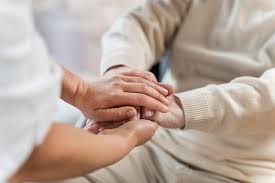
Mindful support
Photo: Freepik
The quality of the gaze
Shame doesn’t only apply to personal hygiene situations, Baranzke says, but also to situations of helplessness and loss of control. Feeling naked or stained can characterise someone both physically and metaphorically. In the care sector in particular, this can become a moral problem. And this often happens through eye contact. “Now there are very different qualities of eye contact,” she explains, “for example, it becomes dangerous if you are overlooked, cut, if you are not recognised with a glance, as was common in so-called ‘black pedagogy’. Eye contact can also have the quality of an act of submission, which could then be a stern look that calls one to order or forces the other person to lower their gaze. In other words, a lot happens in this non-verbal way of shaping a relationship through eye contact, which can be highly ambivalent, because you can also look at someone lovingly, emphatically or with understanding.” It’s always about whether you meet as equals at eye level or fight a power struggle.
All of these shades of view are usually unreflective, involuntary, but in psychosocial professions they have to be professionalised in principle. “Everyone who works in psychosocial professions - and this includes nursing, teaching, medicine, and social work - should reflect on this fact and become aware of their responsibility in shaping relationships.”
In care, the body that can be seen can also be touched
In basic care, there are many non-verbal forms of interaction that are simply routine for care staff, but are anything but normal for those in need of care. ”In care, we experience that a person's physicality is not only visible and can be seen, but that their body also makes them touchable. In addition to the sense of sight, there is also the sense of touch as a sensory quality. Nursing is a special profession in this respect, a touching profession that always works at the limits of shame and shamefulness.” As children, the ethicist explains, we learnt that care was carried out in secret, only to be presented in public in a more attractive way, because then we would look presentable and people would enjoy dealing with us again. In contrast, people in need of care are in a situation where they are no longer able to take care of themselves on their own. Instead, they would have to rely on the support of another, stranger. “The involvement of a stranger brings personal hygiene into the public sphere. I am no longer alone in my bathroom or bedroom at home, but am now in a room where I can be seen or even touched by another person while caring for me. That makes the nursing profession so challenging, because it’s a situation that is both precarious for the person in need of care and precarious for the person providing care, because in principle they have to perform shameful acts. That’s why it’s so incredibly important to react to this situation with a great deal of tact and professional reflection.” You never treat just one body. “The human body is always the body of a person, which means that when you touch a person, you are never just touching a body, but always the person to whom the body belongs.” Whether it’s genital care or a gynaecological examination, there’s no getting around these shameful acts and the situations have to be defused professionally, for example by avoiding eye contact in these situations. “You first have to have the courage to deal with this feeling and then address it in these professions. It is unpleasant for all sides.” However, it is helpful to be aware of this gaze management and the situation-dependent ambivalence of the gaze.
The art of touch
The nursing shortage in hospitals and retirement homes is omnipresent. There is a shortage of staff everywhere. It sometimes seems difficult to maintain the dignity of the person being treated when there is simply no time for explanations. In this context, Baranzke speaks of the “art of touch” and explains it with an example from history: “In her book ‘Desecration and Shame’, Katharina Gröning described the example of the paediatrician Emmi Pickler, who decades ago, in the first half of the 20th century, cared for orphans appropriately and showed how these children were able to develop well precisely through the kind of touch that has a quality all of its own. They were never touched carelessly, but in a way that respected them as other beings and helped them to build up their psychological defences.”
In nursing care, these touches also need to be diversified because, as Baranzke explains, ”if you work in intimate care, then in terms of undoing shame practices (’undoing shame’ means overcoming the paralysing effect of shame, editor’s note), it is better to work with gloves, make the touch as functional as possible and avoid eye contact. However, if you are working in geriatric care, for example with people who are being showered or bathed, or even receiving a massage, then gloves can disrupt their sense of well-being.” Although it is already well known in practice that care is a relationship-based profession that must always establish a relationship of recognition between people, there is still a lack of awareness of how much care is also a touch-based profession, in which one must master the art of touch and not violate the psychological skin of others in an abusive or careless manner. “You always have to reassure yourself verbally, for example by asking: ’Can I touch her now?’”
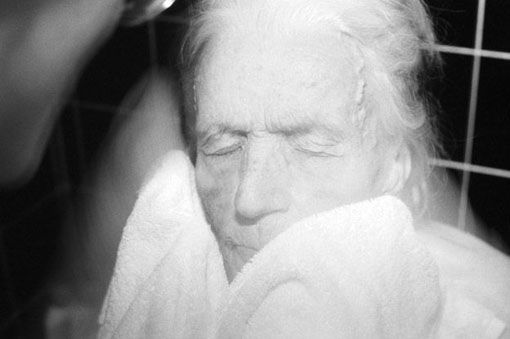
Care of the elderly by a community service worker
Photo: CC BY-SA 3.0 en
Care home and hospital structures are subject to product logic
The researcher notes that the structural depersonalisation in nursing homes and hospitals can have a very negative impact on nursing care and says: “And this is due to economisation and a lack of time. On the one hand, this is based on a concept of work that follows a product logic, i.e., a production logic. This entire DRG system in the healthcare sector (the DRG system - Diagnosis Related Groups - is a flat-rate billing system that regulates the reimbursement of inpatient hospital services in Germany, editor’s note) originally comes from the Chicago automotive assembly line factories, where work was divided up until the finished car emerged. This idea is still reflected in our healthcare system. In care, however, you never just touch a body, but always an embodied person, i.e., in all psychosocial professions you can never work without prior relationship work, recognition work.” In our society, however, relationship work is neither recognised nor paid as work, i.e., it is not regarded as work, despite the fact that relationship work requires time. However, if this time is not granted, for example because there are too few relationship workers in these professions for the tasks at hand, then it is impossible to prevent the person receiving care from being reduced to a body. ”And then you can no longer achieve humane treatment! You can also draw a connection to the much-discussed care robots. Carer robots are incapable of this relationship work. That’s another way of thinking in terms of product logic.”
Strengthening the care relationship
Together with Dr Helen Güther from the private Witten/Herdecke University, Baranzke wrote an article entitled “Beschämbarkeit - Zur pflegeethischen Relevanz einer brisanten Vulnerabilität” (Shamefulness – On the relevance of explosive vulnerability to nursing ethics). She writes about the ’human-blind healthcare system’. In fact, we could regain our sight if “we actually recognise the indispensability of the experiential dimension of personal recognition, i.e., if we step out of our logic and say that it makes a fundamental difference, not only that we have done something together, but that we have done something together as people. A caring relationship is also always dependent on the cooperation of the person receiving care, otherwise it can easily lead to power struggles that can also turn violent. Preventing violence therefore also plays a major role here. We need to be aware of this basic need to experience being recognised as a person, to be able to cooperate, to be allowed to participate and to be invited. Being aware of this basic need is fundamentally important; our society depends on it. Humans are social beings who need to be recognised by the community and this basic social need never ends.”
Uwe Blass
Dr Heike Baranzke is a lecturer in theological ethics in Catholic Theology in the School of Humanities at the University of Wuppertal.