
Invention of the Yagi-Uda antenna
Prof Dr Dieter Brückmann / Communications Engineering
Photo: UniService Third Mission
Transducer between the waves
Communications engineer Dieter Brückmann on the invention of the Yagi-Uda antenna
In 1926, the first reports appeared in a Japanese magazine about the Yagi-Uda antenna, which was developed at the Imperial University of Tohoku in Sendai. What was this device and who developed it?
Dieter Brückmann : To transmit electromagnetic waves via radio, you need an antenna both on the receiving end and on the transmitting end. Antennas are converters between a conducted wave and a free-space wave. Antennas therefore either emit electromagnetic waves generated by a transmitting device or receive electromagnetic waves and transmit them to a receiving device. The simplest form of antenna is a dipole. A dipole antenna typically consists of two conductive metal wires or rods. The drive current coming from the transmitter is applied between the two halves of the antenna. On the receiving side, the received signal is tapped at the antenna and forwarded to the receiver.
One possible disadvantage of a dipole antenna is that the energy of the electromagnetic wave is radiated equally in all directions around the antenna. In many cases, however, it would be more favourable to give the transmitting antenna a directional effect so that the energy is radiated in a bundled manner. The antenna arrangement can also generate focussing in the direction of reception, thereby amplifying the signal compared to a dipole antenna.
The Yagi-Uda antenna is an antenna system that generates such a focussing effect so that significantly greater radio transmission ranges are possible compared to dipole antennas. This type of antenna was developed from 1924 by the Japanese Hidetsugu Yagi and Shintaro Uda and the process was also described in Japanese technical journals. However, these reports initially attracted little attention outside Japan. In 1928, Yagi therefore also published an article in English in the USA, which met with great interest among experts worldwide. This also explains why this type of antenna is usually referred to as a Yagi antenna in German-speaking countries. While the Japanese patent lists both inventors equally, only Yagi is named as the inventor in the basic patents for other countries.
In 1930, the antenna was shown for the first time in Europe at the World Exhibition in Belgium. What range did it have?
Dieter Brückmann: The system with the Yagi-Uda antenna that was shown at the 1930 World Exhibition operated with a wavelength of 45 cm. This corresponds to a frequency of 666.7 MHz. The system presented enabled radio transmission over a distance of up to 20 kilometres.
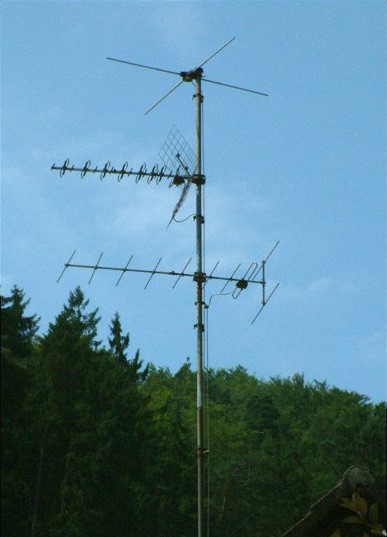
Two Yagi-Uda house aerials for television reception. The reflector of the upper Yagi antenna is designed as a grid. CC BY-SA 3.0
How does an antenna actually work?
Dieter Brückmann: An antenna is used to emit or receive an electromagnetic wave and represents the interface between the transmitter or receiver and the free space as a transmission medium. Its basic structure consists of conductive elements, such as one or more metal rods, which are connected to the wired transmitting or receiving device via an antenna cable. The simplest form of antenna is a dipole consisting of two wires. The dipole can also be regarded as an open resonant circuit. Feeding the dipole with a changing electrical signal creates an electromagnetic field that is radiated into the room. Accordingly, a current is induced in the dipole on the receiving end by the received radio signal. The principle of resonance is used here.
In order to achieve efficient transmission, the length of the antenna is matched to the wavelength of the signal. Variations in the antenna design are used to adapt it to different frequency ranges and applications. In particular, the parameters of size, shape and configuration are adapted. For example, one or more directors and possibly also reflectors give the antenna a directional effect. This directivity is also associated with an antenna gain, which corresponds to an amplification of the signal. This principle is utilised in the Yagi-Uda antenna.
The Yagi antenna was often used during the Second World War. For what purpose?
Dieter Brückmann : During the Second World War, the Yagi-Uda antenna was often used for radar applications. Radar was a new invention in this era and fundamentally changed the military strategy of all the warring parties involved in the Second World War. Radar used radio waves to detect and locate aircraft, ships and other objects. This made it a very important tool for air defence, for naval warfare and also for military operations on the ground. In addition to the classic form of the Yagi-Uda antenna, variants with parabolic mirrors were also used. Due to the directional effect of the Yagi-Uda antenna, the direction in which the detected object is located can also be determined by determining the angle of rotation.
In the 1950s, the usefulness of the Yagi antenna was also recognised for television, wasn't it?
Dieter Brückmann : After the Yagi antenna was used primarily in the military sector during the Second World War, it quickly spread to the amateur radio sector in North America and Europe. The main reasons for this were the simple design, which is also suitable for do-it-yourself construction, and the high antenna gain. From the 1950s onwards, this type of antenna was also increasingly used in commercial applications such as television. The Yagi antenna was frequently used, particularly at the edges of the coverage areas of television transmitters, due to the antenna gain resulting from its directional effect. By using a Yagi antenna, many television viewers in East Germany were also able to receive West German television if they pointed their Yagi antenna in the appropriate direction.
Yagi aerials are available in different sizes. Why does a radio, for example, need a longer antenna than a WLAN device?
Dieter Brückmann: The basic element of a Yagi antenna is a dipole, which should have a length of just under half the wavelength of the radio wave to be received in order to optimise its properties. The other elements of the antenna, the directors, should be slightly shorter and the reflectors slightly longer than the dipole. The directivity and the antenna gain are determined by the overall length of the antenna. With a Yagi-Uda antenna consisting of three elements and a total length of 0.3, an antenna gain of approx. 15 dBi can be achieved, whereby the beamwidth of the antenna lobe is less than 40o. Even more powerful Yagi antennas have up to 10 rod elements.
Typical VHF radio waves are in the frequency range of 87-105 MHz. This results in a wavelength of approximately three metres. The associated antenna should therefore be at least one metre long. WLAN devices, on the other hand, operate in significantly higher frequency bands in the 2.4 GHz or even 5 GHz range. This results in significantly shorter wavelengths of 6 to 12 centimetres. The optimum antenna lengths for this application are therefore only a few centimetres.
Is it actually true that you can easily build a Yagi antenna with materials from the DIY store?
Dieter Brückmann : One of the main advantages of the Yagi antenna is its simple construction and robustness. DIY enthusiasts have long known that a robust Yagi antenna can be constructed using simple metal rods and a few connecting materials, all of which are available from DIY stores.
While building a Yagi antenna for television reception or amateur radio applications requires some manual skills, you can now even find DIY instructions for polystyrene Yagi antennas for WLAN systems in specialist magazines and on the Internet. These can supposedly be put together in just half an hour from leftover packaging and electronic waste.
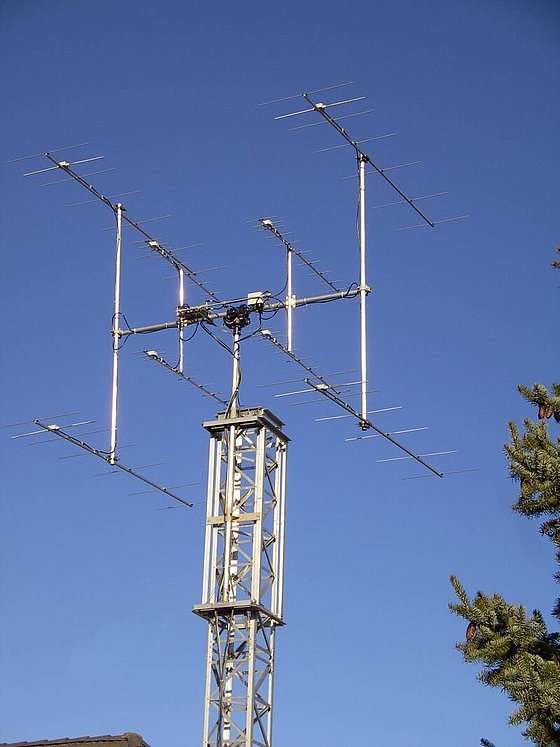
Yagi array antenna for Earth-Moon-Earth connections
Photo: CC BY-SA 3.0
With the trend towards wireless transmission, more antennas are being sold again today. Where are they mainly used today?
Dieter Brückmann: The number of applications in which wireless transmission systems are used has increased significantly in recent years and will continue to grow in the coming years. Each of these radio systems is equipped with an antenna. A wide variety of antenna systems are needed for the sometimes very different requirements and applications, so that there is now a wide range of basic types and variants to meet the most diverse requirements.
In the case of WLAN systems, for example, the requirements for very high data rates have increased significantly in recent years. These high data rates can be achieved in particular through multi-antenna systems and MIMO technology. MIMO stands for Multiple Input / Multiple Output. With this technology, multiple antennas are used on both the transmitter and receiver side, between which parallel data streams are transmitted. In this way, the maximum data rate can be multiplied. Complex digital signal processing on the receiving end can compensate for the mutual overlapping of the parallel data streams.
In addition, electronically steerable directional antennas are becoming increasingly important. These are made up of a number of dipoles whose fields overlap to create a directional effect. In addition, the phase offset between the antenna signals can be varied electronically, allowing the direction of radiation of the antenna array to be specifically adjusted. Antenna arrays with over 1000 dipoles are now being used, with which the direction of radiation can even be varied in three dimensions. Applications include systems based on the current and future 4G to 6G mobile phone standards. This allows the subscriber density and also the maximum data rate of these systems to be further increased.
Uwe Blass
Prof Dr Dieter Brückmann headed the Department of Communications Engineering, Components and Circuit Technology in the Faculty of Electrical Engineering, Media Technology and Information Technology at the University of Wuppertal until 2023.