
Germany’s admission to the League of Nations
Associate Professor Dr Ewald Grothe / History
Photo: UniService Third Mission
Germany’s admission to the League of Nations
Historian Ewald Grothe on Germany’s participation in the first global organisation dedicated to peacekeeping
Mr Grothe, how did the League of Nations come to be founded in the first place?
Ewald Grothe: In the long term , the peace movement and the efforts of the Hague Peace Conferences of 1899 and 1907 had an impact. However, the terrible catastrophe of the First World War immediately preceded its foundation. Consequently, the Covenant of the League of Nations was incorporated into the Treaty of Versailles of 1919. Following ratification, it was founded in January 1920.
How many countries joined the League of Nations?
Ewald Grothe: There were 32 founding members, primarily the victorious powers of the First World War. In 1920, 13 neutral states were invited to join the League of Nations. During its 26 years of existence, a total of 63 states declared their accession. However, the United States of America was absent from the very beginning to the very end, even though its President, Woodrow Wilson, had been one of the initiators.
Normally, a state’s ratification of an international organisation’s constitution was followed by membership. In Germany’s case, however, this was not initially the case. How and why was this circumvented?
Ewald Grothe: Following the ratification of the Covenant of the League of Nations in January 1920, the German Empire was required to ratify the Covenant of an international organisation without being permitted to join it itself. It had to not only recognise the legal personality of the League of Nations, but also accept all its resolutions and decisions. Article 1 of the Covenant of the League of Nations introduced the concept of ‘original Members’, who were listed in an annex to the Covenant. Germany and its allies were not included amongst them. This was primarily due to France’s diplomatic influence.
Germany’s admission to the League of Nations on 10 September 1926, eight years after the end of the First World War, marked its return to the community of nations and was a major foreign policy success under Gustav Stresemann. How did Stresemann manage to achieve this?
Ewald Grothe: Stresemann had already given an assurance during the negotiations on the Treaty of Locarno with the Western powers, Britain and France, in 1925 that he would join the League of Nations. This was a delicate matter because, domestically, the majority of Germans had reservations, and, in terms of foreign policy, Soviet scepticism – that Germany would join an anti-Soviet front – had to be overcome. This was achieved through the Treaty of Berlin, concluded in April 1926, which reaffirmed the Treaty of Rapallo of 1922 (https://www.uni-wuppertal.de/de/third-mission/wissenschaftskommunikation/jahr100wissen/2022/der-vertrag-von-rapallo/) and committed both states to mutual neutrality. Whilst this did not amount to an ‘Eastern Locarno’, it did ensure that, in the event of a war between the Soviet Union and Poland, the Germans would not be permitted to grant the French a right of passage to support Poland.
Germany’s admission to the League of Nations was a major diplomatic success for Stresemann and earned him the international recognition that paved the way for him to be awarded the Nobel Peace Prize in June 1927.
What did the League of Nations mean for Europe?
Ewald Grothe: The League of Nations was intended to promote international cooperation, mediate in cases of conflict and monitor compliance with peace treaties. As almost all European states joined the League of Nations, experience was gained here in reaching international consensus. At the same time, it became apparent that some conflicts, such as the Corfu Crisis of 1923, could not be resolved despite the League of Nations’ intervention.
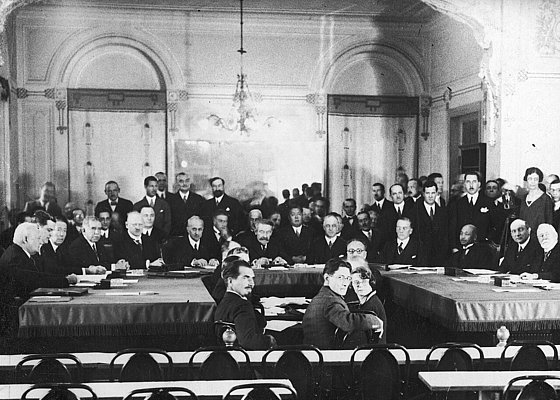
League of Nations session in Lugano, 1928
Foreign Minister Gustav Stresemann is the fifth person from the left at the table
Photo: public domain
The German Reich government attempted to influence the international debate by putting forward its own draft for a League of Nations. However, this draft was rejected by the Allies. Why?
Ewald Grothe: Germany’s proposals were put forward by the liberal international law expert and pacifist Walther Schücking (1875–1935). He advocated for international arbitration, the possibility for all states (including Germany) to join regardless of their form of government, and the election of delegates by national parliaments. He also sought to strengthen economic cooperation between states. The Allies feared that, if these proposals were accepted, the German Empire would have appeared to be the victor of the World War.
From the perspective of international law, an absurd situation arose whereby, under the Treaty of Versailles, Germany was required to ratify the constitution of an international organisation without being permitted to join the organisation itself. This legal arrangement imposed only obligations on the Reich, but conferred no rights. That was frustrating, wasn’t it?
Ewald Grothe: Above all,this was highly problematic because the German Empire was directly affected by the territorial arrangements made by the League of Nations. For instance, the League of Nations became the trustee of the Saar region because France was unable to assert its claim to annexation. The negative perception of the League of Nations amongst the German public proved to be a problem that could only be overcome temporarily.
Furthermore, the League of Nations not only administered former German territories, it was also involved in the transfer of German territories to other states. Under Article 119 of the Treaty of Versailles, the German Empire was even obliged to cede its colonies to the Allied and Associated Powers. In reality, however, the distribution took place without any input from the League of Nations. How was this possible?
Ewald Grothe: Due to opposition from the USA, the Allied powers were not permitted to annexthe former German colonies. This led to the transfer of so-called mandates, which the League of Nations, however, could not control but only authorise retrospectively. Reports on the administration of the mandate territories had to be submitted to the League of Nations. The administration of the former colonies under the mandate system gave opponents of the League of Nations in Germany the opportunity to denounce alleged abuses by the Allies.
The League of Nations represented the first attempt to put a system of collective security into practice. The idea that a potential aggressor could also be part of an alliance system was new and revolutionary. Why, then, was it dissolved in 1946?
Ewald Grothe: The fundamental principle of the League of Nations was solidarity amongst its members and the duty to come to each other’s aid in the event of a conflict. However, only the major powers could truly guarantee this system of international security. Furthermore, shared security interests and the preservation of the status quo were prerequisites for the functioning of such an international alliance. The members’ conviction that they wished to work together towards disarmament faded very quickly.
The League of Nations failed because key states such as the USA did not join it, or only joined temporarily, as was the case with Italy, the Soviet Union and Japan. Furthermore, the League’s resolutions were undermined by its own members, who made diplomatic concessions in order to circumvent the League. Ultimately, the members’ self-interest took precedence over the collective effort to reach a peaceful consensus.
After the end of the Second World War, the remaining 34 members dissolved the League of Nations themselves in April 1946, particularly as the United Nations – a global community of nations – had already been established the previous year.
Uwe Blass
Prof. Dr Ewald Grothe studied history, public law and legal history in Marburg. He completed his habilitation in Wuppertal in 2003 and teaches modern and contemporary history at the university of Wuppertal. He has been an adjunct professor since 2009. Since 2011, he has headed the Archive of Liberalism at the Friedrich Naumann Foundation for Freedom in Gummersbach. Since 2017, he has been chairman of the Brothers Grimm Society in Kassel.