
The first working self-spraying can
Dr Nico Meuter / Chemistry and its Didactics
Photo: University of Wuppertal
The US military helped the aerosol can achieve an international breakthrough
Chemist Nico Meuter on the invention of the first functional self-spraying can
In 1926, Norwegian engineer Erik Rotheim invented a refillable ‘do-it-yourself spray can’ for paint and was granted a patent for it in Germany a year later. He used the propellant dimethyl ether (DME). What is that?
Nico Meuter: The spray can: when I think about it, I’d say it’s a bit like Pandora’s box. One that he invented simply to wax his skis more effectively. And his first version was nowhere near as sophisticated as those found in DIY shops or supermarkets today. But let’s get to the actual question: the molecules of dimethyl ether – that is, its smallest particles – are made up of the same building blocks as ethanol. However, simply because these molecules are structured differently, some of the substance’s properties change fundamentally: ethanol, the typical alcoholic drink, is a liquid at room temperature, whilst dimethyl ether is a gas. However, both are flammable, and with flammable gases one must be even more careful when it comes to ignition sources.
In today’s canisters, the pressure ranges from 5 to 15 bar. A car tyre today has a pressure of a good 2 bar. What effect does the high pressure have?
Nico Meuter: In car tyres, the pressure ensures that the tyre is round and runs smoothly. If you unscrew the valve, or if there’s a hole in it, the air escapes and the tyre is no longer round. In aerosol cans, the pressure also ensures that the contents come out of the can. However, the pressure alone is not enough to completely expel the paint, hair or beard mousse, or similar products from the can. Otherwise, there would be so little left in the can that it wouldn’t be worth using it.
The high pressure also alters the propellant in some way. You may be familiar with this from lighters: they also contain gas, but we can see how full the lighter is by the liquid level. This is because these propellants become liquid under high pressure. Only a small proportion remains in a gaseous state under pressure. When this escapes, more gas is generated from the liquid phase, and the high pressure is maintained inside the can for a very long time.
To return to the example from the previous question: the difference between liquid and gaseous dimethyl ether is enormous. 4 cL of liquid dimethyl ether – the amount that fits into a shot glass – occupies approximately 15 L in its gaseous state – in other words, a full cleaning bucket. With just a little more, a spray can like this can therefore displace a great deal of paint.
Nowadays we use spray cans to style our hair, to combat underarm sweat or even to treat asthma. Isn’t the gas that escapes also toxic to us?
Nico Meuter: Dimethyl ether isn’t toxic. The same applies to other hydrocarbons that are used as propellants. Of course, in large quantities and in small, poorly ventilated rooms, they can cause dizziness, but no major health risks are expected from their use. I’d be a bit more cautious about some of the other ingredients we spray into our hair or under our armpits. I don’t think we should be inhaling them.
Asthma inhalers work quite differently. With these, pressing the trigger forces air into the canister, which then propels the medication out. Asthmatics must inhale this at the exact same time, and it must also be a specific dose. This would not be the case with a continuous flow, as is the case with spray cans.
There is a further limitation with whipped cream sprays, as they contain nitrous oxide. It is perhaps better known as laughing gas. When sprayed normally, it has no effect on us because it dissipates and disperses very quickly. However, if inhaled in concentrated form, it causes a short-lived ‘high’. If misused over a prolonged period, it can cause serious damage to one’s health.
As with everything, the saying ‘the dose makes the poison’ applies here. And the dose to which one is normally exposed is, accordingly, non-toxic.
The technical implementation wasn’t that easy, was it?
Nico Meuter: As mentioned at the start, Erik Rotheim still had his problems with it. He could open his heavy and very unwieldy can and had to use it all up in one go. There was no option back then to set it aside and use it later. Several other engineers worked on it until it became the handy and easy-to-use product we know today – or whose products we can already see on many street corners.
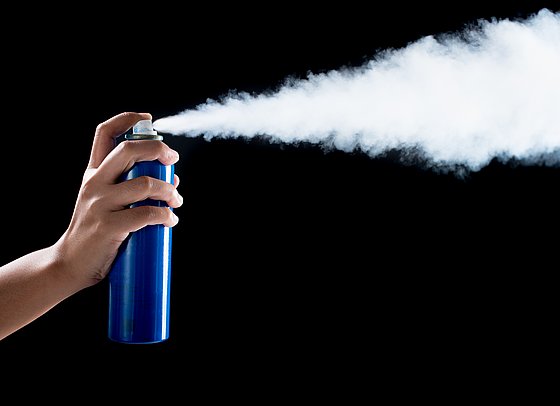
A spray can in use
Photo: Colourbox
However, this invention – which is now used in a wide variety of ways – did not initially make a huge splash. Why not?
Nico Meuter: Back then, it was still a very new technology. Although the idea of using paints had been considered early on, the can was always under high pressure, so the walls were naturally quite thick and heavy. Furthermore, it was not yet possible to control the spray output accurately. The spray nozzle itself was subsequently refined until the aerosol emerged as evenly as possible. There were simply still a great many optimisation steps to be taken before a market-ready product could be achieved.
Rotheim himself did not live to see the success of his patent; he died in 1938, but the breakthrough for his patent did not come until the Second World War. And that’s where malaria comes into the picture. How so?
Nico Meuter: A new method of application can also help bring about a breakthrough. In 1942, during the Pacific War, the Americans faced another problem alongside their enemy: mosquitoes. In those latitudes, they transmitted – and still transmit – various diseases, including malaria. It is a problem that has not yet been fully resolved, but at the time there was an invention that could at least significantly curb this problem: the ‘insecticide bomb’ – as the name suggests – was able to tackle this enemy head-on. In fact, such spray cans were used not only by the military but also at home, helping the technology to enjoy a triumphant rise in the USA. Here in Germany and Europe, hairsprays – or ‘liquid hairnets’ – were of greater interest. A lot has changed since then. Today, lacquers and paints are sprayed using this method. However, as far as I know, skis are still not waxed with them …
When the price of propellants fell, a whole range of other products suddenly became available. From room fragrances to paints and varnishes, right through to spray cream, we spent decades spraying CFCs into the atmosphere, causing lasting damage to our environment. It wasn’t until 1985 that the spray can was exposed as an environmental menace, when the ozone hole was discovered. So what had happened?
Nico Meuter: People realised what this Pandora’s box was actually doing. CFCs –chlorofluorocarbons– were initially seen as the holy grail of chemistry after their discovery: a gas with a wide range of properties that could easily be liquefied. What’s more, it is completely inert, meaning it does not react with the substance you want to spray. It was also used as a refrigerant in fridges. So it was almost the industry’s jack-of-all-trades. Because of the heavy chlorine atom bound within the molecule, it had also been assumed that it could never reach the upper atmosphere, let alone the ozone layer. But it had got up there after all. In relatively small quantities, but that was enough to create the ozone hole. Under the sun’s UVC light, this substance wasn’t quite as inert as thought. Instead, it broke down the ozone. And it continues to do so to this day. Even though, forty years ago, we pulled ourselves together and completely replaced this substance with others.
CFCs are such a problem up there because, to put it very simply, they act as photocatalysts. Some of you may remember learning about catalysts at school: they are substances that facilitate a reaction without being consumed in the process. And in this case, the chlorine radicals released accelerate the breakdown of ozone into oxygen. And as they are not consumed in the process, they keep doing this over and over again. They have been doing so for over forty years now.
Back then, people listened to the science and made changes within a few years. And yet the planet is still struggling with the consequences. At least there are now the first signs that the ozone hole is getting smaller.
Today, critics regard the aerosol can as wasteful packaging, and yet consumption is expected to double by 2032. What continues to make it so attractive to users?
Nico Meuter: I can only agree with the critics on this point: the packaging is wasteful. After all, part of the contents is purely a propellant, used solely to dispense the product. On the other hand, however, it’s also extremely convenient. Would you really want to stand in the bathroom in the morning and pump for five minutes before you can use your hairspray? Or run a compressor for minor touch-ups with paint?
Of course, a replacement that’s only slightly less convenient could be found quite quickly if the use of these sprays were banned overnight. And perhaps there would also be less graffiti appearing on newly erected noise barriers whilst they’re still under construction. It would probably help the climate a little, as the propellants are all greenhouse gases.
But at the end of the day, people are creatures of habit. And it’s incredibly difficult for all of us to step out of our comfort zones.
After all, Pandora couldn’t shake off her curiosity either and ended up opening the box. Only one thing remained in the end, and that is what I, too, wish to hold on to: hope.
Uwe Blass
Dr Nico Meuter is a research assistant in the Chemistry and its Didactics Working Group at the University of Wuppertal