Queen Elizabeth II - a prudent politician
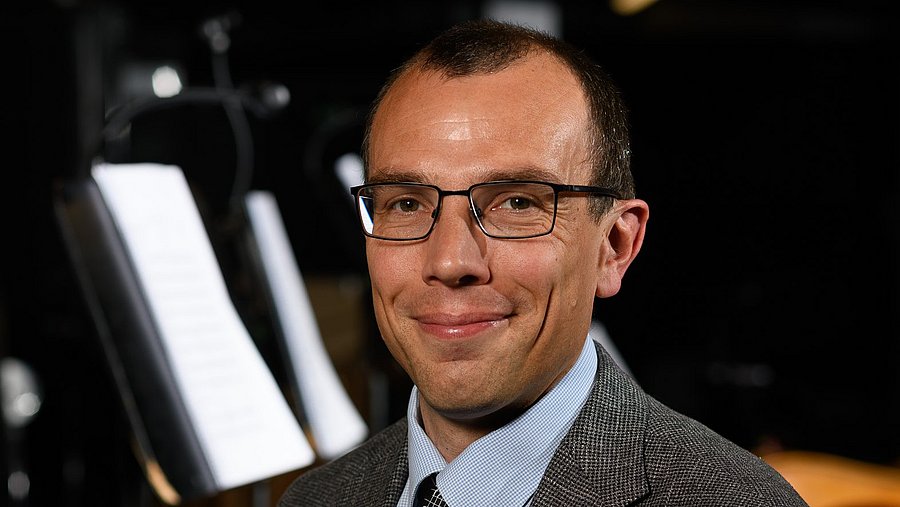
PD Dr Georg Eckert / History
Photo: Mathias Kehren
Queen Elizabeth II, a prudent politician of the 20th century
Historian Georg Eckert on the 100th birthday of the longest reigning British queen
She was the longest reigning queen in the history of Great Britain and died aged 96 on 8 September 2022: Queen Elizabeth II, although her life would actually have been very different. Why did she become heir to the throne in the first place?
Georg Eckert : When she was born on 21 April 1926, Elizabeth was already third in line to the British throne as the first member of a new generation. The little princess quickly attracted the sympathy of the British public, but at first she was probably only recognised as a future queen by the Windsors themselves. Such dynasties are used to guaranteeing the right to the throne even in unlikely cases of succession: as was the case with Elizabeth. It took many coincidences for the succession to actually end up in her favour. On the one hand, the right to the crown would have immediately gone to a younger brother in accordance with the male primogeniture (first-born succession order: succession in favour of the eldest son, editor's note) that was in force until the 2010s, but her parents "only" had another daughter, Elizabeth's younger sister Margaret. On the other hand, the crown initially passed from her grandfather George V to his first-born son in 1936: the future Edward VIII, still a confirmed bachelor at the birth of his niece Elizabeth, who was expected to have children of his own in due course, who would then have become head of state. Nobody could have guessed that Edward VIII, after various romances, wanted to marry an American divorcee, Wallis Simpson. He eventually married her, but had to abdicate in the same year that he ascended the throne: in view of the regulations of the Anglican Church, which stood in the way of a marriage, and public opinion, which had vehemently opposed the relationship, also for political reasons. This constitutional crisis ended with Elizabeth's father taking over the throne as George VI - unexpectedly and rather reluctantly. By now at the latest, Elizabeth's succession to the throne was a foregone conclusion.
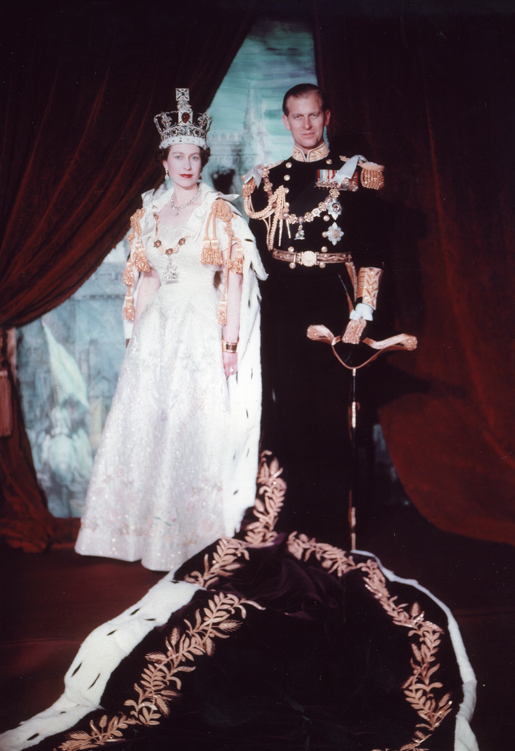
Coronation portrait of Queen Elizabeth II and the Duke of Edinburgh (1953)
Photo: public domain
The first few years as head of the British nation were anything but easy for the young Queen. Suddenly she was the head of the Anglican Church and the Commonwealth. According to historians, how did she cope with this task?
Georg Eckert : Despite all the challenges, Elizabeth was prepared for the succession to the throne in the best possible way. As ruler, she chose an ambitious name that fuelled hopes of a glorious new Elizabethan age. In addition, the British royal family had managed to win over the population during the Second World War. Her father, George VI, had been struggling with serious health problems since 1949, so Elizabeth increasingly stood in for him. She was practising, as it were, and was travelling extensively through the Crown Lands when she received the news of his death in Kenya. Her coronation on 2 June 1953 became a major international media event, broadcast live on television and made into an opulent documentary film. Immediately afterwards, Elizabeth II embarked on a goodwill tour across the world. Her personal presence, strategically planned, helped to moderate the transition from the British Empire to the Commonwealth of Nations. Systematically disseminated images of her growing family supported this change, and the future succession was already secured: The later Charles III and his younger sister Anne had already been born in 1948 and 1950, in the thoroughly controversial marriage to German-born Prince Philip, who had converted to Anglicanism for the occasion.
Elizabeth II appointed 15 prime ministers. But she had a very special relationship with Churchill. Can you explain that?
Georg Eckert : Perhaps this relationship is based a little too much on the cliché that the experienced politician guided the inexperienced queen. Even at a young age, Elizabeth II proved to be an extremely knowledgeable ruler. She calculated very carefully the extent to which she exposed herself politically. This included giving Churchill a dignified farewell from his less successful second term as Prime Minister. Actually, they were hardly a good match, separated by age and lifestyle: here the reserved young Queen, there the aged eccentric Winston Churchill. However, they did have one thing in common, namely their wartime prestige. Although the wartime prime minister was voted out of office in 1945, he owed his enduring popularity to the defence against Nazi Germany - as did the monarchy. The royal family had turned its attention to the population at the time, Elizabeth had even served in the Auxiliary Territorial Service and learnt to drive a lorry, even in old age she still enjoyed driving her own off-road vehicles. Both were also characterised by fearlessness and steadfastness: Elizabeth undertook journeys that she had been advised against for safety reasons. Personal esteem and political calculation led the Queen to order the careful preparation of a state funeral after Churchill's concealed stroke in 1953: "Operation Hope Not", finally carried out in 1965, after Churchill's late death. Significantly, the next British state funeral was to be that of Elizabeth II herself.
One of her mottoes was: "Never complain, never explain." (Never complain, never explain) What did this mean for her office?
Georg Eckert : This quote does not come from Elizabeth II, but from the 19th century. But it aptly describes one of the many successful strategies with which the British royal family was able to secure great popularity for a long time. On the one hand, this epitomised the proverbial British "stiff upper lip", especially after the experience of the Second World War. On the other hand, a certain taciturnity helped to cultivate a certain mystery around the royal family - that of a dynasty that does the good and the right thing without talking about it, let alone having to justify its actions in any way. However, the flexibility with which this maxim was handled was demonstrated early on by intensified, systematic PR work. As early as 1969, the BBC made a documentary film showing the Royal Family in everyday life and working hard for the common good in front of an audience of 30 million Britons. The real motto of a dynasty that was always able to adapt to changes in the media was: "never complain, often explain".
As monarch, she had to overcome a number of crises that threatened the continued existence of the monarchy. What were some of these?
Georg Eckert : During Elizabeth II's time in office, Great Britain faced many major, often interlinked challenges: Decolonisation, wars, economic crises and many more. However, the most threatening crisis for the monarchy itself probably arose after Lady Diana's death in an accident in 1997, which in itself was comparatively insignificant, and at the same time showed the extent to which the above-mentioned motto no longer fitted the times and, above all, no longer fitted the changed media landscape. The divorced daughter-in-law had already utilised a more effective PR strategy before her sudden accidental death and had wrested the sovereignty of opinion over her divorce from Prince Charles from the royal family, precisely by explaining herself in a scandalous interview on the BBC. When, in keeping with protocol, the Union Jack at Buckingham Palace was not flown at half-mast after Diana's death, the tabloid press in particular turned against a supposedly heartless former mother-in-law. Lady Di was proclaimed "Queen of Hearts", and by proclaiming her "People's Princess", British Prime Minister Tony Blair tried to capitalise politically on the dynasty's plight. Elizabeth corrected her course just in time with an empathetic televised speech as a sensitive grandmother. Otherwise, the voices that repeatedly called for the abolition of the monarchy during Elizabeth II's time in office would have quickly become even more audible.
Other ruling houses appoint their successors during their lifetime, as examples in the Netherlands, Spain and Denmark show. This was never an option for the Queen, even though she was very frail in the end. Why not?
Georg Eckert: As long as no sources can be analysed and no relevant documents of the Queen can be read, historians can only make assumptions. Throughout her life, Elizabeth II presented herself as a modest, altruistic guardian of the common good. She certainly recognised this as an important resource of the monarchy: In the modern age, royalty can no longer be legitimised by divine right. The Queen and her husband also cultivated likeable quirks, which also made Elizabeth II stand out more and more favourably from the conceivably unsympathetic scandals surrounding two of her sons; shortly before her death, she excluded her son Andrew from performing royal duties; her eldest son's image had suffered badly from his divorce from Princess Diana, which was carried out in the media. The Queen would not necessarily have assumed that Charles III would one day achieve a level of popularity unexpected by many. Rather, many observers interpreted her perseverance as a political strategy to see the crown pass immediately to her eldest grandson William after the shortest possible term of office of the heir to the throne or even with his renunciation: with a similarly immaculate lifestyle and a family as close to the people as his grandmother, who had appointed a new prime minister just a few days before her death - frail, but dutiful and certainly power-conscious to the end. Her stoic perseverance also reinforced the old myth that a queen is an extraordinary person who is entitled to extraordinary rights: for the benefit of the state and society.

Queen Elizabeth II on a 20-pound note
Photo: public domain
On 21 April, the Queen would have celebrated her 100th birthday. Has she secured the future of the monarchy?
Georg Eckert: Unfortunately, for the historian,the future has the disadvantage of being notoriously uncertain – and depends on what Elizabeth II’s successors ultimately do or fail to do. In retrospect, the Queen has proved to be a prudent politician who knew how to skilfully navigate many transformations. These include, for example, the dissolution of the British Empire without its core disintegrating, the federalisation of Great Britain and, in particular, adapting the monarchy to the demands of the media age. The current King Charles III has experienced first-hand, at various stages of his life, how this can succeed or fail. The balancing act this entails is illustrated by the contrasting life stories of her two sons. Future British monarchs will have to prove themselves, but during her extraordinarily long reign, Elizabeth II has laid solid foundations for the continued existence of an institution that, in this way, is once again in step with the times: with charitable ‘working royals’, with a closeness to the people that is still evident today, for example, in the ‘royal walkabouts’ introduced by Queen Elizabeth II, featuring handshakes and informal conversations, and with a touch of whimsy. A touch of quirkiness wins people over, whether it’s small dogs or large, colourful hats.
Uwe Blass
Dr Georg Eckert studied history and philosophy in Tübingen, where he was awarded a doctorate for a thesis on the early Enlightenment around 1700, with a focus on Britain, and completed his habilitation in Wuppertal. In 2009, he began working as a research assistant in the Department of History and now lectures as a private lecturer in Modern History