World premiere of the opera Turandot
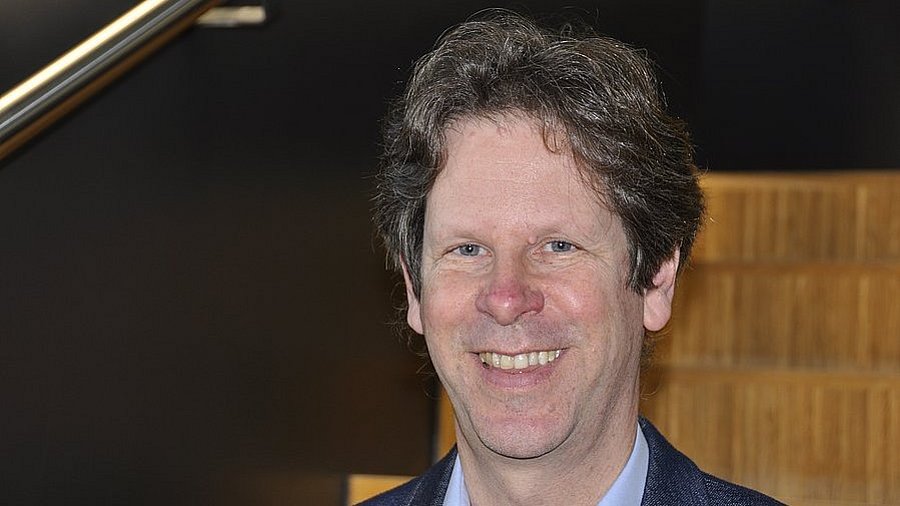
Professor Dr Thomas Erlach / Music Education
Photo: UniService Third Mission
The enigmas of a Chinese princess
Thomas Erlach on the premiere of the opera Turandot byPuccini 100 years ago in Milan
The opera Turandot is based on an 18th century fairy tale by Carlo Gozzi, which Giacomo Puccini had translated by Friedrich Schiller. What is the opera about?
Thomas Erlach: The opera Turandot is set in China in a legendary past, but the underlying fairytale story comes from Persia. The title character is the unmarried daughter of the Chinese emperor, who has acquired an aura of aloofness. There are numerous men who are interested in her, but they have to solve three riddles to win Turandot's heart - but if they answer incorrectly, they will be executed. In the course of the opera, we learn that Turandot is acting so strangely because of an ancient, terrible incident in her family history, i.e. that she is under some kind of traumatic compulsion. At the beginning of the opera, numerous candidates who were unable to answer the riddles have already been executed, so the atmosphere is rather depressing, but Calaf finally appears as a promising candidate who actually succeeds in solving the riddles. However, Turandot is still reluctant to take him as her husband, which delays the resolution of the dramatic knot. Calaf sets her a kind of counter-mystery: Turandot must find out the name of the successful suitor by the next morning, then she can have him killed too. However, she does not succeed, although she causes an uproar throughout the country. Another female character, the young servant Liù, is the exact opposite of the cold-hearted Turandot: she has loved Calaf for a long time and is the only one who knows his name, but does not betray him, instead taking her own life at the end to protect him from death. This is followed by a somewhat enigmatic final duet between Calaf and Turandot, in which the latter voluntarily reveals his name to her, Turandot is then completely transformed and finally presents Calaf to the people as her future husband.
Turandot is actually a terrible character. Nevertheless, the theme was already used in various German operas in the 19th century. What makes it so exciting?
Thomas Erlach: The suspense is created by various aspects. The terrible thing about Turandot is that she is incapable of love because of the aforementioned family curse. She protects her virginity with riddles and draconian punishments, but Calaf breaks this curse, which is why she panics and does everything she can to avoid having to change. Despite the strangeness of the characters and the Chinese setting, the constellation is easy to understand in terms of depth psychology. There are classic fairy-tale motifs in it, such as the "suitors' trial" before a wedding, the trinity of riddles and the Rumpelstiltskin motif, which seem familiar to us, but it has also been pointed out time and again that certain references to Puccini's life can be discovered in the plot, who himself was an extremely unreliable husband and probably felt a great fascination for the Turandot character because she contradicted his usual image of women. In addition, the strong contrasts in the opera create tension - large choral groups and a huge orchestra interact with the highly dramatic and psychologically charged leading roles and create a lot of variety and a long arc of suspense. Liù's humanity makes her a sympathetic character, and the fact that she has to die at the end is an extremely moving, tragic moment in the piece for the opera audience, which also repeatedly leads to discussions about female role models.
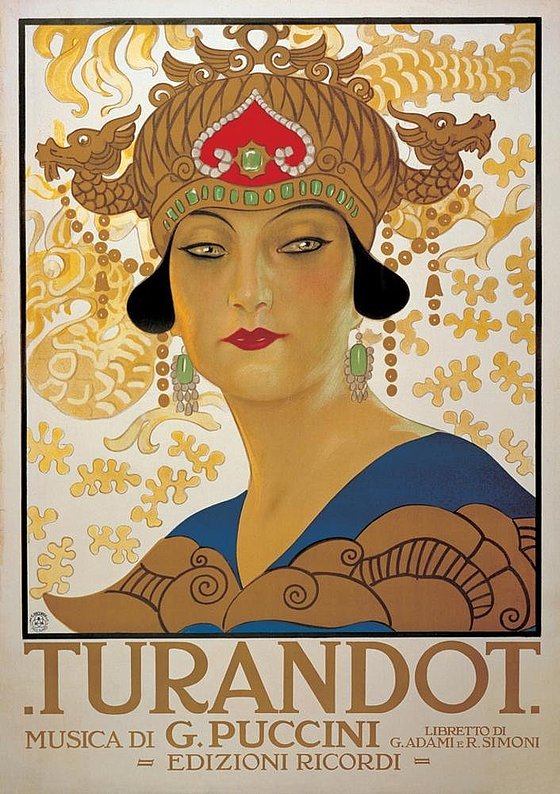
Poster Turandot from 1926
Photo. public domain
On 25 April 1926, Turandot was premiered at La Scala in Milan under the baton of Arturo Toscanini and ended abruptly. Why?
Thomas Erlach: Puccini worked on Turandot for years, but he died in 1924 before he could finish it. Due to his lifestyle (he was a chain smoker), he was suffering from throat cancer, which, despite modern treatment methods at the time - he underwent radium therapy with radioactive needles in his larynx - led to a very painful condition and ultimately to his death at the age of 65. The composed score ends with the death of Liù, so the final scene was missing, which was then recomposed in 1926 by Franco Alfano, a colleague of Puccini. Alfano was an opera composer himself, but he had to be persuaded to complete another composer's work by the intervention of the Italian Prime Minister - so important was the premiere of Puccini's work at the time. Arturo Toscanini, on the other hand, was already a very famous conductor at the time, who had a long-standing friendship with Puccini that was characterised by constant ups and downs, some even speak of a rollercoaster ride of quarrels and reconciliations. Although the ending of the opera was now available, Toscanini decided to address the audience at the premiere after the death of Liù with the words: "This is the end of the master's work" and to cancel the performance. Even before the premiere, there was a certain amount of commotion due to Toscanini's refusal to have the anthem of the Italian fascist movement played before the performance, which is why Mussolini cancelled his participation under a pretext.
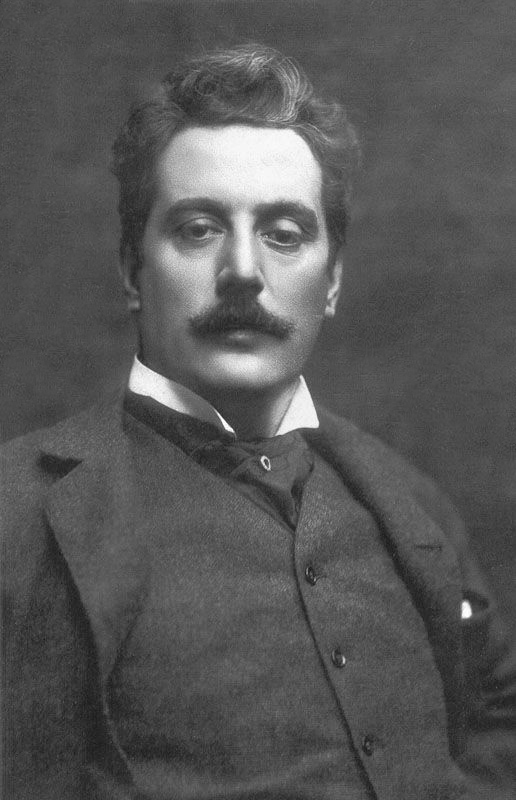
Giacomo Puccini
Photo: public domain
The opera was therefore only completed after Puccini's death by the composer Franco Alfano based on Puccini's sketches. However, he composed a very bombastic ending, which Toscanini did not adopt from the second performance onwards. Why not?
Thomas Erlach: The question of the Turandot ending is a little complicated. Alfano initially composed an ending of 377 bars based on some of Puccini's sketches. However, this version had to be shortened by almost a third due to Toscanini's objections, which he had Alfano communicate to him through the publisher Ricordi, because he had not kept to the agreements. This second version lasts only 15 minutes, is less homogeneous than the first and leaves very little time for the central kissing scene in particular, but it contains slightly more original notes from Puccini's poorly legible sketches. Toscanini had this shortened Alfano ending played from the second performance onwards, and this is still the most frequently heard performance version today. The original version of the Alfano ending was long considered lost and was only performed again in 1982, and occasionally the torso version of the premiere, which ends with Liù's death, can still be heard. Finally, in 2002, an alternative ending was produced by the avant-garde composer Luciano Berio, which is occasionally heard today and avoids the bombast of the Alfano versions. Behind the problem of the ending is the unresolved question of how Puccini musically imagined Turandot's transformation into a loving woman. The existing sketches are unfortunately not meaningful (at one point he wrote in the margin: "Find the melody!"), and Alfano's solution is too abrupt to make the transformation credible. After the tragic death of Liù, the triumphant ending seems rather external.
What are the riddles to be solved in Turandot?
Thomas Erlach: First of all, the crucial point is that the riddles primarily serve as a defence against Turandot's courtship; their exact content is secondary to this. In Puccini's opera, the riddles in the second act also take the place of the traditional love duet, so they also have a dramaturgical function and are intended to emphasise the singing voices. In the various versions of the play by Gozzi and Schiller, various riddles are posed that have little to do with the rest of the story. In Puccini's version, on the other hand, these riddles are intensified in terms of depth psychology, so they are not questions of knowledge as in a quiz programme, but questions about what is existentially significant in the given situation. A specific word is asked in each case, and Calaf's answers are: hope, blood and Turandot. The last of the three riddles also makes it clear that Turandot is essentially a riddle in itself.
The opera is set in China. How did Puccini achieve the impression of a Far Eastern sound world?
Thomas Erlach: Puccini is otherwise primarily known as a composer of beautiful melodies, think of his most frequently performed operas La Bohème or Tosca. In Turandot, his tonal language is much more austere and modern; after all, the work was not written until after the First World War, at the same time as Schönberg's twelve-tone compositions and under the influence of Stravinsky's ballets and Strauss' music dramas. The orchestral sound is extremely colourful, beautiful melodies still appear, but the rhythms and harmonies are innovative and dominate the listening impression. The Far Eastern sound world already played a role for Puccini in Madame Butterfly, but in Turandot it is more pronounced, not in the sense of mere exoticism, but as a sometimes frightening strangeness. Pentatonicism plays a major role here, i.e. working with just five notes that recur frequently in a certain sequence and form a kind of leitmotif for Turandot. The extensive percussion also plays a major role in Turandot, as does the constant recurrence of certain complicated rhythmic constellations, as can also be found in Stravinsky's music at this time. Puccini was also inspired by original quotations from Chinese music boxes for some of the melodies and made detailed studies of them. Also interesting are the characters of the three ministers Ping, Pang and Pong, who represent a kind of Chinese version of the traditional European comedy characters - incidentally, these are extremely difficult roles for the singers.
In the final scene, there is an all-altering kiss, which has not been solved satisfactorily musically to this day, as Puccini's documents are missing. What is the problem?
Thomas Erlach: You have to take a close look at the situation in the play. Calaf has to make several attempts to win Turandot's heart. First, he has to solve her three riddles, but Turandot refuses him after his success, contrary to the previously announced conditions of the test, whereupon Calaf declares that he wants her freely reciprocated love. He sets her the counter-task of finding out his name during the course of the night, but she does not succeed until dawn. Turandot is also under the strong impression of Liù's suicide, which she admires as the heroic act of a loving woman - something that is completely new to her. Now Turandot and Calaf face each other alone for the first time, but Turandot is still not ready or able to love him as a man. The score now reads: "He seizes Turandot by force, drags her from the pavilion, throws her around in his arms and showers her with kisses." This forced kiss unsettles Turandot considerably, but it is only when Calaf himself reveals his name that she changes her feelings for him. In this respect, the kiss is not the last, but the penultimate step towards resolving the dramatic conflict, and this is certainly the more comprehensible interpretation from a human point of view.
Montserrat Caballé and Pedro Lavirgen in Turandot, Barcelona 1980
Photo: public domain
A world-famous aria from this opera is Nessun dorma (No one sleeps). It is part of the standard repertoire of all great tenors and has also been used in various films. What makes it so unique?
Thomas Erlach: Nessun dorma is only partially an opera aria in the traditional sense. It is initially quite short and is also integrated into the plot context. In concrete terms, this means that Puccini composed it in such a way that the audience cannot applaud at the end of the aria because the orchestra continues to play vigorously without interruption and only quietens down after a while. This shows that Puccini did not want any applause after Nessun dorma, as is usually the case in his operas. Removing the aria from its context, as is the case in the famous video with Paul Potts, for example, completely contradicts the meaning and purpose of this composition. It is also worth noting that the two-verse aria consists of very few musical elements, but the chords are extremely sophisticated and describe the eerie atmosphere in the night-time situation when Calaf is being sought by everyone in order to find out his name. The fact that he is nevertheless confident of victory is expressed by the increase in pitch and dynamics at the end, when he sings the famous "vincerò" (I will win). Incidentally, the corresponding phrase was already anticipated once beforehand at the end of the second act and then reappears at the very end of the Alfano finale. Puccini is a musical dramatist through and through - the central musical ideas always have a meaning in the overall structure of the piece and return several times in different lights.
Uwe Blass
Professor Dr Thomas Erlach has been Professor of Music Education at the University of Wuppertal since 2014