

World premiere of the play *Lulu* by Frank Wedekind
PD Dr Christoph Gardian / General Literary Studies
Photo: UniService Third Mission
A world in which sexuality, power and violence are inextricably linked
Christoph Gardian on the origins of Frank Wedekind’s play ‘Lulu’
On 22 October 1926, the premiere of Frank Wedekind’s play ‘Lulu’ took place at the Schauspielhaus in Berlin. Strictly speaking, however, this was a synthesis of two plays that had already been staged, wasn’t it?
Christoph Gardian: Exactly: Frank Wedekind’s‘Lulu’is regarded as his magnum opus. But it is not a play that was originally published as a single, unified work; rather, it is the result of a long creative process. Early drafts dating from 1892 initially gave rise to a ‘monstrous tragedy’ entitled‘Die Büchse der Pandora’ (Pandora’sBox). Because Wedekind and his publisher (Albert Langen, Buch & Kunst-Verlag) feared censorship due to the risqué scenes, he reworked the tragedy and called the result‘Erdgeist’. This play was first published in 1895. At the same time, Wedekind continued to work on‘Die Büchse der Pandora’and found a publisher in Bruno Cassirer in 1903. This was followed, however, by three court cases for the ‘distribution of an obscene work’. Wedekind and Cassirer were ultimately acquitted, but the play remained banned. So Wedekind continued to refine the‘Lulu’ material, combining the two dramas‘Erdgeist’and‘Die Büchse der Pandora’into a stage version entitled‘Lulu’, which was published in 1913 after a further revision. In the authoritative final edition, within the Collected Works,‘Lulu’appears once again as a ‘double tragedy’ comprising‘Erdgeist’and‘Die Büchse der Pandora’.
What is the tragedy about?
Christoph Gardian:‘Lulu’tells the story of a woman who, through her erotic allure, captivates a wide variety of men. She rises from humble beginnings to the highest echelons of the middle classes, marries several times, is desired – yet at the same time controlled, manipulated and exploited. Her relationships regularly end in violence, suicide or murder. Following the death of her last husband, her social and financial downfall begins: she ends up in prison, works as a prostitute in London and is killed there by the serial killer Jack (clearly a reference to Jack the Ripper). The play centres above all on power and manipulation, and offers a critique of bourgeois moral values: claims to ownership and double standards.
Why did Wedekind combine the two plays into one?
Christoph Gardian: There are dramaturgical reasons for combining the two plays into a single, self-contained tragedy under the title‘Lulu’. Wedekind streamlines the plot, reworks numerous scenes and creates a more compact stage version. In this synthesis, the symmetrical structure of the ‘double tragedy’ emerges much more clearly: Lulu’s social rise is mirrored in the second part by her downfall. This transforms the drama into a self-contained tragedy in which the beginning and the end correspond to one another. At the same time, the character of Lulu takes centre stage even more strongly, whilst the individual episodes appear less as scandalous tales and more as stages in a consistent development. The‘Lulu’ version condenses the material and reveals that the rise and fall of the title character are two halves of the same story.
Even the history of its creation and revisions becomes a long-running scandal involving the author, the public, the censors and the courts. As a result, Wedekind continually produced new versions of the text. What, then, was Wilhelmine society not allowed to read?
Christoph Gardian: As I said, the charge in 1904 was ‘distribution of an obscene publication’. The play tackles several taboo subjects at once and brings them into the open: female eroticism and promiscuity, prostitution, homosexuality and a sex-related murder. Overall, however, the issue is probably not the violation of individual taboos, but rather the entire bourgeois understanding of morality and gender at the time is called into question. Wilhelmine society was presumably not meant to read that sexuality is portrayed here as an independent, fundamental force – independent of marriage, morality or religion. Wedekind depicts a woman who neither regrets her sexuality nor submits it to the bourgeois order. Around 1900, this was a powerful provocation. The real provocation lies in the play’s perspective, which exposes bourgeois morality as hypocrisy. The very men who desire Lulu condemn her morally; they want to possess and control her at the same time. The social order is governed by the very same instincts that it officially denies.
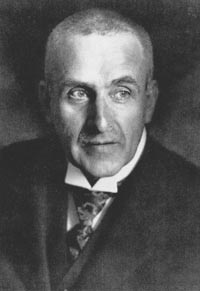
Frank Wedekind
Photo: public domain
Frank Wedekind ignored the conventions of the naturalist drama that prevailed in his day and deliberately employed garish, freak-show-like effects, grotesque scenes and sensationalist elements, without concerning himself with stylistic inconsistencies. Which taboos did his scandalous play break?
Christoph Gardian: The violation of moral and social taboos is one thing. Added to this is a break with the theatrical conventions of the time. Whilst naturalism emphasised psychological credibility and the most realistic portrayal possible, Wedekind worked with exaggeration, the grotesque, circus and variety show elements, abrupt scene changes and a deliberately artificial characterisation. He did not seek to depict reality as faithfully as possible, but rather to expose its contradictions. Wedekind portrays a world in which sexuality, power and violence are inextricably linked. He does not tell a moralistic tale, but demonstrates how social roles are formed and fail.
Are there actually any real-life models for the character of Lulu in Wedekind’s own life?
Christoph Gardian: There is no single real-life model for Lulu. Whilst Wedekind did repeatedly draw on experiences from his own life, Lulu is not a true-to-life portrayal of a real woman. She brings together experiences, observations and literary traditions to form a symbolic figure.
In the 1890s, Wedekind moved in bohemian circles and was familiar with variety theatres and the red-light district from first-hand experience. These experiences are incorporated into the creation of the character of Lulu. Reference is also frequently made to the writer Lou Andreas-Salomé, whom Wedekind knew personally. She was regarded by many as an unusually self-determined woman and inspired numerous artists. But Lulu is more than a biographical figure. She combines traits of the biblical Eve, Pandora from Greek mythology, the fin-de-siècle femme fatale and an innocent creature of nature. Everyone in the play sees something different in Lulu. She has no fixed identity – she becomes a canvas onto which the other characters’ desires, fears and obsessions are projected. This is where her true modernity lies.
There have been many adaptations of the original work, both in theatre and in film. What makes the material so compelling to this day?
Christoph Gardian: The material remains interesting to this day because it offers no easy answers. Lulu is neither unequivocally a perpetrator nor a victim, neither a saint nor a demon. She eludes any clear-cut categorisation. That is why one is constantly forced to reinterpret the character – as a femme fatale, as a victim of patriarchal power structures, or as a symbol of female self-determination. Furthermore, Wedekind addresses questions that remain relevant to this day: How do gender roles arise? Who has control over a person’s body? How are sexuality and power linked? ‘Lulu’ is also fascinating in its form; the play combines tragedy with satire, variety theatre, the grotesque and a crime story. It is visually striking and continually offers directors new ways of interpreting it.
The world premiere of the complete version, entitled ‘Lulu’, did not take place until 1988 in Hamburg, directed by Peter Zadek. In the programme at the time, Zadek wrote about the original version of Wedekind’s *Die Büchse der Pandora* (1892–94): ‘Rough-edged, imperfect, obscene, adolescent … indecent’. What did he mean by that?
Christoph Gardian: By this, Zadek certainly does not mean that Wedekind’s play is badly written. On the contrary: he admired this ‘rough-edged’ quality. The original version comes across as raw, erratic and full of discontinuities. It does not adhere to the rules of classical drama, nor to the psychological coherence of naturalism. Instead, garishly exaggerated scenes and abrupt shifts in tone are strung together. It was precisely this unwieldy form that Zadek found surprisingly modern. ‘Angular’ and ‘imperfect’ therefore mean that there is no smooth, harmonious dramaturgy here. ‘Obscene’ refers to the desire to violate social conventions. And ‘adolescent’ means: The play possesses a youthful radicalism, a defiance of any form of conformity. This makes it ‘unseemly’ – precisely because it is not smoothed over or morally toned down. It is the breaks, the exaggerations and the provocations that make the play so formally interesting.
‘Lulu’ is regarded, on the one hand, as a world-famous erotic tragedy and, on the other, as a murder ballad, conveying the metaphor that the world is a slaughterhouse, where sexuality and violence ultimately reign supreme. Is that why it remains highly topical even today?
Christoph Gardian: Sex and crime, of course, always sell.But ‘Lulu’ is not relevant simply because it deals with sexuality and violence – but because Wedekind shows how closely desire, power and social roles are intertwined. Lulu is desired, idealised, morally condemned and ultimately destroyed by men. This is not a private tragedy, but a social mechanism. The brutal abuse of women by men – that is something we see every day in the news. The world is a slaughterhouse because people want to possess, use and objectify one another. That hasn’t changed in the last 100 years.
Uwe Blass
PD Dr Christoph Gardian is a research fellow at the Chair of General Literary Studies and Modern German Literary History in the school of humanities at the University of Wuppertal.


