The first centrally controlled traffic light systems
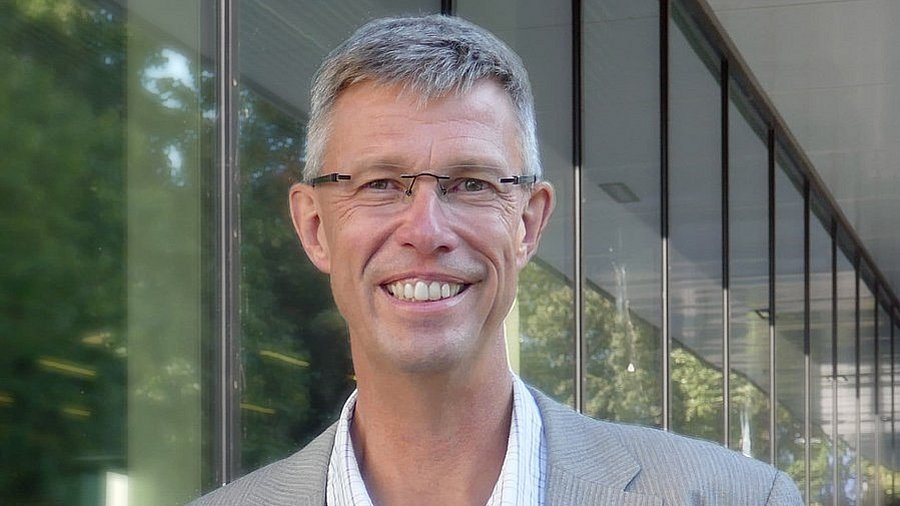
Prof. Dr.-Ing. Jürgen Gerlach / Road Traffic Planning and Engineering
Photo: University of Wuppertal
It’s all going smoothly
Traffic engineer Jürgen Gerlach on the development of centrally controlled traffic light systems
The first traffic light system on a road was installed in Cleveland, USA, in 1914, featuring red and green lights. In 1920, the first three-colour traffic lights were introduced in Detroit and New York. In Europe, the first system of this kind was set up in Paris in 1922. Germany’s first centrally controlled traffic light system came into operation in 1926 at Potsdamer Platz in Berlin. How were these systems operated before that?
Jürgen Gerlach: For a long time,there was no need for traffic light systems because there wasn’t really what you would call heavy traffic. The volume of traffic from horse-drawn carts or horses alone wasn’t heavy enough to require regulation at junctions. Furthermore, speeds were still relatively low in those early years, and the differences in speed between a car and a pedestrian were nowhere near as great. And when approaching a potential conflict zone at a junction, the likelihood of serious accidents only becomes high when the differences in speed are significant. As for the flow of traffic, people had somehow managed to share the space and come to an understanding until – particularly in large cities – so much traffic built up that, at major junctions during peak times, it would actually come to a standstill. That is why regulations became necessary. A very common method of regulation at the time was the use of traffic wardens. Situations at junctions were managed on a case-by-case basis by a traffic warden using hand signals.
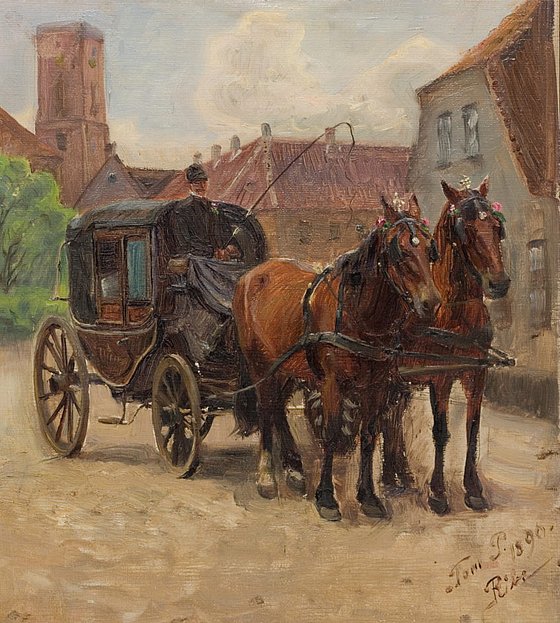
Horse-drawn cart (1890) by Peter Tom-Petersen, Ribe Art Museum, Denmark
The traffic light colours red, amber and green originally stem from the railway system of the 19th century. Why were these colours specifically chosen?
Jürgen Gerlach: Red is the colour we humans perceive most easily; it has a long wavelength and is a signal colour. This became established very early on. For example, people would wave red flags when they needed to attract attention. We also perceive red as the best colour in poor weather and at twilight, in the rain and in fog. It reminds us of ‘Caution’, ‘Stop’ and ‘Halt’. And green is also easily visible and has long carried this symbolism, as green means ‘go’. There were attempts to use white, but on occasion the signal discs would break or fall off. So if a red disc fell off and you saw the white light, you would misinterpret the signal and drive straight through. Yellow eventually became the standard, as it lies between the two and indicates that something is changing. Even today, yellow is used at roadworks to convey the same message: Caution – something is temporarily different here!
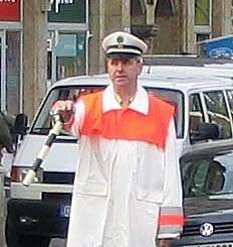
Traffic officer wearing a traffic jacket and carrying a traffic baton in Germany
Photo: Daniel Rentsch, public domain
In smaller towns, including Wuppertal, the first traffic lights were not installed until after the Second World War. How was traffic regulated before then?
Jürgen Gerlach: Actually , not at all to begin with, because there was very little traffic in Wuppertal for a long time. The first traffic regulations probably came about with the introduction of the tram, because – as we know from our own recent research – accidents involving trams are usually serious. And these traffic regulations were also enforced by traffic police officers.
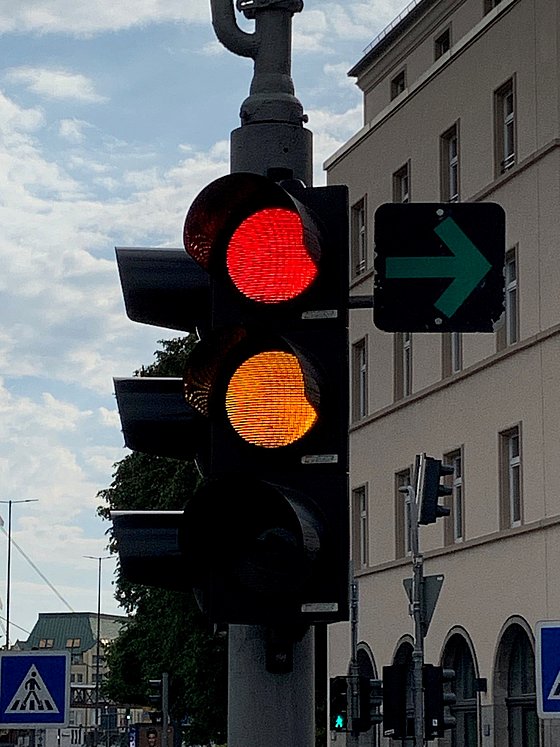
Traffic light system during the switching process
Photo: UniService Third Mission
In the meantime, traffic light systems have also evolved. In Wuppertal, traffic control at key junctions – such as Robert-Daum-Platz – is increasingly being optimised by smart traffic lights. What does that mean?
Jürgen Gerlach: We need to go back in historyfor that . The first traffic signal systems weren’t centrally controlled; they were mechanical. In principle, they always ran on a fixed-time programme. I still remember systems where the red and green panels were rotated into position in the signal field. And that’s how the lights changed, with the same durations for all directions. There were no different durations for main and secondary traffic flows. Those were the early days. Then, with traffic signal systems at junctions and the first centrally controlled systems, these fixed-time schemes were further developed. In other words, longer green phases were specified for certain directions. Then, with technological progress, particularly in the 1970s and 1980s, the first traffic-dependent traffic light control systems were introduced. Incidentally, we refer to the pole plus the signal head mounted on top as a ‘traffic light’. A traffic light system then comprises several of these signal heads and traffic lights. Added to this is the control box, hence the term ‘traffic light control system’. Methods for detecting traffic were constantly being refined. In the early years, this was done using so-called loops laid into the carriageway. These are wire loops that detect whether a vehicle is on them or not. You could actually see this. It looked like a rectangle that had been milled into the carriageway, immediately in front of the stop line, and filled with a dark material. That’s how the vehicles were detected. Today, alongside the loops, there are cameras of all sorts; some respond to infrared, whilst with AI, real cameras are sometimes used as well. This allows for traffic-dependent signal control; in other words, there is no longer fixed-time control with set green phases. At some point, loops were also installed at the end of a road so that the system could detect how many cars were queuing up, thereby triggering the next green phase and extending the green light. Most traffic light systems today are controlled using a two- or four-phase system. In the 1990s and 2000s, priority was then given to public transport. This meant that a bus or tram would now carry a transponder which would then register with the traffic light control unit. The first systems of this kind operated via radio; other technologies are now also used. In this way, the system received information that, for example, a bus was approaching and wished to turn left. The control system knows how far away the bus still is, and the traffic lights switch to the next green phase early enough so that the bus does not have to stop. The aim is to prevent public transport from getting stuck in traffic at the traffic lights, but rather to enable it to keep moving continuously.
This is now standard practice in all German cities and has also led to a surge in the installation of new traffic light systems. Here in Wuppertal too – for example, at Robert-Daum-Platz heading towards Döppersberg – buses are deliberately diverted out of the traffic jam. It has its own dedicated bus lane on the B7 so it can pass the traffic jam. And then it is the first to get the green light so that, as the ‘lead vehicle’ – as we call it – it can merge into general traffic. If we didn’t have this, we’d need far more dedicated bus lanes and, consequently, more space. But even AI has its limits, because when requests come in from everywhere during peak hours and all lanes are full, it switches back to fixed-time control.
AI is the breakthrough we’ve had over the last few years. These camera systems can do what, for example, a loop detector cannot: they can extend a green phase for a large group of schoolchildren wishing to cross the road. One can also envisage a future where people with disabilities might carry transponders, or be recognised by specific symbols, and then also receive an extended green phase. Similar systems could also be developed for cyclists.
Through the Centre for Transport and its Chair of Road Traffic Planning and Engineering, the university is conducting its own research projects on traffic planning. To what extent will traffic lights play a role in this in the future?
Jürgen Gerlach: They will continue to have their place. I don’t believe they will be phased out. We certainly need to ask ourselves what impact automated driving will have on traffic flow or traffic control in the future. What happens in the event of an accident? Will it be possible to communicate directly with the vehicle behind, saying ‘Watch out, something’s happened’? Or might it even be possible at some point to ‘buy’ green phases to get through faster? These are all conceivable scenarios, because the technology is capable of it.
Here at the department, we have been looking into tram accidents linked to traffic light systems. There are 57 towns and cities in Germany with tram services, and in these locations there have repeatedly been serious accidents – often fatal – when trams cross roads. These sections of road are secured and also feature what is known as a ‘Z-crossing’, where pedestrians are guided through a looped barrier so that they must always face the tram. This raised the question of the best safety measures. In addition to the audible signal, some cities use a double flashing light, whilst others use a red signal or have a green phase that applies to both the tram and the pedestrian crossing. We compared these, but found that accidents still occur regardless of the system used. In all these cases, the pedestrian’s attention was not focused on the rail traffic. Nevertheless, smart systems could be deployed in future to provide immediate warnings, provided that public acceptance allows for this and that we continue to react alertly even after repeated warnings in everyday road traffic. So if AI detects that danger is imminent, it could issue a warning, for example via a shrill sound on a smartphone.
Another area of our research focuses on cycle traffic outside built-up areas, as we have unfortunately seen an increase in accidents there in recent years. Our question is always how infrastructure can be better adapted, both in terms of planning and technology. We therefore wish to promote cycling more in future and are considering how to guide cyclists along main routes – including through junctions – without them having to stop too often. To this end, we aim to minimise the need for cyclists to stop and wait in everyday situations, so that cycling becomes an even more attractive alternative. And traffic lights continue to play an important role in this regard.
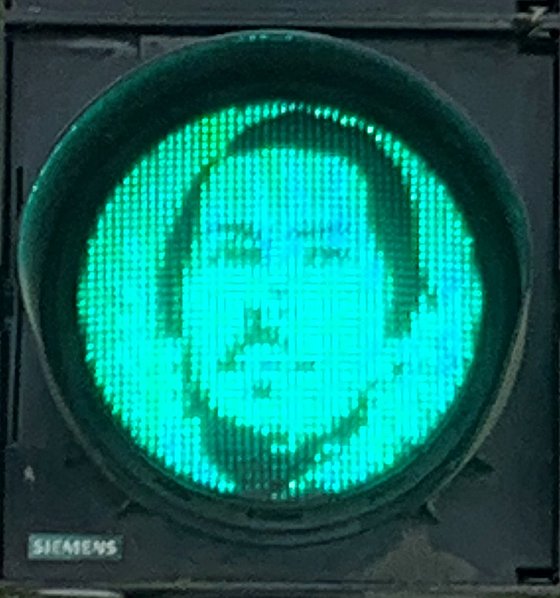
Pedestrian traffic lights featuring a portrait of Friedrich Engels
Photo: UniService Third Mission)
Road safety can be a bit of fun too. Following an art project in 2021, traffic light figures at four locations across the city now bear the likeness of the Wuppertal-born philosopher Friedrich Engels. The Wuppertal Institute for Climate, Environment and Energy has drawn up an ambitious blueprint for Elberfeld, with the aim of gradually creating a largely car-free neighbourhood. If the city centre is to become car-free in future, then surely I’ll actually need traffic lights for cyclists. Will we then have to take a different approach to the design of the traffic light systems?
Jürgen Gerlach: There are, of course, already traffic light systems for cyclists today. It’s certainly true that we expect cycling to continue to have great potential. If you look at developments in city centres – and that includes Wuppertal – over the last 20 years, the number of cyclists hasn’t just increased by a few per cent, but by a factor of ten. In major cities such as Frankfurt and Cologne, we’re talking about a tenfold increase. In other words, ten times as much cycling as 20 or 30 years ago. And so it goes without saying that we need to make cycling safe. That said, I don’t believe we’ll be able to do without cars entirely in the long term. Perhaps today’s pedestrian zones will one day be expanded to become cycle zones. The potential remains particularly high because, in Germany, a large proportion of car journeys are significantly under five kilometres. That means you can already use a bike several days a week. And with e-bikes and the like, it will become even easier.
How important will traffic lights remain for road traffic planning in the future?
Jürgen Gerlach: It depends on how automated and autonomous driving develops in the future, but I believe we’ll still need traffic lights for many years to come, simply to release conflict zones one after the other.
Uwe Blass
Prof. Dr.-Ing. Jürgen Gerlach heads the Teaching and Research Group for Road Traffic Planning and Engineering in the Faculty of Architecture and Civil Engineering at the University of Wuppertal.