100th birthday of Ingeborg Bachmann
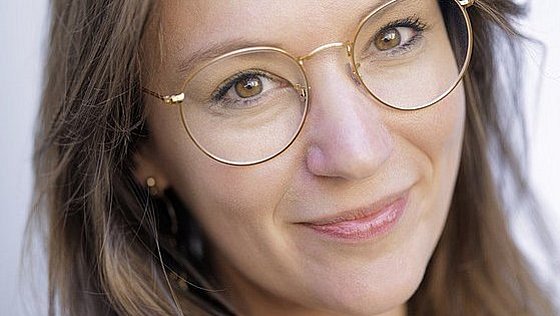
Dr Sabrina Huber / Modern German Literary History
Photo: ©Ralf Schultheiß
Literary forms of intensive reflection
German scholar Sabrina Huber on the 100th birthday of Ingeborg Bachmann
Ingeborg Bachmann's youth was engulfed by the horrors of National Socialism. This experience shaped her language, her thoughts and her entire oeuvre. She also dealt intensively with the role of women and the difficulty of finding truth in a destroyed world. A central theme was "history in the self". What does that mean?
Sabrina Huber: Ingeborg Bachmann uses the formula of 'history in the self' to describe the experience that history is not simply past. In her Frankfurt Poetry Lecture, she says: "The first change that the ego has experienced is that it no longer resides in history, but that history now resides in the ego." The violence of National Socialism did not end in 1945, but continues to have an effect on people, on us and also on her: in our and her language, in relationships, fears and in silence. For me, this is precisely one of the great strengths of her work, and it is what gets close to us as we read. Bachmann is not only interested in political systems or historical events, but also in how violence is inscribed in perception, language and everyday life.
That is why you can never separate the private from the political. Her texts show time and again that social violence extends into intimate spaces: into romantic relationships, into conversational situations, into language and linguistic images themselves. What is particularly impressive is that this violence is often not overtly visible, but remains subliminal, appearing almost everyday. It is precisely these elusive forms that Bachmann makes visible in her literature. Her literature, be it poems or stories, is therefore not simply memoir literature, but a very precise analysis of how history and violence live on in people.
Her first major successes came with the publication of her stories in the Viennese daily newspaper. She later described her relationship with Vienna as a constant love-hate relationship. Why?
Sabrina Huber: Vienna was an intellectual and literary space of opportunity for Bachmann. It was where she studied, where she moved in philosophical and literary circles, where she made decisive and personally formative relationships and where she began her career as a writer. Vienna initially meant opportunity: intellectual openness, encounters, aesthetic experience, thinking. It was here that she began to write and think.
But at the same time, Vienna remained inextricably linked to the repressed continuities of the post-war period. In Austria in particular, she saw early on how quickly things returned to normality after 1945 without coming to terms with their own history. This simultaneity and tension characterises her relationship to the city. Vienna always means cultural intensity and repression at the same time, intellectual openness and historical and social violence, which continues in language, manners and social structures. At no point does she speak nostalgically about Vienna, but always with this mixture of closeness and distance, which is also productive. Her relationship to Vienna can therefore hardly be broken down into categories such as closeness or rejection. Bachmann later returned to Vienna, at least in a literary sense: perhaps because it was there that the question of how history lives on in people and languages became more concentrated for her as an example. The city remains a place of attachment and imposition at the same time.
The title poem of the first volume of poetry "Die gestundete Zeit", published in 1953, contains "the variety of possible associations, the urgency of the calls that are made to us to look along, to think along, to sympathise, to conjure up related experiences, until this web of words has become a part of us", said the writer Hilde Spiel. This unusual volume of poetry hit the post-war literary scene like a bomb. Why was that?
Sabrina Huber: I think the impact of Die gestundete Zeit has a lot to do with the fact that Bachmann appeared in a literary situation in which language itself had become questionable after 1945. Her poems sound completely different from much of the (post-war) German-language literature of the time: they react to this experience not with linguistic impoverishment, but with a peculiar condensation. They combine historical shock, existential experience and the highest intellectual precision with an enormous power of language. This language is powerful.
Bachmann refuses to use any soothing language. Even the title Die gestundete Zeit contains this feeling of a postponed catastrophe, of a precarious in-between. The poems speak of fear, threat, war, loss and historical upheaval without ever tipping over into political, moral or even individually conceived unambiguities. It is precisely this combination of existential intensity and linguistic rigour that was, I believe, new and still captivates us readers with her verses today.
What's more, Bachmann makes language itself a problem. Her poems not only reflect on experiences, but also always show the uncertainty and fragility of speech itself, precisely by juxtaposing powerful images with a speechlessness that is articulated elsewhere. I believe that her poetry was and is so powerful because after 1945 it opened up a new form of poetic thought: intellectual, existential and linguistically radical at the same time. She does not let us escape.
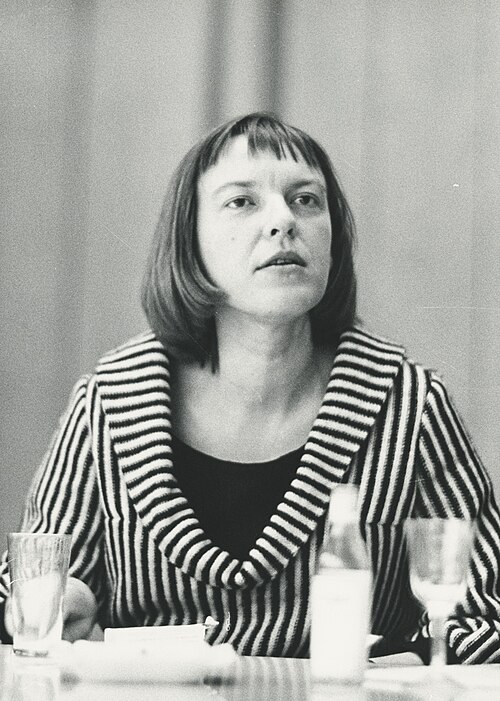
Ingeborg Bachmann
Photo: Fritz Peyer CC BY- SA 4.0
She was considered a poet in the public eye. Can you explain that?
Sabrina Huber: In the 1950s, Bachmann was initially recognised by the public primarily as a poet. Her early volumes of poetry, her readings with Gruppe 47 and her enormous presence very quickly made her a central figure in German-language post-war literature. In the process, a public figure emerged as a 'poet', which to some extent still overshadows Bachmann today.
But I think this term is not entirely unproblematic in her case. It has meant that Bachmann has often only been read as a lyrical, even sensitive voice and it has been easy to overlook how analytical, philosophical and critical of language her writing actually is. Her later prose in particular shows with great precision how violence, power and history inscribe themselves into language and relationships.
I am therefore less interested in Bachmann as a poet than in the enormous intellectual acuity of her work. Her texts are not only linguistically impressive, but also literary forms of intense reflection.
Bachmann also lived in Berlin for several years. In May 1973, she said in an interview that Germany was very difficult for Austrians to understand: "Our thinking is different because our language is different." What did she mean by that?
Sabrina Huber: The sentence arises from a concrete experience: Bachmann lives in Berlin and obviously thinks about the fact that the same language does not mean the same cultural experience. That interests me because she doesn't see language as something uniform here. Although Austria and Germany obviously share the same language, she evidently assumes that historical experiences, cultural influences and societal self-evidence are inscribed differently in this language.
This seems to me to be central to her and her work: language is never just a means of communication, but always also a cultural space of experience. This is why her work pays so much attention to pitches, nuances, to what goes along with speech without being explicitly stated.
We should perhaps not forget that Bachmann comes from Carinthia, a border region with linguistic and cultural transitions. Perhaps this is precisely why her work is so attentive to nuances, breaks and shifts within the language itself. That seems to me to resonate in this sentence.
Bachmann herself described Malina, the only novel she published during her lifetime (1971), as "an autobiography, but not in the conventional sense. A spiritual, imaginary autobiography." And the literary critic Marcel Reich-Ranicki reads it as a "poetic report on illness, as the psychogram of a severe suffering". It is interesting to note the feminist reception of this novel, which changed from initial rejection to a central appreciation as an analysis of patriarchal destruction. From the 1980s onwards, the novel was read as a depiction of female self-extinction in a male-dominated world. Has Malina become a groundbreaking novel for female writing?
Sabrina Huber: Far be it from me to reduce this novel to female writing or even a psychogram of suffering. Malina is very much underestimated, and that also seems to me to be a male perspective, especially, if you'll allow me, with the reference to Reich-Ranicki. Of course, the feminist reception was important because it recognised early on how precisely Bachmann analyses asymmetrical relationships and male systems of order. But for me, the real radicality of the novel lies elsewhere.
Malina is a novel about the shattering of reality and identity in the narrative itself. The ego never remains stable, conversations tilt, memories shift, dream and present intertwine. This is precisely what creates this peculiar feeling of permanent uncertainty. The text defies any simple psychological or autobiographical reading. This is why I also consider Bachmann's own formulation of a 'spiritual, imaginary autobiography' to be very important. Malina does not simply retell lives, but examines the conditions under which an ego can speak, remember and exist at all.
The famous final sentence is therefore also very impressive: "It was murder." That is powerful. It refuses any reassuring explanation. The final sentence stands like a judgement that can no longer be taken back. This is not about a private relationship catastrophe, but about something more fundamental: the destruction of an ego through orders in which it no longer finds a real place to speak.
For me, the enduring significance of Malina therefore lies less in the fact that the novel represents 'female experience' than in the fact that Bachmann has found a way to give literary form to inner disruption, memory and loss of identity.
Bachmann was of the opinion that "the truth is reasonable for man". Not all writers shared this attitude, did they?
Sabrina Huber: Bachmann's statement is so important to me because he sees literature as neither moral nor decorative. For her, 'the truth is reasonable for man' does not mean that literature has unambiguous truths or simply conveys "true" messages. Her texts consciously refuse to be unambiguous. Rather, it means that literature must confront people with reality, even where it becomes disturbing, contradictory or painful.
This is closely linked to Bachmann's thinking. Truth thus (and in her texts) never appears as a stable realisation, but precisely where certainties become fragile. Her texts refuse simple political readings. Malina is a good example of this: the novel does not explain anything, rather it permanently deprives its readers of secure ground. Memory, identity and reality are constantly shifting. The novel dissects perception, memory and language so radically that readers are themselves caught up in a form of uncertainty. Cognition, and perhaps also this intended truth, is not created here through messages, but through literary form. Literature becomes a space of radical uncertainty.
For me, this is precisely where the political dimension of her writing lies. Perhaps this is precisely the imposition that Bachmann is talking about: that literature does not convey messages and positions, but has the ability to question familiar reality.
If you look at her biography, you get the impression that Ingeborg Bachmann was restless and restless all her life. What caused that?
Sabrina Huber: I would be cautious about prematurely psychologising Bachmann's life as personal restlessness. This impression arises with her in particular because she consistently resisted any form of categorisation: against national attributions, against literary role models, against the idea of a fixed identity. And also not infrequently because women are still and repeatedly characterised, above all by their relationships with male writers. This does her and her work an injustice and shamelessly minimises it.
It is striking that Bachmann always seeks out spaces that enable intellectual movement: Vienna, Berlin, Naples, Rome. These are not mere changes of location, but different cultural and linguistic constellations. I am particularly interested in the fact that her writing is strongly characterised by movements and transitions: between places, stations, but also between philosophy and literature, music and language, thought and imagination.
Perhaps this is also the real restlessness of her work. Not in a biographical restlessness, as this reading would suggest, but in a very high standard of thought and language that centres precisely on movements and transitions, where something is not fixed. Bachmann is never satisfied with ready-made answers
Ingeborg Bachmann died in 1973 after suffering burns from a burning cigarette in her flat in Rome due to her addiction to tablets and alcoholism. Today, she is considered one of the most important German-language poets and prose writers of the 20th century. What fascinates you today about this writer, who was born 100 years ago, on 25 June 1926?
Sabrina Huber: I got to know Bachmann through the stories in the volume Das dreißigste Jahr. These texts made a deep impression on me at the time because they capture moments of existential uncertainty with enormous linguistic precision: they are real crises and we find in them the feeling that a life, a relationship or an idea of oneself suddenly becomes fragile. It got under my skin how such existential experiences can be expressed in and through language without explaining them.
To this day, I am fascinated by her linguistic radicalism, in prose and poetry. Especially in her small forms, less so in the large novel. Bachmann writes with incredible precision, but her texts remain open, ambiguous and often disturbing. You read them again and again and always discover something new. She trusts literature to change perceptions. Perhaps this is the point that impresses me the most: that literature is not an illustration of experience and reality, but rather a form of cognition in its own right.
Uwe Blass
Dr Sabrina Huber is a research assistant at the Chair of Modern German Literary History at the University of Wuppertal.