
Gertrude Bell – Queen of the Desert
Dr Georg Eckert / History
Photo: Mathias Kehren
The Queen of the Desert
Historian Georg Eckert on the British woman Gertrude Bell and her extraordinary life
One hundred years ago, on 12 July 1926, Gertrude Bell died in Baghdad. Who was this extraordinary woman?
Georg Eckert: Extraordinary people rarely fit into a mould. Gertrude Bell was characterised by a certain restlessness and enormous daring – and the supposed contradictions that defined her life: a bold pioneer who made the first ascents of an entire group of Alpine peaks, but also a fearless camel rider, travelling through the desert from one tribal leader to the next; scholarly ambition as an archaeologist in the Orient and, in the same region, a co-organiser of the Arab Revolt against the Ottoman Empire during the First World War; an evidently ‘modern’ woman with a self-assured, largely self-determined way of life, and a staunch opponent of the introduction of women’s suffrage. Yet on closer inspection, these contradictions actually fit together quite well. Gertrude Bell simply did what interested her – and she could afford to do so thanks to her background.
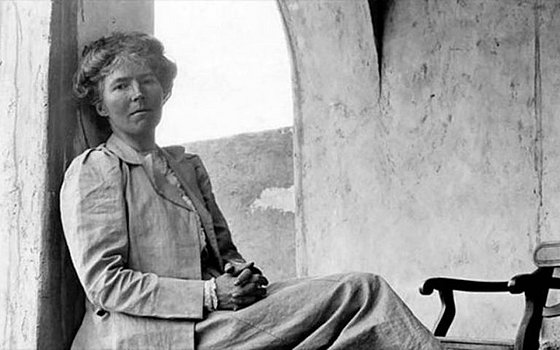
Gertrude Bell, undated
Photo: public domain
Gertrude Bell spent the First World War in Cairo, where she also worked for the secret service. How did this come about, and what was her role there?
Georg Eckert: A number of factors led to this involvement. First and foremost was what might be called Bell’s ‘network’; she came from a family of steel industrialists, whose salon was frequented by, amongst others, the naturalist Charles Darwin, the co-founder of the ‘Arts and Crafts Movement’ William Morris, and the social reformer John Ruskin. Bell had even been allowed to study at Oxford and forged further contacts during her travels – including, incidentally, with the German orientalist and Consul-General Friedrich Rosen, as well as the archaeologist Wilhelm Dörpfeld, who hailed from Wuppertal. Her achievements as a scholar and regional expert constituted the second key factor; in 1914, Bell had even received the prestigious award from the National Geographic Society for her daring journey from Damascus to Ha’il, the headquarters of the Ibn Rashid family, and back. Thirdly, with the outbreak of the First World War, her exotic interests and expertise suddenly took on strategic significance, all the more so after the disastrous defeat at Gallipoli; the British attack on the Dardanelles planned by Winston Churchill – that is, against the Ottoman Empire, which was allied with the German Empire – had ended in a bloody failure. Now Britain was working to undermine the Ottoman Empire from within and, in this way, secure the Middle East for the Entente and for itself. This required an intimate familiarity with the Arab (tribal) world, a knowledge possessed by only a few, including Gertrude Bell and the officer Thomas Edward Lawrence, later immortalised in the film ‘Lawrence of Arabia’, who, like Bell, possessed profound knowledge gained from archaeological work as well as expertise in geography and regional studies – knowledge which, within the imperial framework, was always simultaneously subject to military application. From the numerous travelogues she wrote, it was only a short step, in terms of content, to political memoranda.
She was involved, through Winston Churchill, in the colonial partition of the Ottoman Empire. How did she come to possess such extensive knowledge of the Orient?
Georg Eckert: If one asks about Bell’s knowledge – on the basis of which the then Colonial Secretary, Winston Churchill, brought her in as an expert on the Orient for the important Cairo Conference of 1921 – one must look to her sources. First and foremost, she was an avid reader who, in her desire to pursue a degree, had seen an opportunity to overcome amateurism through scientific methods – and she was a veritable bookworm and prolific letter-writer. She then gained her own experience on numerous expeditions, drawing up maps of previously unknown areas and meticulously documenting archaeological excavations. No less important must have been the information she gathered through conversations with tribal leaders and other members of the elite, with whom she maintained close contact, speaking in the language – indeed, even the dialects – of the various sheikhs whose company she sought.
She was very popular with the Arabs at the time and was committed to preserving cultural treasures. She even founded the Iraqi National Museum. How was that possible for a woman back then?
Georg Eckert: Perhaps, precisely because she was a woman, Gertrude Bell was able to achieve something that would not have been possible for a man with comparable abilities and knowledge, because she was hardly suspected of threatening the authority and prestige of high-ranking figures in a male-dominated, hierarchical environment. It was precisely this underestimation that opened up opportunities for her to make an impact without arousing suspicion. There are quite a few group photographs in which Bell is the only woman among many men in suits, uniforms and oriental robes. None of them believed that this woman was capable of challenging them in any way; rather, they thought her skills and knowledge could be exploited without any significant quid pro quo; the fact that Gertrude Bell had turned against the suffragettes may even have made her seem like an ally to some. In this way, she carved out a space for herself that even Arab leaders with no emancipatory intentions were happy to grant her. However, she had little contact with the wider population; even in the Arab world, her name was likely to have been familiar mainly to the political and scholarly elite who cooperated with Britain – whether influential tribal leaders or officials trained by the British themselves in the service of the newly founded Iraq.
She is regarded as the architect of modern-day Iraq and played a decisive role in determining the borders of modern Iraq in 1921. She wanted Christians, Sunnis, Shias, Jews and Kurds to live together peacefully. But that has remained a utopia to this day, hasn’t it?
Georg Eckert: Today’s experiences cast doubt on some of the optimism of the past, but they would be almost inconceivable without developments that were unforeseeable at the time: the then unforeseeable scale of Jewish migration to Israel, founded in 1948; the upheavals of the Cold War; the Iranian Revolution; the Iraqi dictatorship; and many other factors. After the First World War, the outlook was different, for the collapse of the Ottoman Empire opened up new possibilities, in which Gertrude Bell and other British figures did not envisage nation-states modelled on the European example, but rather integration into a transformed British Empire. They viewed the Middle East more as a region of competing tribes which, with astute policy, could be successfully integrated into a loose imperial confederation, and they had found from experience that a balance of interests could be effectively achieved amongst many groups. From the perspective of Bell and other experts on the Orient, the aim was to win over key tribes through astute cooperation and, if necessary, to combat the others by military means. This is indeed what happened during the Iraqi uprising of 1920, often referred to as the Shi’ite Revolution. This attempt to shake off British rule and that of the tribes allied with the Empire failed, partly due to the deployment of the Royal Air Force ordered by Churchill. Moreover, the high costs of such interventions reinforced the British intention to transform the Empire’s rule from a direct (i.e. colony-like) form into an indirect one, in which the de jure sovereign states would become de facto dependent on Great Britain. It was in accordance with this principle that the deliberations of the 1921 Cairo Conference took place; Winston Churchill, drawing on an Arabic folktale, somewhat disparagingly referred to its participants as the ‘forty thieves’.
She was regarded as courageous and unyielding. How could one tell?
Georg Eckert: Gertrude Bell’s life was also characterised by the fact that, thanks to her wealthy background, she did not have to base her major life decisions on financial considerations; she could afford to lead an independent life. Moments of courage are evident in many situations: she contradicted teachers and later professors; she insisted on pursuing her chosen field of study; she held unpopular views (on women’s suffrage, for example, and on the Christian faith, which she regarded as superstition in her scientific rationalism); she climbed many mountain peaks in the Alps (the Getrudspitze in the Bernese Oberland is named after her as its first ascender); in 1913, she set out on a journey lasting several months and covering more than 1,800 miles, during which she was even taken prisoner; she was often the only woman in Arab circles and amongst the British military and the British colonial administration, which regarded itself as the elite of the Empire; and, on her own initiative, she pushed through the establishment of the Iraqi National Museum, of which she was appointed the first director: At that time, it was still known as the Baghdad Archaeological Museum; it would scarcely have been possible to appoint a British woman as director of such a distinctly national institution.
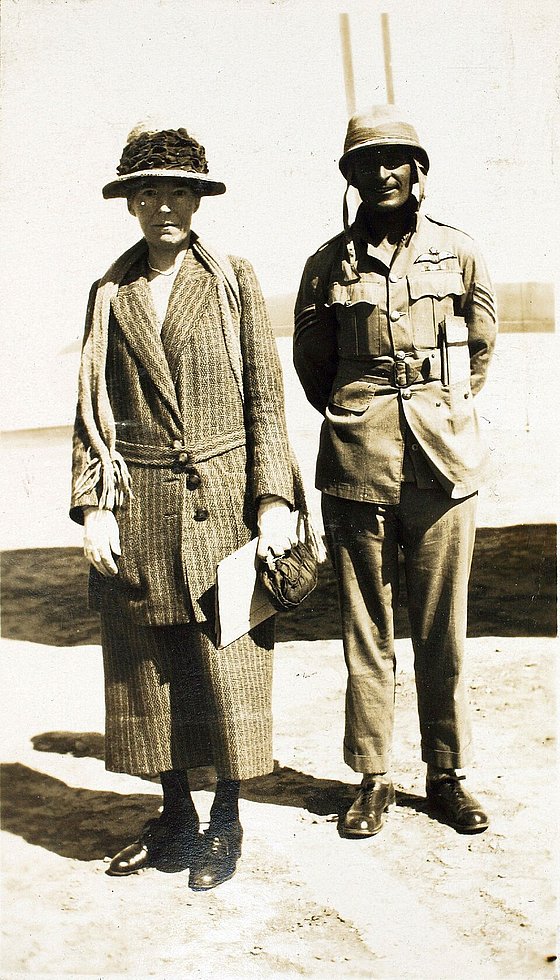
Gertrude Bell with a Royal Air Force sergeant
Photo: public domain
She was on familiar terms with the most influential men in the Orient. Lawrence of Arabia was one of them. She was a close political confidante to the first King of Iraq, Faisal I. However, when the country was granted official autonomy, Gertrude Bell always had British interests in mind, didn’t she?
Georg Eckert: It was no coincidence that Gertrude Bell was awarded the title of Commander of the British Empire in 1917 – a high imperial honour. Most Britons of her generation – Winston Churchill, for example, who was only a few years younger and was to outlive her by almost forty years – were accustomed to thinking within the logic of the Empire. This meant pursuing geopolitics to expand British influence across the globe, whilst taking into account not only political but increasingly economic interests as well: from her perspective, by no means solely those of the mother country, for imperial actors were accustomed to bearing their duty as the ‘white man’s burden’. They saw themselves engaged in a selfless endeavour that specifically benefited the development of those whom, from today’s perspective, we tend to perceive primarily as victims of exploitation. Of course, one must take a nuanced view of this, for powerful local interests were also aligned with British policy – in Iraq, for example, those of the Hashemite dynasty. King Faisal I hailed from this dynasty; the British rewarded him with the Iraqi crown in recognition of his role as a leader in the Arab Revolt against the Ottoman Empire during the First World War (whilst his brother Abdallah I was made Emir of Transjordan). This illustrates how, after the war, Britain and France, as Mandatory Powers of the League of Nations, divided up the Middle East, implementing the postulated right of peoples to self-determination in a way that suited their strategic interests.
Strategic and economic considerations were paramount then, just as they are today. However much Bell championed the preservation of artistic treasures, she also advocated the exploitation of oil reserves by the British. Was she, after all, convinced of the righteousness of Britain as a colonial power?
Georg Eckert: It was part of the imperial mindset not to view such matters as irreconcilable contradictions. ‘Preservation of art treasures’ could also mean transferring them to European museums – Bell ensured the enactment of an Iraqi law on the basis of which she herself decided which finds would remain in Iraq and which might be taken out of the country: on the one hand, a far-reaching regulation for its time, which recognised the significance of the find for its place of discovery and thus enshrined the country’s sovereignty over its own history; on the other hand, it was nonetheless a continuation of a colonial practice. The cultural dimension of such undertakings should not be underestimated, as the various restitution debates of recent years demonstrate: for instance, those concerning the Benin Bronzes, which were shipped to Germany and have been returned in recent years. From the Empire’s perspective, this tended to mean thinking in terms of win-win situations: as with oil, the profits from which soon benefited British companies, but also lined the pockets of some tribes.
Her death in 1926, however, came as a surprise. How did she die?
Georg Eckert: Gertrude Bell died of an overdose of sleeping tablets. The sources do not reveal whether this was an accident or deliberate; the woman, who was a prolific writer in the best sense of the word, left no suicide note, but some evidence suggests it was suicide. In any case, her zest for life had waned in her final months. The woman who had once been so athletic – though she had also been a chain smoker for years – suffered, amongst other things, from breathing difficulties; this was compounded by mental health issues which, in the common sense of the term, could certainly be described as symptoms of depression – and dashed hopes, for King Faisal did not turn out to be the ideal ruler she had projected him to be, and to make matters worse, he scarcely sought her counsel any more. Her beloved dog also died. In short: Gertrude Bell was going through a rough patch.
How do we remember today the woman who was known during her lifetime as the Queen of the Desert?
Georg Eckert: It depends on who ‘we’ refers to. In Germany, Gertrude Bell is not particularly well known; talking about her here is therefore a lovely rarity. Her name is known in this country primarily amongst experts in the history of the Middle East and archaeology. In Britain, the memory of her is considerably more vivid, because Gertrude Bell was deeply involved in attempts to steer the Empire into a new era: by creating new dependencies designed to bind Iraq and other now-sovereign communities closely to a transformed global empire. A stained-glass window by the famous artist Douglas Strachan commemorates her at St Lawrence’s Church in East Rounton; her extensive archive at Newcastle University is now listed on UNESCO’s International Memory of the World Register, to this day, the British Academy is home to the Institute for the Study of Iraq, founded in 1932 in memory of Gertrude Bell, who had donated generously to such causes – and the Iraqi National Museum now (once again) honours Gertrude Bell’s contribution to its establishment. Incidentally, her grave in Baghdad is well maintained, a further indication of her significance: a simple headstone that modestly identifies her as ‘Oriental Secretary’. She was far more interested in the desert than in life as a queen.
Uwe Blass
Dr Georg Eckert studied history and philosophy in Tübingen, where he was awarded a doctorate for a thesis on the early Enlightenment around 1700, with a focus on Britain, and completed his habilitation in Wuppertal. In 2009, he began working as a research assistant in the Department of History and now lectures as a Privatdozent in Modern History.