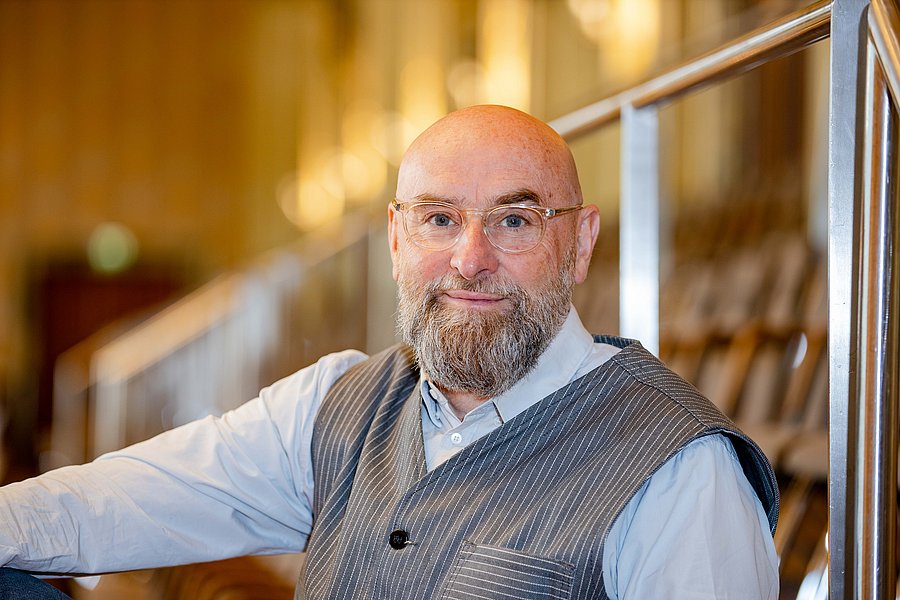
Britain's first red telephone box
Professor Martin Topel / Industrial Design
Photo: Sebastian Jarych
The small building in the urban space
Industrial designer Martin Topel on Britain's first red telephone box
In 1924, London architect Sir Giles Gilbert Scott presented his design for the UK's first red telephone box in a design competition, which was launched nationwide two years later as the K2 model. Over the years, it developed into a real cultural icon. What made the model so special?
Martin Topel: The red telephone box is an example of how design can create meaning beyond its immediate purpose. It is simultaneously a functional object, an architectural element and a cultural symbol. It is precisely this multidimensionality that makes it relevant to this day.
The telephone box was not conceived as a technical device, but as a small building in the urban space. Its proportions, structure and characteristic roof are reminiscent of classical architecture. This creates an unusual dignity for an everyday object. At the same time, it is clearly structured and immediately understandable - that is a special combination. And the time factor, which has allowed this product to become part of the collective consciousness for more than three generations thanks to careful further development.
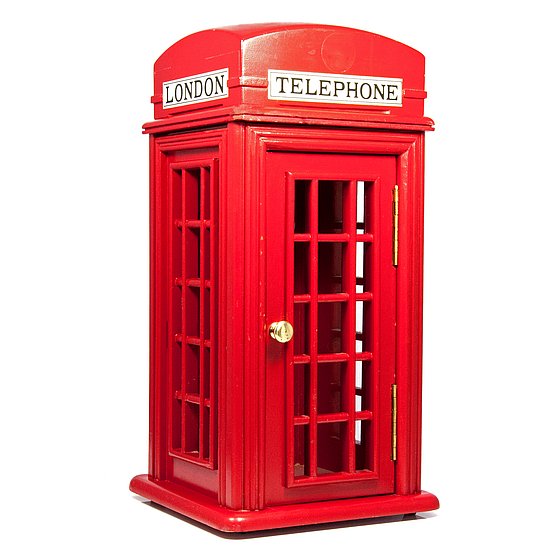
Red telephone box
Photo: Colorbox
When designing the roof, Scott took his inspiration from a mausoleum by the architect Sir John Soane. What did that look like?
Martin Topel: Scott drew inspiration from this mausoleum, which is characterised by a striking, gently domed shape. This roof motif was abstracted and applied to the telephone box.
The result is a distinctive, multi-tiered roof shape with gently rounded lines. It looks like a miniature dome and stands out clearly from purely functional flat roofs. It is precisely this detail that gives the telephone box its architectural character and contributes greatly to its recognisability.
By the end of the 1930s, more than 20,000 had been installed, although the bright red colour was not always used. Why not?
Martin Topel: In towns and cities, only the familiar red was used. This colour ensures maximum visibility and quick orientation in public spaces. One mustn’t forget that towns and cities at that time were often characterised by fog and poor visibility. Red became a functional design element here. At the same time, this consistent choice of colour has developed enormous symbolic power over time. But in rural areas, other colours could be chosen. This colour spectrum ranged from green, yellow, white and grey. Furthermore, from 1930 onwards, police telephone boxes were also installed, which were painted blue for identification purposes.
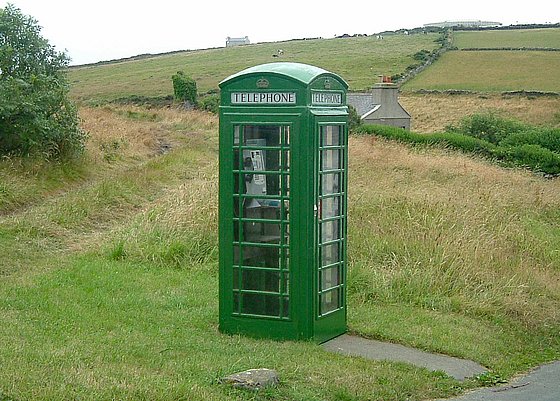
Green telephone box type K6 on the Isle of Man, public domain
After Elizabeth II's accession to the throne, the crown in the roof was modified in 1953. So there are cells of types K1 to K8. What changes have been made to the telephone box over the years?
Martin Topel : The first model to be installed in large numbers was the K2 version. This version of the K1 model, which was revised for the series, had a floor plan of 90x90 cm, was 2.51 metres high and weighed 750 kilograms. This expensive, large version was initially produced exclusively in London with 1,200 units. From 1929, Scott developed a cheaper and much more compact version - the K3 version. This was produced in 12,000 units.
In 1936, a further revision was made to mark the silver jubilee of King George V, the K6 version. A further 60,000 of these were produced throughout the kingdom.
In the further development of all variants, improvements were mainly introduced that reduced the manufacturing effort and costs, or involved functional improvements such as better ventilation, easier accessibility or larger glass surfaces for greater transparency. In formal terms, however, only the K3, K4 and K6 models refer to the original, world-famous design.
Telephone booths have also been used as locations in films in various countries and have become a fixture in the minds of generations of viewers through classics such as "Elevator to the Scaffold" (1958) with Jeanne Moreau, "Dirty Harry" (1971) with Clint Eastwood, "Don't Hang Up" (2002) with Colin Farrell or even magically, for example in "Harry Potter and the Order of the Phoenix" (2007). In 2006, the K2 telephone box was voted one of Britain's ten design icons. In that sense, a small phone box transports culture into the world, doesn't it?
Martin Topel: Absolutely. The phone box is an excellent example of how design can convey cultural meaning. Thanks to its strong visual identity, it has become a symbol that goes far beyond its original function.
In films, photographs and tourism, it is representative of Great Britain - just like double-decker buses or black taxis. When an object is so consistently designed and sensitively reworked over decades, it becomes part of the collective memory.
In this sense, the telephone box really is a cultural ambassador.
In the 1990s, the number of telephone boxes in the UK peaked at around 100,000. But that is long gone. Mobile phones have overtaken them. How are the listed boxes still used today?
Martin Topel: Today, many of the historic telephone boxes are being creatively repurposed. Some still serve as telephone stations, but the majority have been given new functions. For example, they can be found as small libraries, defibrillator stations, Wi-Fi hotspots or mini-kiosks. Some of them are also deliberately preserved as tourist photo backdrops.
This conversion is particularly interesting from a design perspective: it shows that long-lasting, well-designed objects have the ability to adapt to new requirements. The telephone box therefore remains relevant - no longer as a communication infrastructure, but as a cultural and functional artefact in the public space.
All public telephone boxes in Germany are to be dismantled by the end of 2026 at the latest. However, the red boxes from the UK can even be found in some German cities today. For example, the YMCA has installed the telephone box on the Bundeshöhe as a book exchange centre. What do you associate with the classic telephone box?
Martin Topel: I can still remember the special smell of the German telephone boxes. This mixture of damp telephone book and "technology". I also remember the fact that I had all the essential phone numbers in my head back then - unimaginable in the age of the smartphone.
I've also often used phone boxes on my motorbike trips as protection from unexpected downpours - I'll certainly miss them in this capacity.
Uwe Blass
_____________________________________________________________________________________________________
Professor Martin Topel is an industrial designer and has been a professor at the University of Wuppertal's Industrial Design programme since 1999. His chair specialises in the product development of capital goods and product systems