€9.4 million in funding
Between queues and crowds: the EU’s CrowdING project is researching crowds

The research findings are intended to help make infrastructure safer and more people-friendly. // Photo: Colourbox.de*
CrowdING focuses on everyday situations in public spaces: people in shopping centres, at flea markets, at concerts or at railway stations. “It is not primarily about dangerous situations, but ideally our research will help to prevent certain incidents and any accidents that might result from them,” says Prof Dr Anna Sieben.
Ultimately, CrowdING is intended not only to provide scientific insights, but also to enable practical applications. These include, for example, a proposed computer model to be used as a planning tool for large-scale events or the design of public spaces. The findings can also help to make infrastructure safer and more people-friendly – for example, through better organisation of access points, escape routes or waiting areas.
Bringing knowledge together
What makes CrowdING special is the close collaboration between different disciplines. Experts from social psychology, physics and computer science are working together to investigate how physical parameters and human behaviour interact.
Those involved believe that bringing these research disciplines together is also urgently needed.
“When studying crowds and their dynamics, it was long assumed that individuals move in a uniform manner, as we see in the animal kingdom with herd and swarm behaviour,” explains Prof. Dr Armin Seyfried.
However, humans differ significantly from animals and behave very differently as individuals, adds Anna Sieben. “The fact that we, as humans, are guided by social norms – for example, letting others alight first at a station before boarding ourselves – must also be taken into account when studying crowds,” emphasises the psychologist.
This calls for new research approaches.
What sets crowds in motion?
The first phase of the project focuses on describing the movements of crowds from both psychological and physical perspectives. Building on this, the researchers aim to investigate – with the help of simulations – when people change their behaviour. Why does a queue form, when does jostling or shoving occur, when does the queue break up – and what lies behind it all?
“There are already models we can use to simulate crowds. We’re talking here about agent-based models, in which each agent represents an individual. However, they are based on the assumption that everyone moves in the same way. Our aim in CrowdING is to develop agent-based models that can realistically simulate the behaviour of crowds and in which the agents act differently,” says Armin Seyfried.
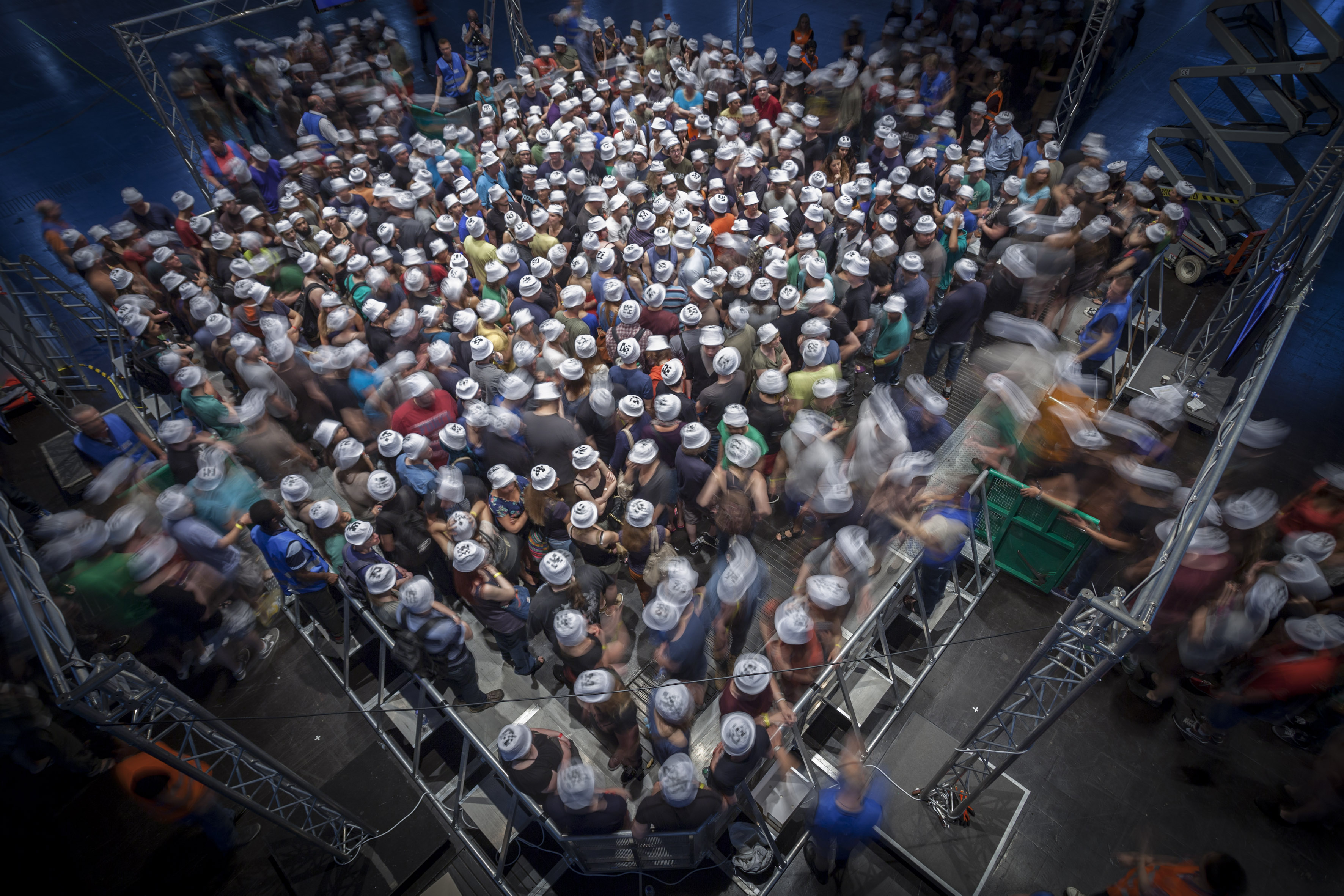
Why do people move in a certain way when gathered in large groups? This is one of the questions that the research aims to answer. The first experiments will take place at the University of Wuppertal at the end of November. // Photo: Jülich Research Centre / Marc Strunz-Michels
Valuable data from past and present experiments
When analysing crowds, the research team can initially draw on extensive material from previous experiments. This includes, for example, video footage from trials in which the entrance to a concert was simulated.
“The footage we capture during such experiments can, of course, now be put to excellent use for new analyses,” says Sieben. The research examines how people behave at different times and how the dynamics of the crowd change.
However, this is only the beginning. As the project progresses, the researchers will repeatedly carry out new large-scale experiments. The first such experiment at the University of Wuppertal is scheduled for the end of November. During the week from 30 November to 4 December, fundamental behavioural patterns will be examined in controlled situations with around two hundred participants. Among other things, the CrowdING team aims to learn more about how patterns form and dissolve in crowds. Anyone interested in taking part in the study can contact Professor Anna Sieben by email at sieben[at]uni-wuppertal.de.
Forms as a guide in a crowd
The researchers find the topic of form and shape particularly fascinating – they refer to it as morphology. A queue is one such form, as is the ‘butterfly’ formation that frequently develops on station platforms in front of the doors of a stationary train.
“In public spaces, we are constantly processing external impressions. We humans simplify this complexity and then tend to perceive the space as a whole rather than as individual details: we tend to see the queue rather than looking at the individual people who make it up. With the help of such forms, we recognise the current phase a crowd is in, orient ourselves and behave accordingly,” says Anna Sieben, explaining the significance of these forms.
“Whilst morphological analyses and corresponding models for calculating shapes and structures – for example, of materials – do exist in physics, these have so far been scarcely used in research into crowds and their dynamics,” says Seyfried. Nor have they yet been combined with findings from psychology.
“In a crowd – unlike in other social situations – we usually communicate non-verbally on the basis of social norms; furthermore, the high density often limits our perception of the overall situation, and we interact with people we do not know. All of this helps determine how closely people huddle together, how they move, or whether they form fixed patterns,” explains Sieben. In the CrowdING project, they are now investigating this interplay in greater detail.
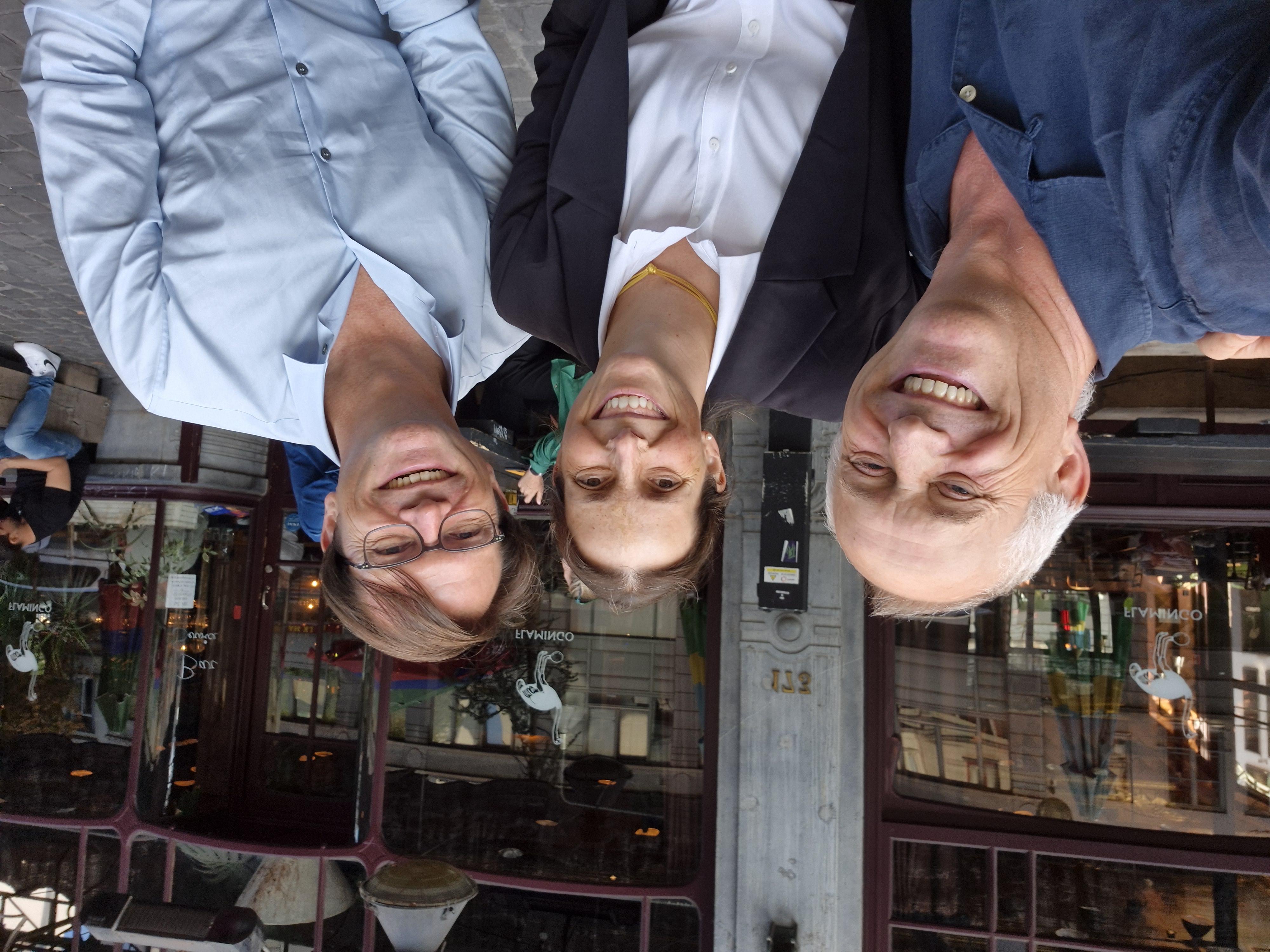
From left: Professor Armin Seyfried, Professor Anna Sieben and Professor Tom Postmes. // Photo: Armin Seyfried
The CrowdING team
The ERC Synergy Grant is one of the highest European honours in the field of science. It supports groundbreaking, interdisciplinary research that can only be achieved through teamwork. Around 15 researchers from three research groups are collaborating on the CrowdING project. Alongside Prof. Anna Sieben and Prof. Armin Seyfried, who teach at the university of Wuppertal and each lead a group at the Institute for Advanced Simulation – Civil Security Research (IAS-7) at Forschungszentrum Jülich – Prof. Tom Postmes from the University of Groningen is also involved in the EU project with a team. The research team has around 9.4 million euros at its disposal for the next six years.
At the University of Wuppertal, the first three of an expected total of six PhD students are currently familiarising themselves with their respective research fields and, under the supervision of Prof. Sieben and Prof. Seyfried, are developing the central research questions for their theses.
* The rights to use the Colourbox image (at the very top) are held by the university of Wuppertal. It is not licensed for publication by third parties.