For more educational equality
Wuppertal FUN project provides lasting support for children with learning difficulties
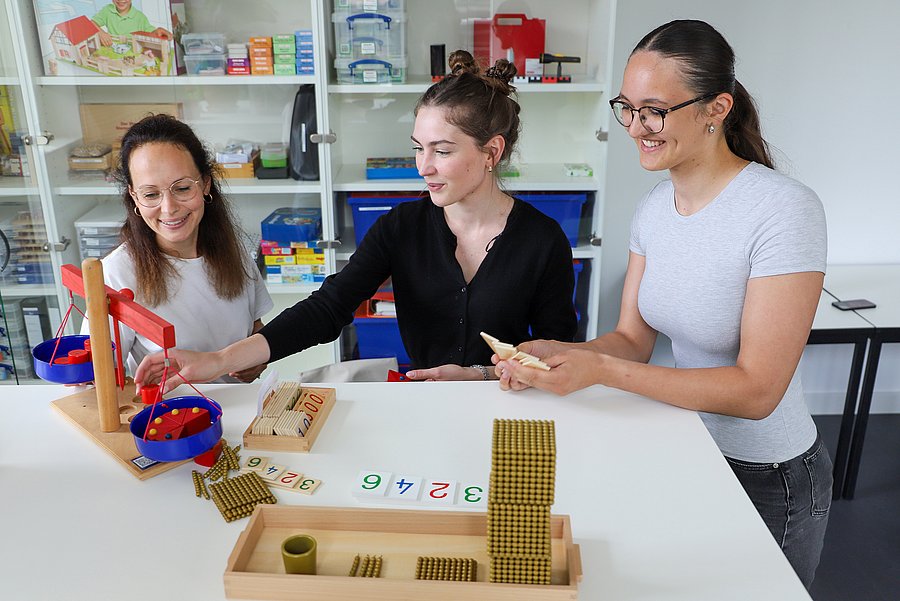
For five years now, students at the University of Wuppertal have been helping primary school pupils to catch up on their learning. They are prepared and supported by their lecturers. // Photo Meltem Er
For ten years now, the findings of national and international comparative studies have shown that (too) many primary school pupils in Germany achieve at most or not even the minimum standards in reading, writing and maths at the end of the fourth school year. This trend has become even more pronounced since 2020 with the coronavirus pandemic - especially for children from socially challenging backgrounds.
Seven committed cooperation schools
Against this background, Professor Dr Claudia Kastens and her team from the Department of Primary School Research at the University of Wuppertal launched the "FUN - Support and Tutoring" project in the summer semester of 2021. One of the starting points was a survey of 30 primary schools in Wuppertal in spring 2021, in which the head teachers reported significant deficits in reading, writing and maths for more than 1,300 children.
Together with seven primary schools in Wuppertal, the project is now implementing targeted support measures for children with learning deficits. These include the Gemeinschaftsgrundschule Eichenstraße, the Gemeinschaftsgrundschule Germanenstraße, the Gemeinschaftsgrundschule Haarhausen, the Offene Ganztagsgrundschule Liegnitzer Straße, the Gemeinschaftsgrundschule Opphofer Straße, the Grundschule Reichsgrafenstraße and the Städtische Evangelische Grundschule Sophienschule.
Students develop individualised support concepts
As part of the FUN programme, student teachers take the compulsory elective module "Heterogeneity and individual support". Here, they acquire in-depth knowledge of diagnosis and support in the areas of written language acquisition and maths. In subsequent in-depth seminars, students develop individualised support concepts and implement these directly at the cooperating schools. In addition to technical skills, the motivation, self-concept and cognitive load of the children are also taken into account.
Since the start of the project, around 750 children have been supported by around 320 students. The tutoring now takes place mainly as part of after-school care and is provided once or twice a week in addition to lessons. All support is closely coordinated with the class and subject teachers. On average, each child receives around 30 hours of individualised support.
Cooperation will continue
The experience of the past five years shows: "Continuous and individually tailored support can enable sustainable learning progress. At the same time, the prospective teachers also benefit as they gain practical experience at an early stage and receive intensive support," says project manager Claudia Kastens.
In addition, the project has also had a positive impact on cooperation between schools, the university and students. Regular network meetings and reliable communication structures strengthen co-operation and promote school development. Due to the positive experiences and successes, "FUN - Support and Tutoring" will be continued in the future.