Auction at the Kunsthalle
Who’s bringing CERN into their living room?
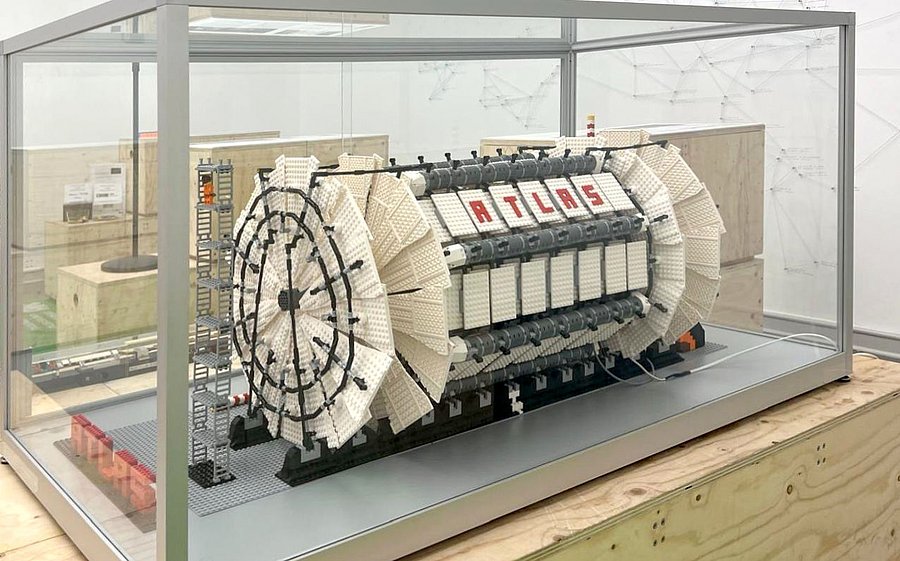
The Lego model is on display at the Kunsthalle (Thursday to Sunday, 2 pm to 6 pm each day). // Photo: Kunsthalle Barmen
The afternoon begins at 4 pm with a lecture by Prof. Dr Wolfgang Wagner on cutting-edge research at the European Organisation for Nuclear Research (CERN). Thousands of scientists from all over the world work together there to understand the fundamental building blocks and forces of our universe. Prof. Wagner’s research group at the University of Wuppertal is part of the international ATLAS collaboration.
What happens at the very heart of matter? What forces hold our universe together? And what processes took place immediately after the Big Bang? The ATLAS detector helps to find answers to these fundamental questions. In the summer of 2012, it helped achieve a scientific breakthrough: the researchers were able to detect the long-sought-after Higgs particle – a key component in understanding why elementary particles have mass.
9,571 LEGO bricks for cutting-edge research
In 2014, an idea emerged at the University of Wuppertal to visualise the complex research carried out using the ATLAS detector. Physicists built a 1:50 scale model of the detector using LEGO bricks. This allows all the key components of the gigantic research instrument to be seen in miniature.
The idea for the LEGO ATLAS model originally came from physicist Dr Sascha Mehlhase, who in 2011 wanted to recreate an ATLAS detector entirely from LEGO bricks. In Wuppertal, this resulted in a model comprising 9,571 LEGO bricks, which was initially set up in the corridors of the experimental particle physics department. School classes and visitors were thus able to gain an insight into how particle physics works.
Now the research model is becoming a collector’s item
More than a decade later, the model is taking on a new role: it is becoming a special collector’s item for LEGO fans, model-builders and science enthusiasts – whilst also supporting the Kunsthalle Barmen.
The model will be auctioned on 11 September at 5 pm. All proceeds will go towards supporting the work of the Kunsthalle Barmen. Visitors are warmly invited to bid and take home an extraordinary piece of Wuppertal’s scientific history. Even those who cannot be there in person have the opportunity to take part in the auction.