Launch
A bizarre odyssey: Wuppertaler Edition is adapting the science fiction epic ‘Astronautilia’ for digital release
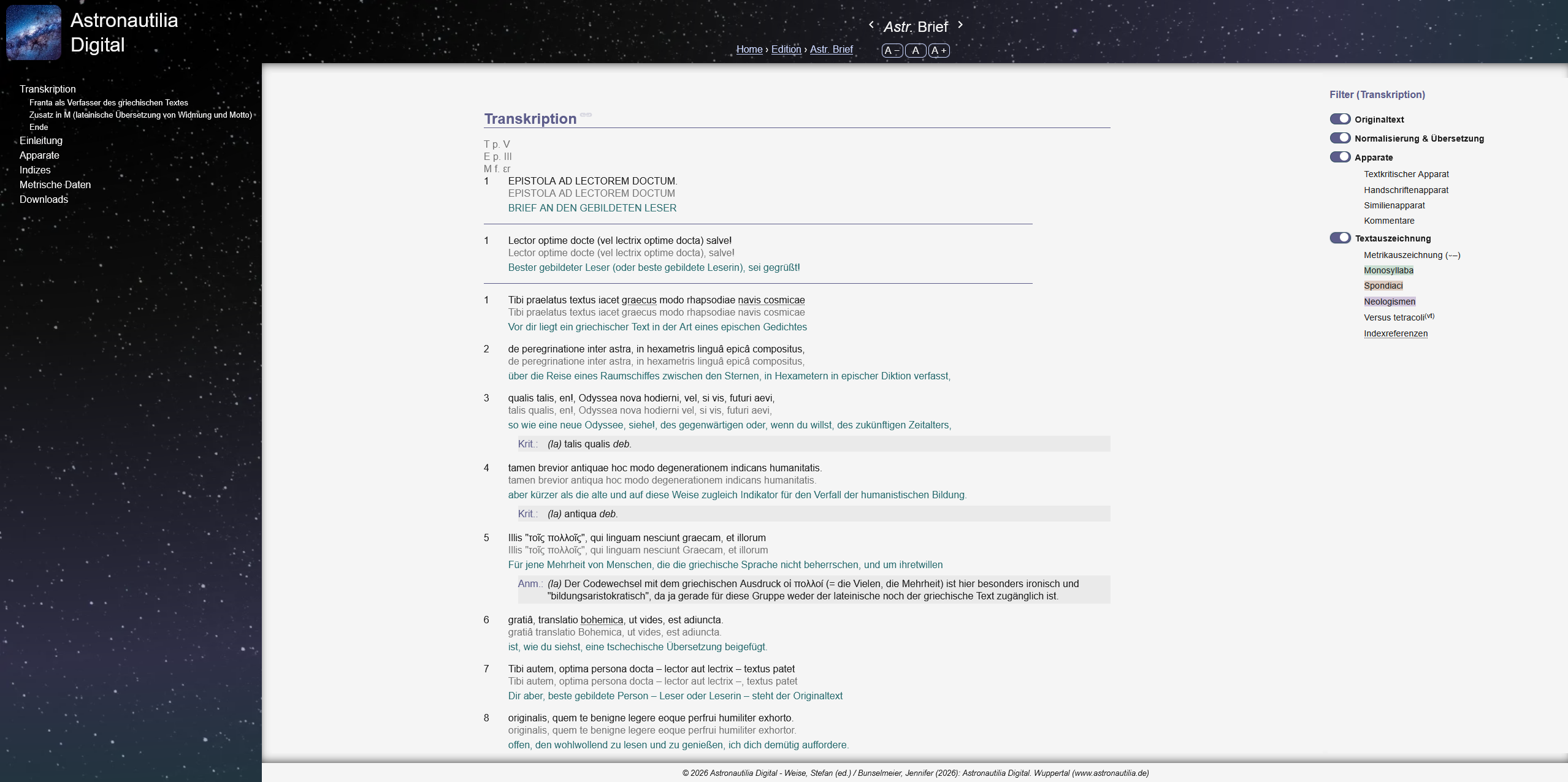
New edition: Researchers at the University of Wuppertal are digitising the work *Astronautilia*. // © 2026 Astronautilia Digital – Weise, Stefan (ed.) / Bunselmeier, Jennifer (2026): Astronautilia Digital. Wuppertal
The timing of the website’s launch is no coincidence: 13 August marks the 31st anniversary of the death of the Czech author and psychologist Václav Pinkava (1926–1995). Between 1993 and 1994, he wrote the text, comprising over 6,500 verses, and subsequently translated it into Czech. Shortly after his death in 1995, the Ancient Greek–Czech science fiction epic „Astronautilia“ was published.
One of the rare printed copies is held by Wuppertal University Library. It was presented in 2016 as a gift from the author’s son, Václav Z. J. Pinkava. In the same year, a conference was also held at the university in honour of the author’s 90th birthday. Now, in the year of his 100th birthday, BUW researchers Dr Stefan Weise (Classical Philology/Greek) and Dr Jennifer Bunselmeier (Digital Humanities) are working on a publicly accessible digital edition of the work, complete with a German translation. They are supported in this endeavour by the entire team of the Digital Humanities research group, led by Prof. Dr Patrick Sahle.
Edition provides an introduction to the work
The plot: In the distant future, it is discovered by chance that there is a sheep observing the universe. Without its observation, the universe cannot exist. A devious guardian named Mandys abducts it, and Captain Nemo is dispatched with a crew of robots, animal-like creatures and men to capture the sheep and its abductor in the vastness of space. The adventure takes Nemo to various planets. Eventually, he lands back on Earth – but in the past, in the year 1993. To get back to the future, Nemo bribes an archivist with the tale of his adventures – written in Ancient Greek in the style of Homer.
The version now launched contains the first sections of the epic with annotations and translates these so-called ‘cantos’ into German prose. The Wuppertal edition will be gradually expanded and completed. With Cantos 1 and 24, anyone interested can already read the beginning and the end and gain a more in-depth overview of the work through the introduction.
Further information is available on the project website: astronautilia.uni-wuppertal.de.
The preview version of the edition is available on the following page: www.astronautilia.de