Appointed doctor at the age of 77
Risk analysis: Franz-Georg Neupert develops new forecasting method for the automotive industry
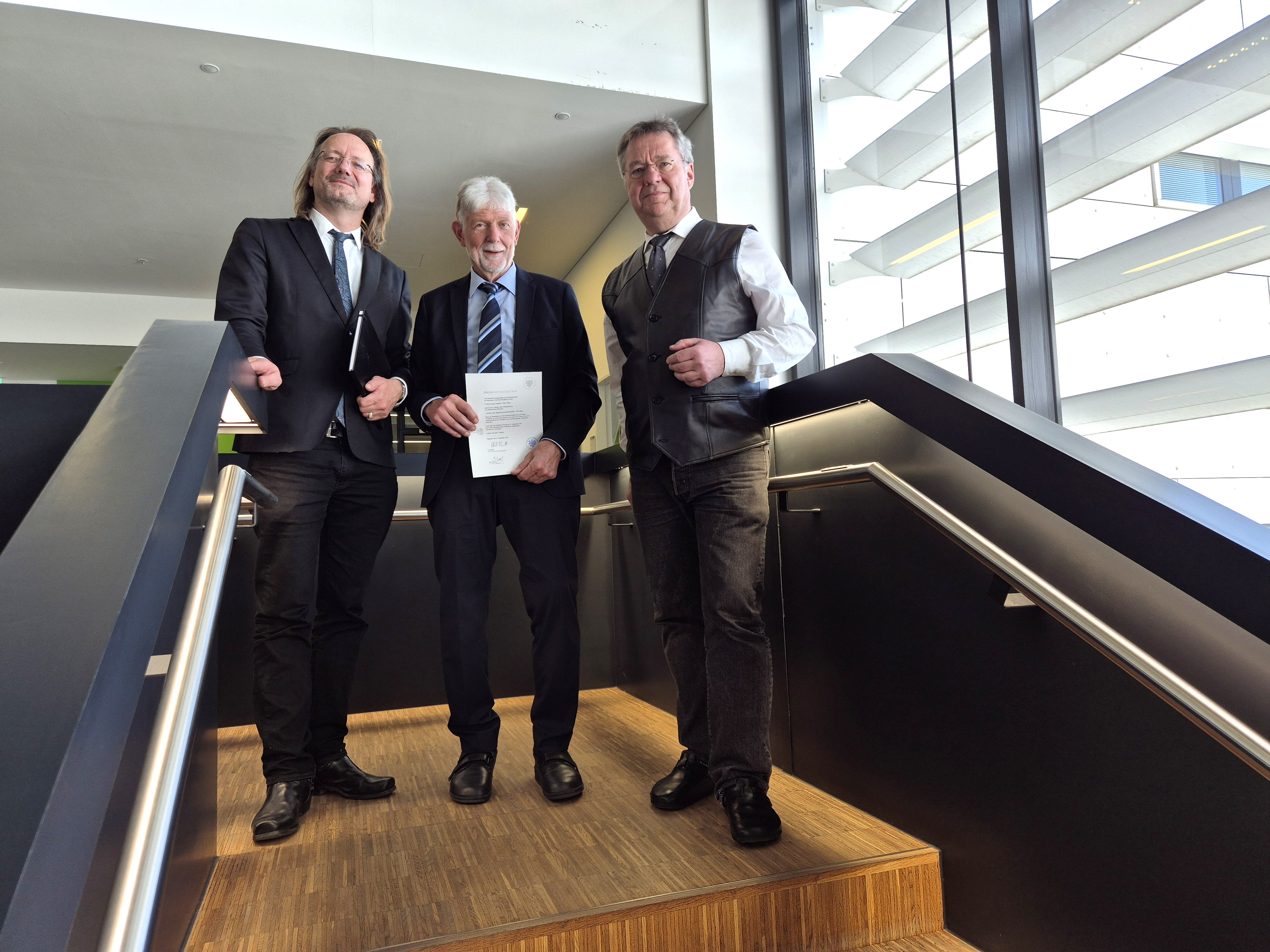
In the presence of doctoral supervisor Professor Stefan Bracke (left), the Dean of the School of Mechanical Engineering and Safety Engineering, Professor Eberhard Schmidt (right), presented Dr Franz-Georg Neupert (centre) with his doctoral certificate at the end of April. // Photo Jannis Pietruschka
As part of his doctorate, Franz-Georg Neupert developed a process that enables car manufacturers to make much more precise and reliable predictions about the behaviour of their vehicles in real-life use. This plays an important role, for example, when deciding on possible recall campaigns.
"Nowadays, cars that are on the road after being sold send a lot of different data to manufacturers. Also about functional failures. If the manufacturer realises at some point that a certain damage pattern is being reported more frequently than it normally should be, they have to assess the risk posed by this functional fault," explains Franz-Georg Neupert. Based on this, the manufacturer decides on the necessary further steps and ultimately whether an entire batch of the affected vehicle production has to be recalled. However, current methods still too often lead to incorrect conclusions. The 77-year-old has therefore set out to find a better solution.
Transferable results
The method developed by Franz-Georg Neupert takes into account significantly more influencing factors than was previously the case when extrapolating failure probabilities - i.e. for the questions: How bad is it and how bad could it get? - The new method also helps to predict the probability of breakdowns by taking into account more influencing factors than was previously the case, such as temperature fluctuations, the interaction of various causes and vehicle downtimes. The new method also helps to better understand the causes of failure. "A recall campaign or a targeted inspection must, of course, have a sound basis. Both sides, manufacturers and end customers, benefit from a more precise analysis and assessment of the risk," says the 77-year-old.
Although Franz-Georg Neupert's work is focussed on the automotive industry, the results can also be applied to other products. "Ultimately to all technical devices that send data about their condition," says the recent PhD graduate. The process also supports damage prevention. Because where functional failures can be analysed more precisely, appropriate countermeasures can be better planned and consequential damage can be avoided.
"The work combines decades of practical experience from industry with sound scientific methodology. The fact that Franz-Georg Neupert only started and completed his doctorate in retirement makes his achievement particularly remarkable," emphasises Stefan Bracke. The professor of reliability technology and risk analysis at the university of Wuppertal supervised the dissertation. The doctoral supervisor summarises with appreciation: "With his doctorate, Franz-Georg Neupert impressively demonstrates that scientific curiosity, perseverance and passion are not a question of age."
Publication
The dissertation has been published in the Shaker series "Berichte aus der Zuverlässigkeitsanalytik und Risikoforschung".
Franz-Georg Neupert (author), Stefan Bracke (editor): Methods for statistical analysis and prediction of failures of automotive functional units from field data considering significant perturbations. Berichte aus der Zuverlässigkeitsanalytik und Risikoforschung (Volume 9), also dissertation University of Wuppertal; Shaker Verlag, Aachen, Germany, ISBN 978-3-8191-0496-1. (2026)