Industry in Transition
The lecture series ‘Climate Crisis and Sustainability’ invites participants to discuss a sustainable future for the Rhineland mining region
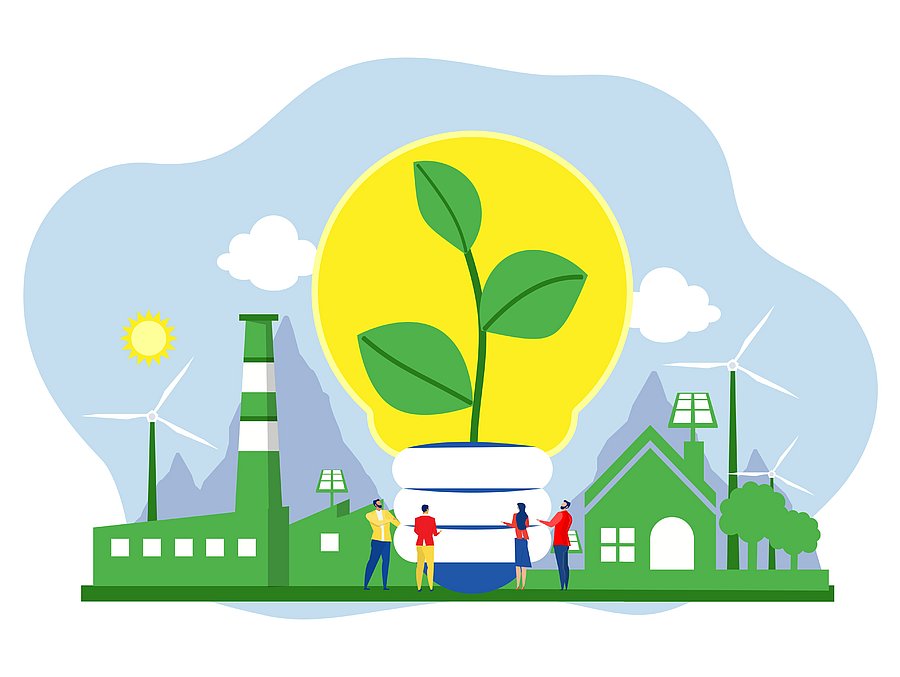
The lecture series explores how the transition to a climate-neutral region can be achieved. // Photo* Colourbox/#60176911
How can the phase-out of coal be successfully achieved, and how can businesses adapt to new technologies and climate targets at the same time? How can local communities be involved to build trust in the necessary changes? As Germany’s largest lignite-mining region, the Rhineland mining area is currently facing a profound structural transformation towards becoming a climate-neutral economic and industrial region. This raises many questions for the economy, the environment and society.
Six presentations by experts from various disciplines bridge the gap between interdisciplinary research and practical application. They will present specific projects and research approaches that address the challenges mentioned and support the structural transformation in the Rhenish mining region. Topics include new economic models, the future of carbon, the value of regional cooperation and the design of sustainable supply chains.
The ‘Climate Crisis and Sustainability’ series is organised by the Centre for Transformation Research and Sustainability (transzent), the General Students’ Committee (AStA) and Students for Future at the University of Wuppertal (BUW), in collaboration with the Wuppertal Institute.
The ‘IN4climate.RR’ project serves as the thematic framework for the lecture series; through this project, the Wuppertal Institute and the state agency for energy and climate protection ‘NRW.Energy4Climate’ are supporting the transformation of industry in the Rhineland mining region towards climate neutrality.
Organisational information
All lectures are free of charge, will be recorded and will subsequently be available as recordings. The series is open to anyone interested. Students at the University of Wuppertal can have the lecture recognised for credit (see info box).
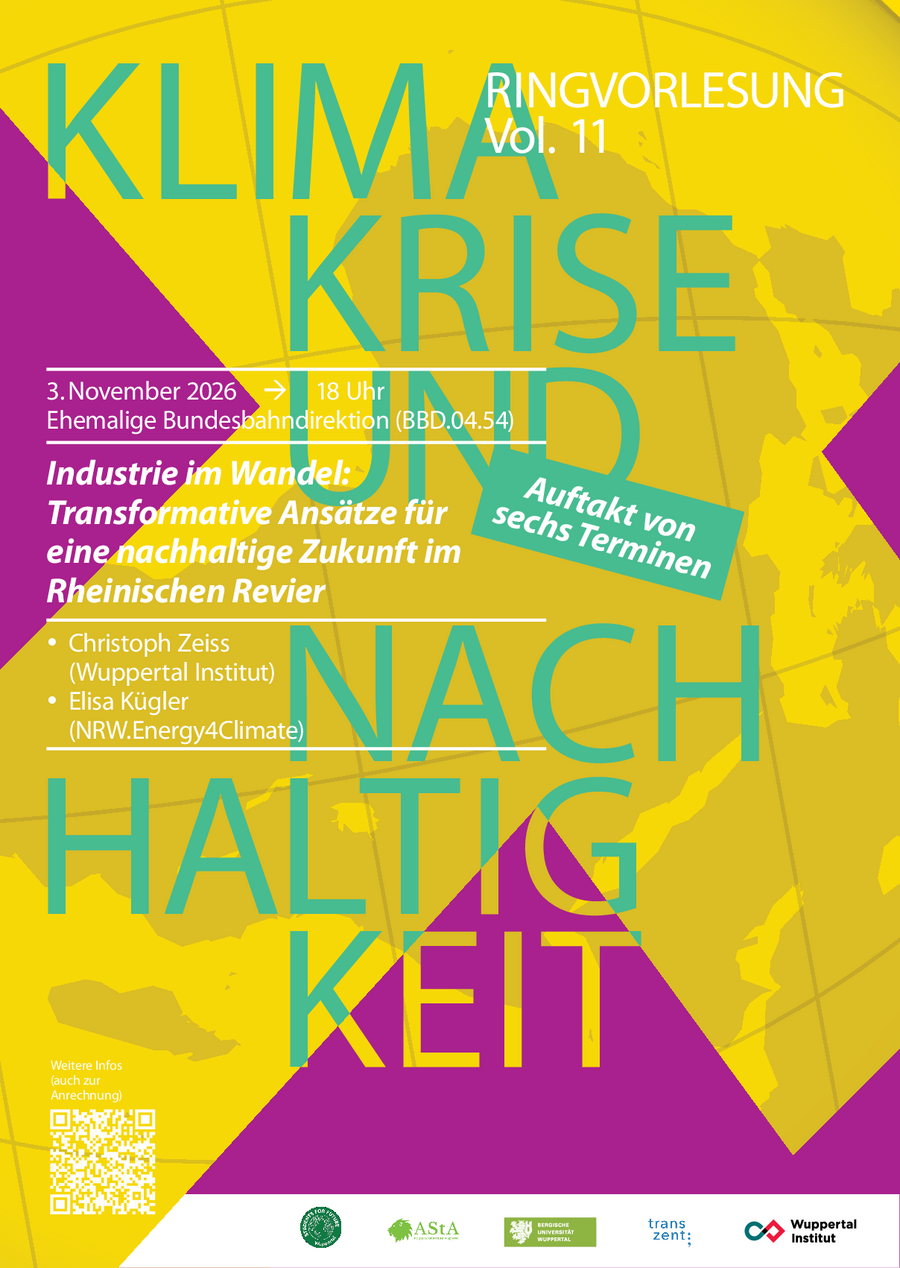
The lectures begin at 6 pm on Tuesdays. The launch event will take place at the former Federal Railways Headquarters (Döppersberg 41, 42103 Wuppertal, Room BBD.04.54); all subsequent sessions will be held online via Zoom at this link. Registration is not required for the online sessions. For the opening event, however, registration via the registration form is requested to aid planning.
Schedule
- 3 November 2026 – former Federal Railway Headquarters and online, 6.00 pm
‘Industry in Transition’ with Christoph Zeiss (Wuppertal Institute) and Elisa Kügler (NRW.Energy4Climate), venue: Döppersberg 41, 42103 Wuppertal, Room BBD.04.54 - 17 November 2026 – online, 6.00 pm
‘Sustainable Economic Management’ with Lisa Kolde (Wuppertal Institute) and Kristin Krebs (University of Wuppertal) - 1 December 2026 – online, 6.00 pm
“The future of carbon” with Christoph Zeiss (Wuppertal Institute) and Maximilian Witting (Ludwig Maximilian University of Munich) - 15 December 2026 – online, 6.00 pm
“Regional cooperation for the circular economy” with Jan Bitter-Krahe (Wuppertal Institute) - 12 January 2027 – online, 6.00 pm
“Energy infrastructures for tomorrow” with Maximilian Blum (Wuppertal Institute) and Jörg Radtke (Ingolstadt University of Technology) - 26 January 2027 – online, 6.00 pm
“Industrial value chains in transition” with Alexander Scholz (Wuppertal Institute) and Armin Paasch (Misereor)
Credit for the lecture series for BUW students
In the winter semester, too, the lecture series in the combinatorial Bachelor’s programme can be credited towards the ‘OPB307 Transformation and Sustainability’ module as part of the optional component. It is also possible to have the course recognised for the teacher training programme in the module ‘BIL305 Upbringing and Education’ (limited places; registration via Studilöwe required). If you have any questions regarding credit recognition, please contact transzent[at]uni-wuppertal.de by email.
* The rights to use the Colourbox image are held by the University of Wuppertal. It is not licensed for publication by third parties.