International cooperation
A new era in particle physics: Researchers from the University of Wuppertal are involved in an upgrade at CERN
Through the experiments at CERN, physicists aim to expand their understanding of what all matter in the universe is made of and what holds its individual building blocks together. They now have new opportunities to do so: in 2030, the ‘High-Luminosity LHC’ (HL-LHC) is set to begin operations as the successor to the current accelerator. Its increased capacity – also known as ‘luminosity’ in particle physics – will generate a dataset six times larger than the one currently available.
New detector technology is also coming from Wuppertal
In future, researchers expect up to 200 proton-proton collisions to occur simultaneously – 40 million times per second. To cope with this flood of data, the ATLAS detector must also be modernised and its core systems fundamentally redesigned. The detector at the LHC records the collisions and tracks of the elementary particles. Researchers search this data for clues to possible ‘new physics’.
The Wuppertal-based research group led by particle physicist and ATLAS Germany spokesperson Prof Dr Wolfgang Wagner is also playing a crucial role in the next generation of detector technology. Researchers and engineers at the University of Wuppertal are responsible for developing the readout electronics and the detector control system. This ensures that ATLAS can continue to collect data even under the extremely demanding conditions of the HL-LHC.
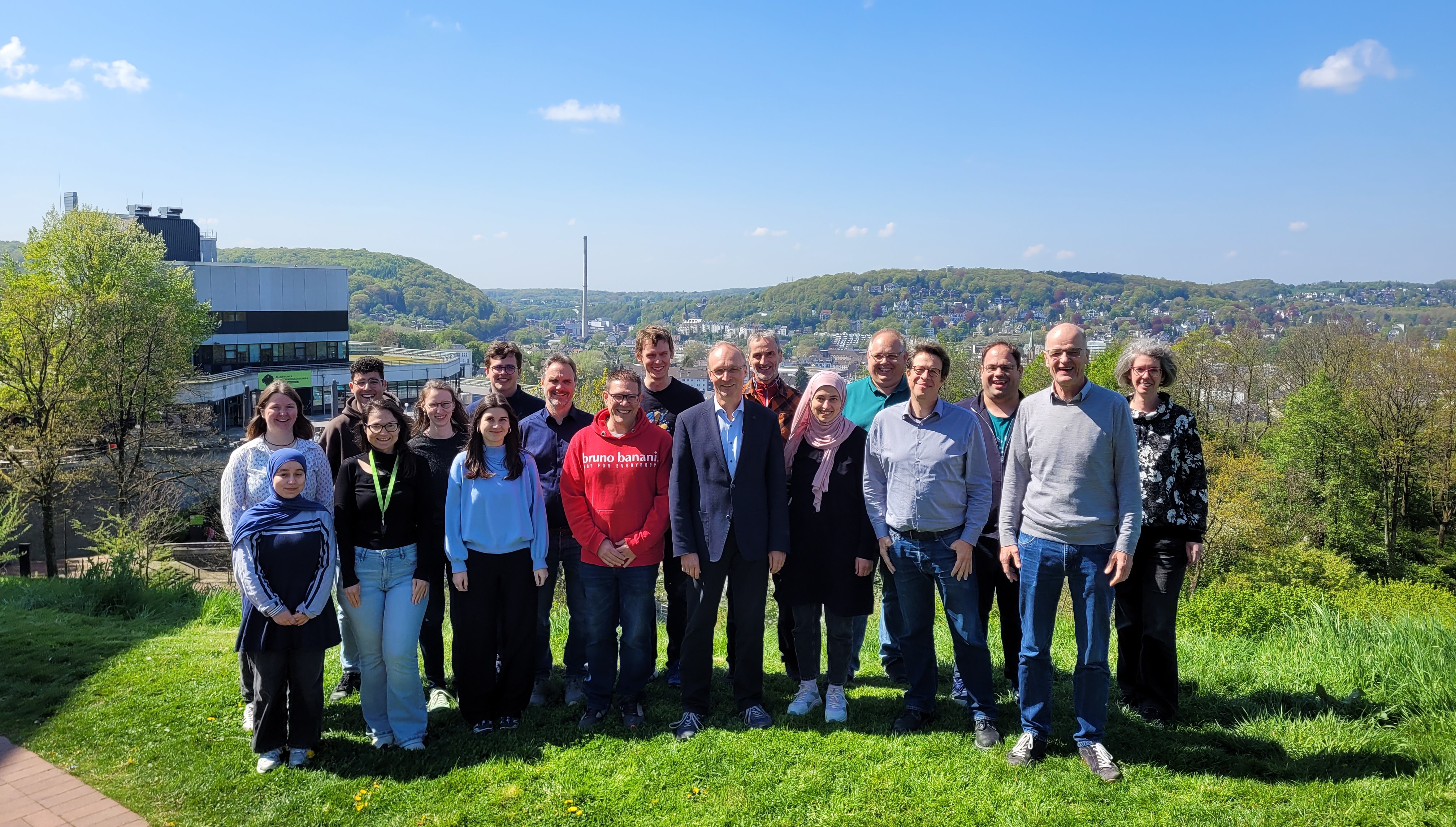
The Wuppertal Experimental Particle Physics Group, led by Professors Wolfgang Wagner (8th from the right) and Christian Zeitnitz (2nd from the right), is involved in leading experiments at the European research centre CERN. // Photo: Isabella Kappner
Being able to answer open questions
“The HL-LHC will shape particle physics for decades to come, and its preparation is one of the most ambitious scientific projects our collaboration has ever undertaken. This will enable us to push the boundaries of knowledge further, to probe the limits of our current theories and to seek answers to the questions they leave unresolved,” says ATLAS spokesperson Stéphane Willocq.
Benedetto Gorini, coordinator for the ATLAS upgrade, agrees: “This is an ambitious and extremely complex programme that requires the commitment of everyone involved across our entire collaboration, and thousands of ATLAS members worldwide have taken part in these activities.”
The equipment, which has been designed and tested at the individual ATLAS institutes, is currently being transported to CERN for installation.
Work continues unabated – quite the contrary
However, this massive effort surrounding the upgrade is only part of the story. Whilst the teams are retrofitting the experiment for the HL-LHC, the global physics collaboration is stepping up a gear to analyse the vast datasets collected at the LHC. Over the course of its operation, ATLAS has recorded more than 50,000 quadrillion proton-proton collisions – a figure with 16 zeros. Thanks to this wealth of data, the coming years will be among the most scientifically productive in the experiment’s history.
Here, too, there is no getting round Wuppertal’s expertise on the elementary particles known as the top quark and the W boson. According to current scientific understanding, these cannot be broken down into any smaller building blocks and are fundamental components of the so-called Standard Model of particle physics – in other words, the theory we know of to date. “We are on the cusp of an exciting phase in the history of particle physics,” sums up Professor Wagner. “Our analyses address some of the most fundamental questions of nature, in particular the search for hitherto hidden forces of nature that enable new forms of particle transformation and may also explain the asymmetry between matter and antimatter observed in the universe.”
Ready for ‘new physics’
Kerstin Tackmann, physics coordinator at ATLAS, explains: “The data collected form the basis for a comprehensive and diverse programme of physical analysis covering a broad spectrum of topics. The statistical significance of this data will enable us to put the Standard Model of particle physics through its paces as never before.”
The ATLAS collaboration is heading into the HL-LHC era with great confidence, confirms ATLAS spokesperson Willocq. “We know that our joint efforts have repeatedly led to significant scientific advances. The coming years will be marked by both extraordinary scientific discoveries and remarkable technical achievements.”
The University of Wuppertal has been part of ATLAS for more than 20 years
The ATLAS experiment is carried out by an international collaboration comprising 6,000 members from institutions around the world. More than 1,600 Master’s students and PhD candidates are involved in the experiment. Researchers from the university of Wuppertal have been contributing to the project for more than 20 years. Their main areas of focus are:
- The construction and operation of the Pixel detector – ATLAS’s innermost sub-detector
- The search for new physics
- Precision measurements and investigations in the field of top quark physics and the physics of heavy gauge bosons
- Leading various analysis groups
“The success of ATLAS is based on vibrant international collaboration,” emphasises Prof Dr Wolfgang Wagner. “We are proud of the crucial contributions our team has already made to the ATLAS scientific programme.”