Emmy Noether Programme
From Light and Data to Complex Molecules: Wuppertal Assistant Professor Seeks New Methods in Chemical Synthesis
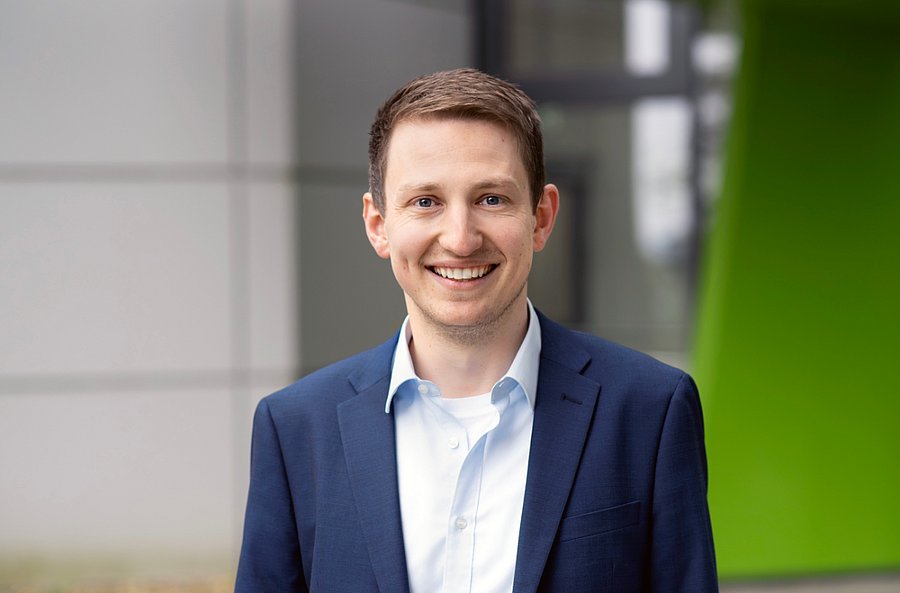
Assistant Professor Dr Felix Strieth-Kalthoff // photo Friederike von Heyden
The central idea behind Strieth-Kalthoff’s research is to build complex molecules from simple starting materials. Such molecules are relevant, for example, in parmaceuticals or advanced materials. His work aims to identify new synthetic pathways – that is, new ways of combining molecular building blocks to access target structures that are difficult to obtain with existing methods.
To achieve this, Strieth-Kalthoff uses light, including sunlight, together with photocatalysts to initiate the required chemical reactions. “These substances absorb light energy and transfer it to other molecules. This allows them to react more easily with each other, forming larger and more complex molecules”, he explains, describing a process that can lead to more cost-effective, sustainable, and safer chemical synthesis.
Machine learning bridges the gap between simulation and experiment
In this project, Strieth-Kalthoff focuses on iron-based photocatalysts. “These are inexpensive, green, non-toxic, and highly reactive, but so far we barely understand how exactly they work.” he says. To address this, he combines approaches from chemistry and computer science, including simulations, robotics, and machine learning. “To better understand the photocatalysts, we analyze large amounts of data from experiments and simulations. How do the catalysts behave in the laboratory, and how can these processes be described computationally? With the help of machine learning, we want to identify patterns in the data and use them to specifically develop new, high-performance photocatalysts.” In the long term, these design strategies are intended to become more broadly applicable and extend beyond iron photocatalysis.
With his research, Strieth-Kalthoff is laying the foundation for new approaches in chemical synthesis. These approaches could, in the future, support more targeted development of functional molecules, for example, new medicines like antibiotics and cancer therapeutics, environmentally compatible crop protection agents, materials for flexible displays, or particularly durable plastics.
The funding of €1.1 million over six years will allow Strieth-Kalthoff to expand his team, invest in experimental and computational infrastructure, and further develop the emerging interdisciplinary field of digital chemistry.
Professor Stefan Kirsch, Vice-Rector for Research and Digital Affairs, congratulates him and emphasizes: “This award for an up-and-coming young researcher highlights how attractive chemistry at BUW is in both research and teaching.”