Sustainable construction
Living Lab NRW inspires the student competition ‘Gateway Wuppertal – Creating something new from what already exists’ – TU Wien wins
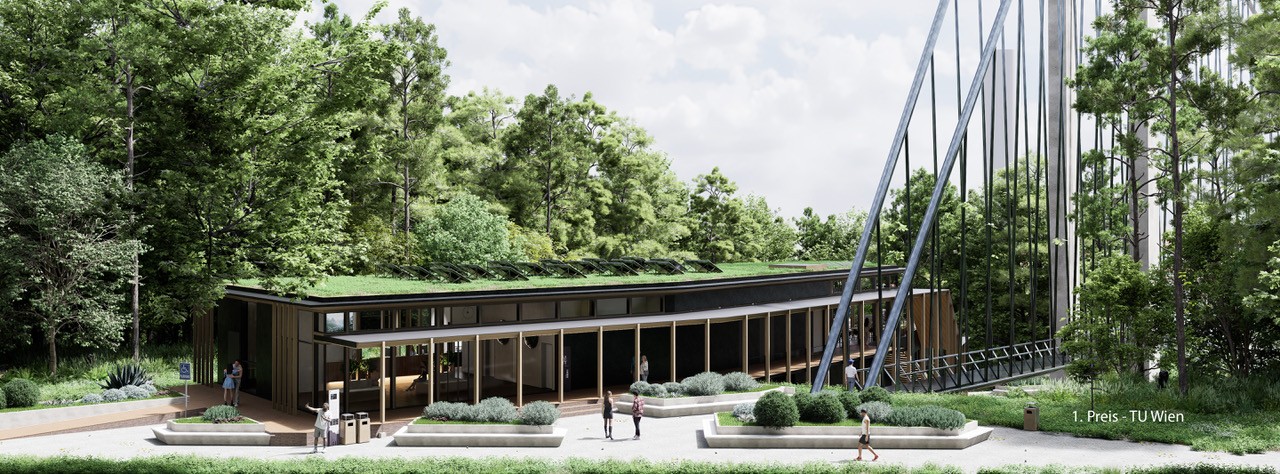
The team from TU Wien impressed the jury with their design “Building Gateways” // Graphic: TU Wien/Simon Berger, Elias Walder, Emanuel Aigner
For three years, the University of Wuppertal conducted research into climate-neutral and sustainable construction, using the buildings of the Living Lab NRW as a base. The project comes to an end this year – a fitting moment for the VDI to incorporate the Living Lab NRW into its competition, which took place for the fourteenth time this year.
The competition is aimed at students from various disciplines, who were able to submit designs as part of teams. Under the title ‘Gateway Wuppertal – Creating something new from what already exists’, the brief focused on the reuse of existing building components. The aim was to develop creative, resource-efficient and forward-looking solutions that would serve as inspiration for BUGA 2031 and Wuppertal’s sustainable development.
Living Lab NRW supported the competition teams by providing access to existing materials, research findings and expert guidance. The aim was to translate theoretical approaches from teaching and research directly into practice and to bridge the gap between academia and real-world application.
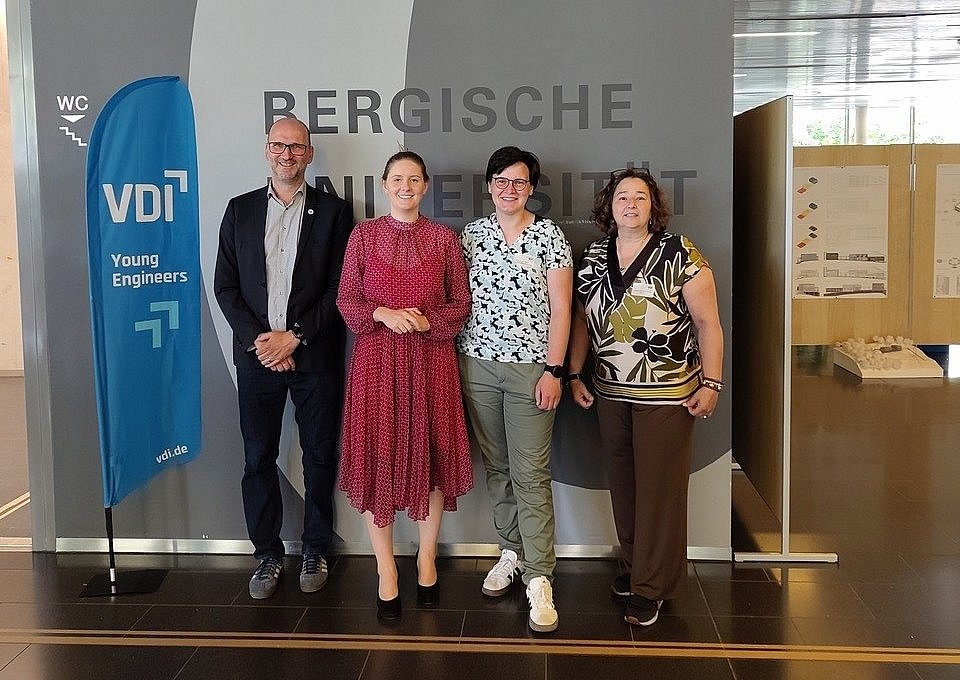
At the jury meeting, the competition team led by Frank Jansen (VDI, left), Dr Katharina Simon (BUW/Living Lab NRW, second from right) and Susanne Brambora-Schulz (BUGA 2031, right) Wuppertal’s Lord Mayor, Miriam Scherff. As a guest of honour, she congratulated the award-winning student teams. // Photo: VDI/Rouven Selge
Versatile and sustainable
The submitted designs take into account circular construction, family-friendliness and sustainable urban development. They also incorporated barrier-free access to the suspension bridge, visitor facilities and an apartment with a studio for artists in a natural setting on the Kiesberg. At their meeting in early July at the University of Wuppertal, a panel of experts – which included Living Lab project leader Dr Katharina Simon from the School of Architecture and Civil Engineering – selected the winners.
The team from the Vienna University of Technology impressed the jury with their holistic design approach. The idea: in terms of urban planning, the building blends sensitively into its surroundings and creates a strong connection between landscape, infrastructure and architecture. The jury particularly praised the clear way in which the building enhances the qualities of the site without imposing itself on the surroundings.
They also highlighted the fact that the team consistently took the high proportion of reused materials into account. “The existing resources are utilised convincingly in both design and construction and shape the identity of the project. This results in an appealing, distinctive architecture that exemplarily combines sustainability, functionality and design quality,” explains the jury.
Second prize goes to a team from the University of Stuttgart, whilst two third prizes also go to Stuttgart and to Aachen University of Applied Sciences.