
Honorary doctorate
“Football is a barometer of social change” – an interview with Manuel Neukirchner
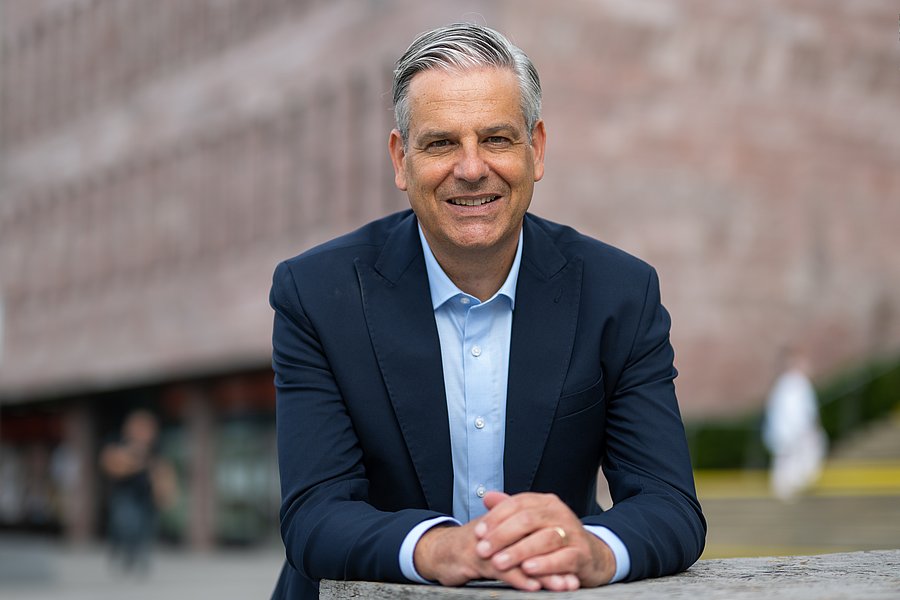
Manuel Neukirchner was awarded an honorary doctorate by the Faculty of Humanities and Cultural Studies. // Photo: German Football Museum
You yourself studied at the University of Wuppertal. What memories do you have of your time as a student?
At the time, I studied General Literary Studies, Modern German Literary History and History. It was an incredibly exciting and intense period of my life. It was particularly in the literary studies seminars that I laid an important foundation; I explored narrative structures. Unravelling how fictional stories work, how suspense can be created, how characters are developed – all of that fascinates me, and I learnt a great deal about it whilst at university. Whether I was providing live commentary as a football reporter on the radio, writing essays or features as a print journalist, crafting speeches as a speechwriter, or – as I do today – writing and curating books and exhibitions – my degree provided me with essential tools. I’d describe it as a universal education. Looking back, however, the general atmosphere back then is just as important to me. It was a wonderfully relaxed time – exactly as student life should be at its best. I had the space to try things out, broaden my horizons and simply look to the left and right along the way. I associate all of that with my years in Wuppertal.
What aspects of your degree still help you today in your work as Director of the German Football Museum? (Particularly given your specialisation in the humanities)
As a humanities scholar who wasn’t studying to become a teacher, you’re always asked: ‘And what are you going to do with that later on?’ Today I can answer that: an awful lot! A degree in the humanities always offers you a universal approach that broadens your horizons and opens up completely new perspectives. I’m still benefiting from that today, really.
When we’re designing a new exhibition, it’s never just a matter of putting a few exhibits in a display case. We explore interconnections; we aim to convey complex cultural-historical and social contexts within a highly engaging and consistently aesthetically sophisticated overall concept. Not losing sight of the bigger picture whilst still uncovering surprising, new and, ideally, previously unknown details – that’s what matters. And that’s how cultural studies works in the broadest sense, too.
What appealed to you about the task of telling the story of football in a museum?
There is only this one museum with a permanent exhibition on the history of German football and a constant stream of new, powerful special exhibitions on the phenomenon of football. Yes, we are one of a kind. To have the opportunity, as founding director, to conceive such an institution alongside outstanding intercultural experts, to plan it from the ground up – the exhibition, the architecture – to bring it to life and to lead it today – that is a deeply fulfilling task for me. The German Football Museum has now been in existence for 16 years, spanning its planning, construction and operational phases, which have challenged me to the very limit, precisely because there was – and still is – no blueprint for this institution. That is what makes the project so extraordinary for me.
What continually appeals to me in terms of content is the fascinating opportunity to build a bridge between sporting history and contemporary history. Football’s influence extends far beyond the chalk lines on the pitch and continues to unfold day by day. That is the key difference compared to other museums: at the German Football Museum, we never merely look back at a bygone era, but always convey the here and now as well. And there’s a third point that’s important to me – perhaps even the most important: right from the start, I was concerned with the way in which we present the content within the space. In some cases, we’re creating entirely new formats within the museum space that do justice to the changed perceptions of people today.
When we conceived the Football Museum in 2015, terms like ‘scenography’ and ‘immersion’ weren’t yet part of the cultural lexicon. But it was precisely this powerful, holistic spatial experience that we had already envisaged and created back then. It is part of our fundamental philosophy that we are not a dusty repository for objects that are no longer in use, but rather present ourselves as a highly emotional, engaging exhibition venue that inspires and moves visitors. The symbiosis of historical depth and avant-garde museum language – that is what drives me!
What can a football museum tell us about a society that goes beyond results, titles and records?
Our German Football Museum is, at its core, a museum about the state of our country. The New York Times wrote at our opening that we were a ‘museum about football – and about Germany’. That captures the essence of it: German football history is inextricably interwoven with our national history. The major tournaments and turning points reflect the development of our entire society.
Take Germany’s first World Cup title in 1954: the ‘Miracle of Bern’ was far more than a sporting triumph against the Hungarians, who seemed invincible at the time. In the collective consciousness, it marked the emotional birth of the young Federal Republic following the horrors of the Second World War – a moment when, after years of rubble and guilt, people were able to cautiously feel a sense of community once again for the first time.
Twenty years later, at the 1974 World Cup, the painful reality of the Cold War was reflected on the pitch. The legendary group stage match between West Germany and East Germany, which ended 0–1 thanks to Jürgen Sparwasser’s goal, was the sporting expression of a deep rift between the two German states.
When we went on to become world champions in Rome in 1990, the tournament was dominated by the theme of reunification. The Wall had already fallen, and formal reunification was imminent. Franz Beckenbauer’s solitary stroll across the pitch of Rome’s Olympic Stadium after the final whistle has become a collective memory of that era.
The often-cited ‘summer fairy tale’ of 2006, in turn, marked the first World Cup in a reunified Germany. It showed the world – and ourselves – a completely new, relaxed, open and hospitable Germany. And when we finally secured our fourth World Cup title in Rio in 2014, the team on the pitch was the perfect, living embodiment of our modern, immigrant-based society. A football museum thus demonstrates that the game is a barometer of social change. We tell stories of identity, of ruptures, of integration and of shifting values. Anyone who wants to understand what makes Germany tick can look at its football history.
What does the honorary doctorate from the Faculty of Humanities and Cultural Studies mean to you personally?
It fills me with immense gratitude! It is a great recognition and tribute to my work. It also makes it clear that football is no longer measured solely by a 1–0 scoreline. And that is precisely what I wanted – and still want – to achieve through my work: to portray football as part of cultural and social life.
For me, of course, the honorary doctorate also has a wonderful personal dimension. As a former student of the University of Wuppertal, it brings things full circle for me. When I received the certificate from the Vice-Chancellor, I couldn’t help but think of two outstanding professors at this university, who have sadly passed away: Dietrich Weber and Jürgen Born. Both were influential founding fathers of General Literary Studies in Wuppertal, and I was fortunate enough to have known them both.
With his work on narrative research, Dietrich Weber championed entirely new approaches that virtually defied the previously accepted narrative theory, which excluded the author as a person within the fictional text from acting as a narrative medium. That was fascinating! And Jürgen Born, as an internationally renowned Kafka scholar, made a lasting contribution to literary studies. His contributions to the historical-critical edition of Kafka’s works, the founding of the Research Centre for Prague German Literature, and his success in bringing Kafka’s private library to Wuppertal represent milestones for the University of Wuppertal. I am grateful that I was able to experience and get to know both of them during my time as a student!
What advice would you give to today’s students who do not yet know where their career path will lead?
My most important piece of advice is: don’t be afraid of a path that seems unclear. A degree – and particularly one in the humanities – is not a rigid vocational training programme that can only result in a single job title at the end. Don’t treat your time at university merely as a hunt for credit points, but as an intellectual playground for adventure. Try out different things, look to the left and right of the path, and trust that the pieces of your life’s puzzle will eventually fall into place. Approach your student years with curiosity; choose the topics that spark your passion, not just those that look good on your CV. Those who learn to approach problems in a structured way, to think critically and to be enthusiastic about a cause possess precisely the key skills that are sought after everywhere in our dynamic world of work. Have confidence in your abilities, maintain the necessary composure – and allow life to surprise you a little along the way.
Contact the Press Office
Katja Bischof
Editor
Telephone 0202/439-3722
Email bischof[at]uni-wuppertal.de


