Smart route planning
Research into safe routes to school: schools and local authorities are called upon to take part in the workshop
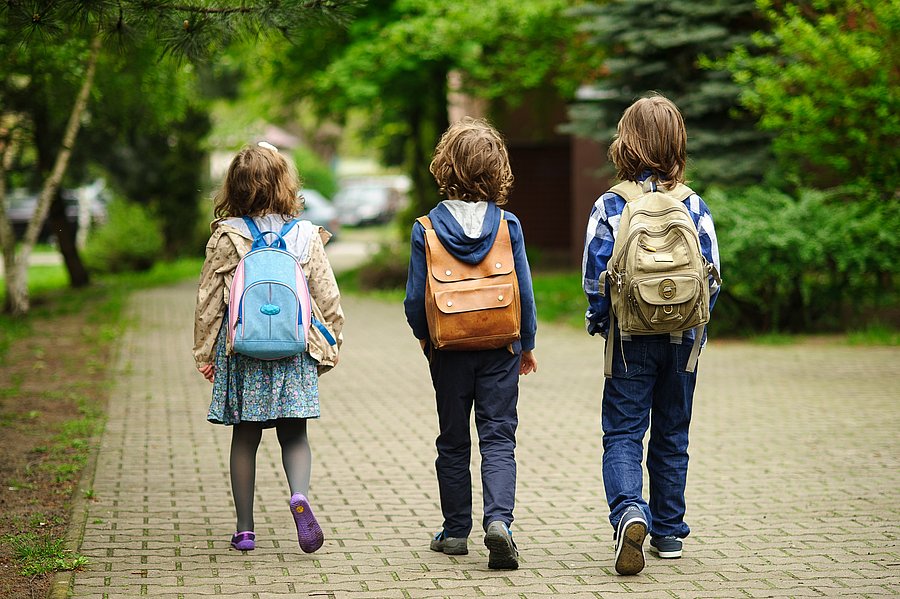
The SAFER research project aims to develop an intelligent route-planning system that takes into account not only the shortest route, but also safety considerations and the quality of the route. // Photo: Colourbox.de*
As part of the SAFER project, mathematicians at the University of Wuppertal are working on calculating routes that strike a good balance between the shortest and the safest routes. “We are currently developing and testing the algorithms underpinning these calculations and investigating which routes should be suggested,” explains Prof Dr Michael Stiglmayr from the Optimization Research Group.
This is because the web app – which is the project’s ultimate goal – is not intended to present every possible route in future. As is customary with today’s navigation apps, it is designed to offer a selection. “Ultimately, users should be able to choose from a handful of routes that are sufficiently varied, as safety needs also differ from person to person. The result should take into account criteria such as route length, duration and safety, and make these visible to users,” says Stiglmayr.
Schools and local authorities also benefit
The service benefits more than just parents and pupils. For schools, the project provides answers to important questions such as ‘Where are the safe routes so that we can promote them?’ and ‘Which routes are used, and how?’.
Using resident registration data, it is possible to predict which routes are particularly busy. This information can be usefully combined with the new calculation methods developed by the project. By assigning a corresponding risk level to different types of road crossings – such as traffic lights, zebra crossings or central islands – local authorities can, amongst other things, make informed assessments of how potential changes to the transport infrastructure might affect safety on the journey to school.
On Wednesday 23 September (10 am – 1 pm), the project partners are hosting an online workshop aimed at representatives from schools and local authorities. The aim is to discuss needs and exchange ideas for the remainder of the project. Keynote presentations by the project partners are also planned. Anyone interested in taking part can contact Michael Stiglmayr by email: stiglmayr[at]uni-wuppertal.de.
The SAFER project – Safe, Algorithm-based Pedestrian Routing – is funded with 590,000 euros by the State of North Rhine-Westphalia and the European Regional Development Fund as part of the NeueWege.IN.NRW innovation competition.
* The rights to use this image are held by the university of Wuppertal. It is not licensed for publication by third parties.