Particle physics
Breakthrough Prize honours muon research - decisive contribution from Wuppertal
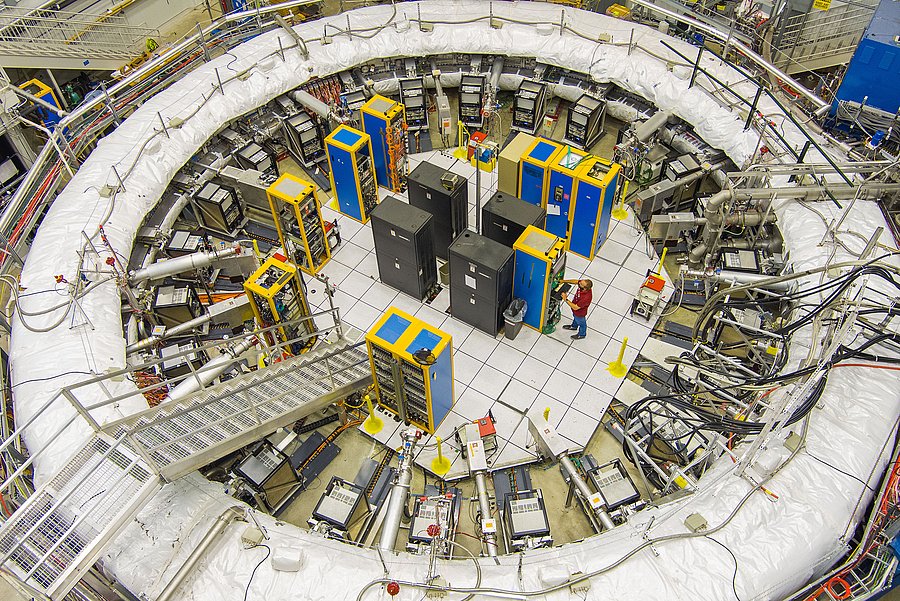
The central element of the "Muon g-2" experiment is the storage ring at the Fermi National Accelerator Laboratory (Fermilab) near Chicago (USA). // Photo Ryan Postel, Fermilab
For around 50 years, the so-called standard model of particle physics has been very successful in describing processes inside atoms. In the last 25 years, however, there has been a problem: one important quantity, the so-called anomalous magnetic moment of the muon (an elementary particle), did not agree in the calculations with very precise measurements. For decades, this discrepancy was interpreted as a signal of a new, undiscovered force. Hundreds of new theories and models were devised to answer this profound question, without success.
This contradiction was finally resolved. First by a new, very precise theoretical calculation of a particularly uncertain contribution (the so-called hadronic vacuum polarisation). Subsequently, new and increasingly precise experiments also confirmed this result.
Current article in the scientific journal Nature
The BMW collaboration, led by Wuppertal physicist Professor Zoltán Fodor, published this new theoretical calculation from 2021 in the journal Nature. The most important parameter was recalculated. The result was not only more accurate than before, but also eliminated the uncertainties of previous calculations. An even better calculation - led by the BUW - has now also been published in Nature. This calculation used a combination of theoretical calculations and experimental data, in the areas where they are most reliable. Improved simulations were also used, which enable more accurate results.
The Budapest-Marseille-Wuppertal (BMW) collaboration is an international research network in theoretical particle physics, more precisely in lattice QCD. Scientists from the University of Wuppertal (leading), the Eötvös Loránd University in Budapest and the Centre de Physique Théorique (CPT) in Marseille, among others, are involved.
Background
The Breakthrough Prizes are the most highly endowed prizes in the field of science. They are awarded annually for outstanding scientific achievements and are sponsored by the non-profit organisation Breakthrough Prize Foundation.
The Breakthrough Prize in Fundamental Physics honours researchers who have made fundamental contributions to theoretical or experimental fundamental physics. The research group working on the "Muon g-2" experiment is recognised above all for its perseverance in the search for answers to fundamental questions in physics and for the enormous precision of its experiments. The Wuppertal researchers, among others, made a decisive contribution to this scientific question and its final answer with their calculations.