
When steering cars became easier
Prof. Dr.-Ing Uwe Janoske / Fluid Mechanics
Photo: UniService Third Mission
When an invention made steering cars easier
Year100Knowledge-Interview with Prof Dr Uwe Janoske on the invention of power steering
The first power steering system was invented by Francis Davis in 1926. What made steering easier?
Uwe Janoske: Davis used hydraulic assistance to reduce the steering forces. He used a specially developed system to supplement the mechanical steering.
How does this hydraulic system work?
Uwe Janoske : Systems such as those used in hydraulic presses, which only built up pressure when required, showed many sealing and leakage problems. Davis therefore developed a special system that constantly pumped unpressurised oil and built up pressure when required, i.e. during steering movements, thus reducing the steering forces.
Technically speaking, the term power steering is not actually correct. Why not?
Uwe Janoske: In most steering systems, the hydraulics only serve as a support and supplement to the mechanical steering. Power steering based on purely hydraulic steering is usually only used in special applications (tractors, mobile cranes). That is why the term "power steering" is actually more appropriate.
Davis worked at General Motors after his invention. However, they refused to introduce power steering. Why?
Uwe Janoske: Davis worked intensively on the further development of power steering at General Motors. He worked on numerous details and refinements to increase the steering feel, so that the development was practically ready for series production in 1933. However, the planned quantities were so low due to the global economic crisis that the tooling and production costs were too high and GM rejected the idea of using it in series production.
It was not until 1951, 25 years after the invention, that Chrysler became the first car manufacturer to introduce auxiliary steering in the Chrysler Imperial. Why so late?
Uwe Janoske: Davis developed the system at the Bendix company from 1936, but its use in passenger cars was again delayed by the approaching Second World War. However, he was able to equip military vehicles with the system, but the breakthrough in the passenger car sector had to wait until 1951.
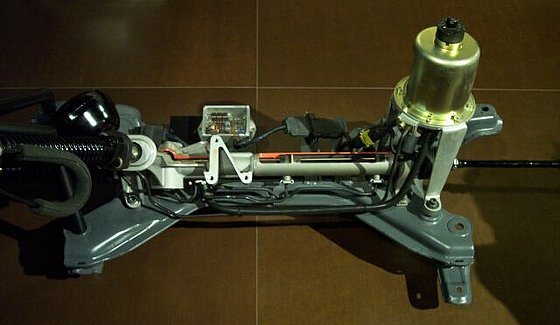
Electrohydraulic power steering
Photo: CC BY-SA 3.0
In 1952, General Motors presented its own auxiliary steering system based on Davis' research, but this was replaced a year later by the so-called Packard-Gemmer steering system from the Packard Motor Car Company. Why did this principle finally prevail?
Uwe Janoske: With the Davis solution, the steering aid was attached to the steering column, so that damage was possible, e.g. due to steering movements when stationary. With the Packard-Gemmer solution, this problem was avoided by mounting it on the chassis, so that the solution became established later on.
Now there is the electric drive, the electrohydraulic drive and the electromechanical drive for power steering. Since the 2000s, however, the electromechanical drive in passenger cars has replaced systems with hydraulic drives. Why is that?
Uwe Janoske: The electromechanical drive has the advantage that the hydraulic components, including the hydraulic oil, are no longer required. This means that leaks are completely avoided. The electromechanical drive supports the driver's steering movements and reduces the steering forces.
Today, the first car manufacturers are already using so-called steer-by-wire systems, in which the mechanical connection between the steering wheel and wheels is completely eliminated; the steering commands are transmitted electronically and implemented electrically. This makes even more safety functions possible - including autonomous driving. Is that the future?
Uwe Janoske: The first systems will go into series production in 2026. Direct control will open up new possibilities for autonomous driving and the elimination of the steering column will also open up new vehicle design options, meaning that further systems will follow in the future.
Uwe Blass
Prof Dr Uwe Janoske is Head of the Chair of Fluid Mechanics in the School of Mechanical Engineering and Safety Engineering at the University of Wuppertal.