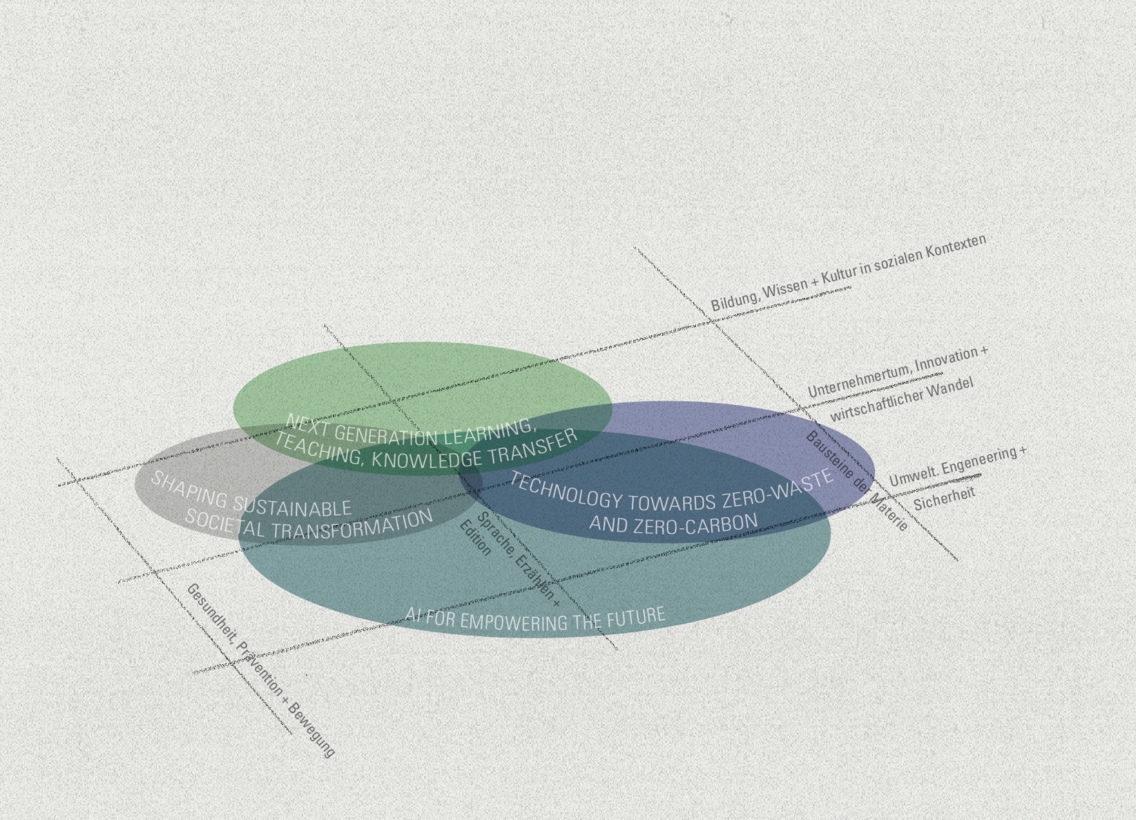
Research Areas at the University of Wuppertal
Through its research areas, the BUW has created a framework for addressing questions about shaping the future in the face of global challenges and enabling an interdisciplinary approach. The research areas create spaces for communication and networking. They bring together the disciplinary strengths of the faculties and their researchers in a unique way and thus form the breeding ground for the development of new ideas for interdisciplinary centres and externally funded projects and initiatives.
Technology Towards Zero-Waste and Zero-Carbon (TEC2ZERO)
The TEC2ZERO field of activity works on the design of future technologies that increase energy efficiency, rethink mobility solutions and focus on the responsible use of critical raw materials - including the assessment of possible toxicological and ecological effects.
This approach combines economics, management and education: from sustainable product design and efficient implementation strategies to lifelong learning and clear communication that successfully supports change processes.
In the area of material flow, the focus is on comprehensive life cycle analyses, the use of waste as a resource, urban mining and the recovery of secondary raw materials. Through intelligent supply chain management, we create transparent, circular value chains.
Together, we aim to develop solutions that combine ecological responsibility, economic efficiency and technological innovation.
Next Generation Learning, Teaching, Knowledge Transfer (NextGen)
With the NextGen field of activity, the University of Wuppertal bundles its diverse activities relating to future-oriented learning and positions itself as a designer of innovative forms of teaching, learning and knowledge transfer - from kindergarten and school to university and professional practice.
NextGen makes existing competences and projects of the BUW visible, connects stakeholders from different research disciplines and opens up spaces for creative ideas and joint developments. We explore the question of what "Next Generation Learning, Teaching, Knowledge Transfer" can look like across disciplines. The focus is on the vision of actively shaping innovative teaching, learning and knowledge transfer and providing impetus for sustainable, networked, digital and diversity-sensitive learning - in order to rethink education in a future-oriented way.
Shaping Sustainable Societal Transformation (Shape)
The central aim of this field is not only to analyse social change, but to actively help shape it: It is about how societies - locally and globally - can be moved towards sustainability, taking into account ecological, social, economic, technical and cultural dimensions.
In the coming years, it will also be a matter of making societies more resilient - to the climate crisis, scarcity of resources, digitalisation, demographic change...
Universities have a key role to play: not only as providers of knowledge, but also as agents of transformation.
Participatory formats, e.g. co-design with citizens, living labs and art interventions are becoming increasingly important.
Against this backdrop, this field of activity opens up innovative approaches to key questions about the future:
- How do we want to live?
- What ideas of socio-ecologically sustainable prosperity do we have?
- What kind of society do we want to be?
- And: How do we get there?

Artificial Intelligence for Empowering the Future (AI4EF)
Through the initiative Artificial Intelligence for Empowering the Future (AI4EF), the University of Wuppertal is coordinating its multidisciplinary activities related to artificial intelligence, positioning itself as a leading force in designing a human-centered digital future. AI4EF makes existing expertise visible, connects stakeholders from research, teaching, administration and transfer and creates spaces for new ideas and joint developments.
The focus is on the vision of a responsible and sustainable use of AI - as a tool that empowers people, improves processes and creates added value for society. The mission: to provide impetus, strengthen structures and promote interdisciplinary collaboration. AI4EF pursues clear goals and a long-term strategy to not only research AI at BUW, but to actively help shape it.