Event in the CityKirche
Discovering the wonders of physics in everyday life at university
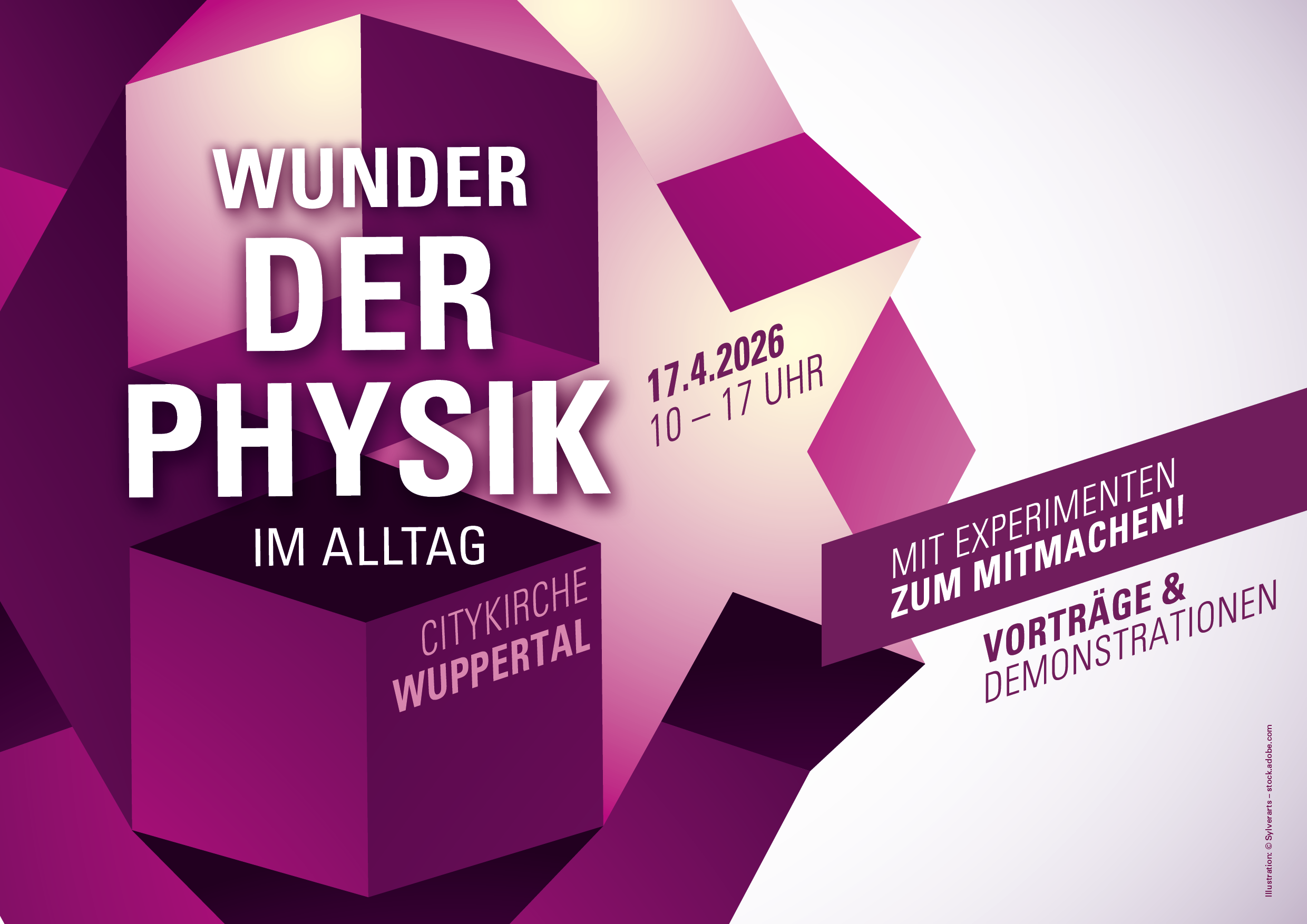
Graphics University of Wuppertal / Illustration: Sylverarts - stock.adobe.com
"Physics is so much more than a school subject that few people like to think about. Physics is exciting and versatile, it surrounds us around the clock and does something to all of us. At CityKirche, we want to take away any fears of contact and show guests where our research can be found in their lives," explains organiser Professor Christian Hölbling from the Physics department.
Anyone who can't get enough of this can also find out about studying physics at the University of Wuppertal. "Of course, we will also be available to answer any questions on this topic at the Day of Physics," says Christian Hölbling.
Link to the event website: uni-w.de/6pnzo
In two lecture blocks, scientists from the University of Wuppertal will present exciting insights into current topics in physics - from planetary climate issues, the formation of the elements and the discovery of X-rays to modern superconductivity and particle physics.
The programme is complemented by vivid demonstrations and exhibits. Numerous everyday examples will also be discussed. Questions are always welcome.
Superconductors, for example, are needed to conduct electricity with absolutely no loss. Why they can also float and what this is good for is shown in the CityKirche. Just like a cloud chamber for visualising cosmic particles and a model of a specific particle accelerator in which particles are accelerated to almost the speed of light so that they collide. Why is this being done? This is the only way for researchers to learn more about the structure of matter and the fundamental forces of the universe, without which our everyday life as we know it would be inconceivable.
Date: 17 April, 10 a.m. to 5 p.m., Physics Day, CityKirche Wuppertal.