Change of office
Prof. Dr Rita Casale elected as new Vice-Rector for Sustainable Organisational Development and Diversity
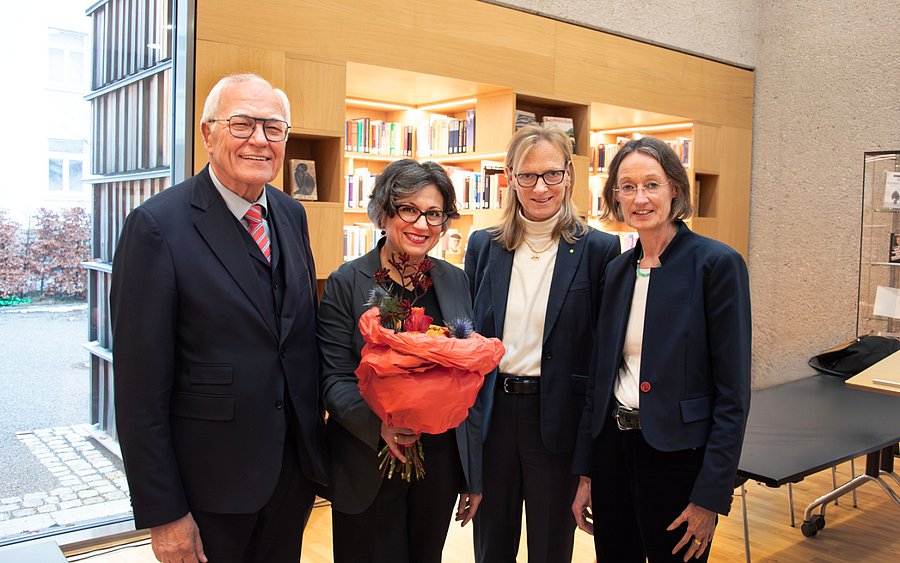
Congratulating Prof Casale on her new position (from left to right): University Council Chairman Dr Josef Beutelmann, Prof Dr Rita Casale, Rector Prof Dr Birgitta Wolff and Vice-Rector Prof Dr Gertrud Oelerich // Photo Friederike von Heyden
"Sustainable organisational development and diversity are among the strategically central topics of our university," emphasises Prof. Dr Birgitta Wolff, Rector of the University of Wuppertal. "It is great that we have been able to recruit Rita Casale, an outstanding, academically well-connected and highly committed colleague who will shape these topics with a high level of professionalism and vision."
Expertise and many years of commitment
Prof Dr Casale has been active in academic self-administration and university-wide committees for many years. As a member of the University Council (since 2020), she has been closely involved in strategic university development issues and is very familiar with the current challenges. She has also played a key role in various cross-faculty initiatives on sustainability and social transformation - including in the Interdisciplinary Centre for Transformation Research and Sustainability (transzent) and in corresponding working groups.
In research and teaching, Casale focuses on the philosophy of education, the history and theory of educational science, gender studies and the scientific reflection of educational processes. She contributes extensive expertise, particularly in the areas of sustainability-related teaching, curricular development and cooperation between different disciplines. She also works on issues of diversity, educational fairness and feminist criticism of educational practices.
Rector Wolff is also pleased about the special joy of communication with the entire university community that the new vice-rector brings to the office: "Prof Dr Casale combines analytical acuity with great experience in moderating, mediating and participatory work - this is exactly what we need in a department that is aimed at all status groups across the university. She will enrich our team professionally, strategically and personally."
Casale also has a proven track record in university diversity work - for example as a deputy member of the anti-discrimination committee and as part of her research into the social conditions of education and participation. Together with students, she has organised several events, conferences and panel discussions on transformation processes, migration, integration and sustainability in recent years.
The Rectorate team, which includes Chancellor Dr Ursula Löffler, Vice-Rector Prof Dr Susanne Buch (Studies and Teaching), Vice-Rector Prof Dr Stefan Kirsch (Research and Digital Affairs) and Vice-Rector Prof Dr Peter Gust (Third Mission and International Affairs), also expressly welcomes the election. With Casale, the team will continue to be broadly based in terms of expertise and at the same time continue to have a significantly above-average proportion of women. And now also internationally.
The goals of the new vice-rector
She has a number of plans for her term of office: Firstly, the 57-year-old wants to develop a comprehensive sustainability concept that systematically combines ecological, social and economic dimensions. She is particularly keen to emphasise the contributions of the humanities, cultural and social sciences even more strongly as an integral part of the university's sustainability profile.
In the long term, Casale plans to provide impetus for the development of transdisciplinary degree programmes and new interdisciplinary research networks, e.g. on "Sustainability and Urban Transformation" - in close cooperation with stakeholders from culture, business and civil society in the Bergisch city-triangle. It would also like to further expand the research profile of equality, diversity and inclusion, for example by supporting stronger cross-faculty networking. The aim is also to further increase the number of female doctoral candidates and promote excellent female academics. In the field of inclusion, it is pursuing the expansion of interdisciplinary research on inequality and the further implementation of existing inclusion agreements. In addition to the structural progress already achieved, the anti-discrimination guideline and the work of the advice centre are to be further anchored in everyday university life.
About the person
Rita Casale studied philosophy and history in Bari, Italy, in Paris and Freiburg im Breisgau. In 1997, she received her doctorate from the Collegio di Dottorato "Filosofia moderna e contemporanea" (Bari-Ferrara-Urbino). After working as a research assistant in the Department of Education at the Johann Wolfgang Goethe University in Frankfurt am Main (2001), she was a senior assistant at the Chair of General Education at the University of Zurich under Prof Jürgen Oelkers from 2002 to 2007. This was followed by a visiting professorship at the Institute for Educational Science at the University of Vienna (2006) and a deputy professorship for General Educational Science at the University of Fribourg (Switzerland) in 2008.
Since 2009, she has been a professor of general educational science/theory of education at the University of Wuppertal and was a fellow in the Cluster of Excellence "Cultural Foundations of Integration" at the University of Konstanz's Centre for Advanced Study in the Humanities in the summer semester of 2011.
Casale is the author of the book Heidegger's Nietzsche. Geschichte einer Obsession (2010). She has published numerous works on the philosophy of education, pedagogical historiography, feminist theory and history as well as diverse contributions on political and pedagogical thinking in modernity and contemporary philosophy (phenomenology and post-structuralism). She is currently working on a history of the concept of education after 1945.