First printed crossword puzzle
Dr Katarina Colomo / Linguistics
Photo: UniService Third Mission
The mental change of scenery
Linguist Katarina Colomo on crossword puzzles, which were first printed in Germany 100 years ago
100 years ago, the first crossword puzzle was printed in Germany in the Berliner Illustrirten (BIZ). Experts say that these language-based puzzles consolidate vocabulary. Is that true?
Katarina Colomo: Any active engagement with new words helps if you want to consolidate the words. When solving crossword puzzles, the word must be actively recalled from the vocabulary, so it is not enough to simply recognise it. That's why crossword puzzles can actually be used for vocabulary training, yes.
There are simple puzzles, but also difficult ones that make greater demands on general knowledge. An example of this would be the Zeit puzzle, which is very popular in Germany under the title 'Um die Ecke gedacht' ('Thinking outside the box'). How does that work?
Katarina Colomo : The main reason why "Um die Ecke gedacht" is so difficult is that the clues are so hard to interpret. They cannot be interpreted literally. You have to be very flexible, call up lots of associations, think on several levels and be creative - in other words, "think outside the box". The clues contain relevant ambiguities, secondary meanings, play with idioms or linguistic form. At first, the scope for solutions seems huge and you don't even know which way to think. In retrospect, the right answer is not necessarily difficult.
The meaning of words and their relationships to each other is crucial for solving crossword puzzles. Players often have to find synonyms, antonyms or related terms. Can crossword puzzles also be used in teaching?
Katarina Colomo: Of course! Puzzles can be used to reinforce specialised vocabulary in a fun way. There are also some studies that prove this. When reading, it is often enough if the specialised vocabulary is passively present. To be able to solve a crossword puzzle, however, this is no longer enough: the terms not only have to be actively recalled, they also have to be linked. In the classic crossword puzzle, the clue is usually a synonym, a definition or sometimes even an antonym (i.e. an opposing word). The words are therefore also semantically linked, reference is made to existing knowledge, and this makes didactic sense.
We use the e-learning platform Moodle here. It is relatively easy to integrate crossword puzzles into Moodle with the help of H5P.
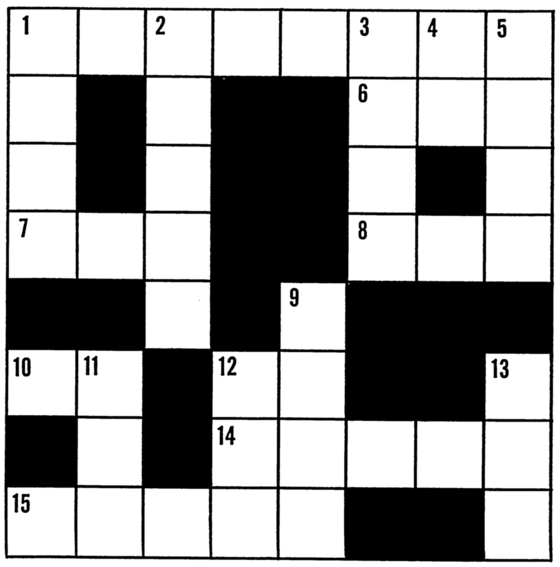
Simple crossword puzzle with black pictures
Photo: public domain
Even language learning can be supported by crossword puzzles, right?
Katarina Colomo: Yes! It doesn't really matter whether subject-specific vocabulary is being practised or vocabulary from a foreign language. In addition to the effects just mentioned, correct spelling also plays an important role. The crossword puzzle is not just about the meaning, but also about the correct form. In addition to the descriptive clue, there are also formal clues, namely the word length, which is determined by the number of boxes, and the letters that have already been found. Firstly, you have to find exactly the right word, a synonym is not enough: DENTIST or DENTIST? APFELSINE or ORANGE? CHAIR, LIFT or ELEVATOR? In the end, only one fits into the grid. The spelling must also be correct; if there is a spelling mistake, the word will no longer fit. Attention is therefore also drawn to the correct spelling. Crossword puzzles therefore also have a place in the teaching of spelling, and not just in foreign languages.
Speaking of spelling: you can write ORTHOGRAPHY with <ph> or <f>, but only one of the two variants will ever fit in a crossword puzzle. There is generally no formal variation in crosswords.
Originally, crossword puzzles were created by hand, with the grid being designed first. Today, software is used. According to a survey conducted in 2024, the statista portal says: "In 2024, there were around 8.95 million people in the German-speaking population aged 14 and over who frequently solved puzzles in their free time." What attracts people to these puzzles?
Katarina Colomo: I believe that several aspects come together. Firstly, we have to concentrate to solve a puzzle. This distracts us from everyday life - and a mental change of scenery is good for us. Secondly, they can always be solved! It simply feels good to master a challenge. But the puzzles shouldn't be too difficult or too easy. Fortunately, there is so much on offer that everyone can find the right level. This was the case even before the internet: Crossword constructors design puzzles to suit different target groups. Children's magazines require a different vocabulary and different solution strategies than magazines, and the puzzle in a daily newspaper is usually easier than the one in DIE ZEIT.
Another nice thing about puzzles is that you can solve them alone or together. They can therefore also have a social component - but you don't have to rely on someone else playing along.
There are now even crossword encyclopaedias with more than 300,000 questions and answers.
Do you know the four-letter term for 'great' in the youth language?
Katarina Colomo: I can think of three. If it's asked anywhere today, it's probably MEGA. It could also be GEIL or COOL. That's what my daughter would say today. Funnily enough, those are also the words we used as teenagers in the 80s/90s. MEGA is probably already outdated again. Youth language has a short half-life! By the time a youth language term is well-known enough to appear in a crossword puzzle, it's usually already outdated again. But we know this and take it into account when we solve crosswords.
In 1985, after four years of preparatory work, Charles Cilard presented the world's largest crossword puzzle to date. It was 870 metres long, 30 cm wide and had 2,610,000 squares. When did you solve your last crossword puzzle?
Katarina Colomo: In the summer, when our neighbours redirected their newspaper subscription to us - but only once or twice. I like looking for matching words, but the usual crossword puzzles also assume a lot of knowledge that I'm not particularly interested in, for example about famous people or geography. That quickly becomes too boring for me. I prefer to solve Sudokus.
Uwe Blass
Linguist Dr Katarina Colomo works as a senior academic advisor in German Studies in the school of humanities and cultural sciences at the University of Wuppertal.