"PeroSat" research project
From underground to space - Sustainable energy supply for satellites from the former mining region NRW
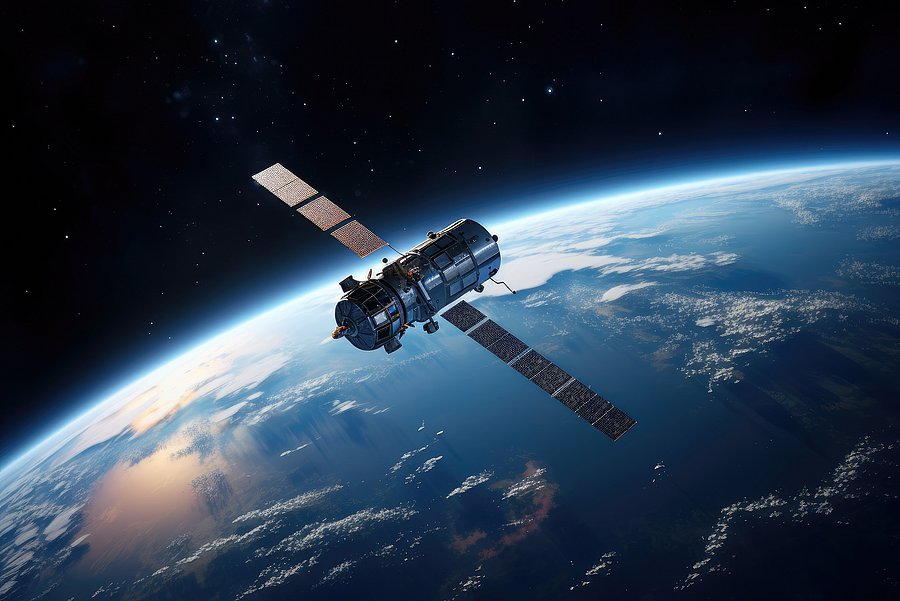
The research team wants to equip satellites with innovative technology from NRW in future // Photo Lubos Chlubny - stock.adobe.com
Classic solar cells for space travel are predominantly made of gallium arsenide. Although this technology is powerful, it is also heavy, expensive and extremely resource-intensive to manufacture. In addition, gallium arsenide cells are based on critical raw materials, which means that they are strategically dependent on individual manufacturing countries such as China. This is where "PeroSat" comes in: By developing ultra-light, flexible and sustainable perovskite solar cells, the researchers want to revolutionise the energy supply of satellites in space travel, i.e. make it more efficient, more environmentally friendly and independent of critical raw materials.
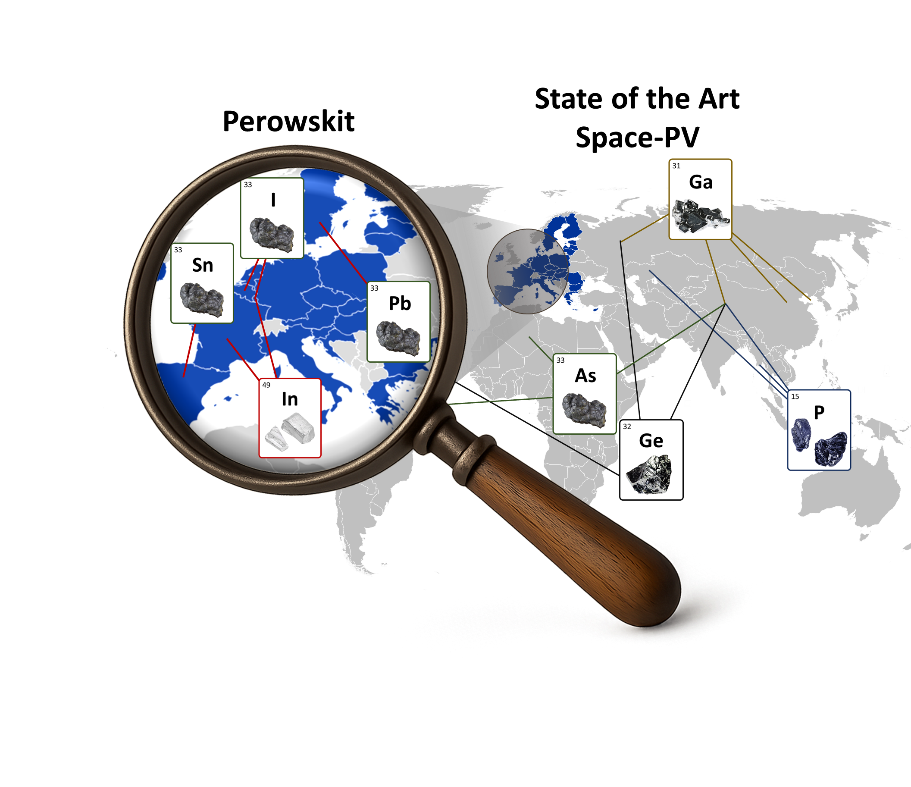
Regions of origin for critical raw materials: perovskite solar cells vs. state of the art // Graphic: Chair of Electronic Components
Click on the graphic: Larger version
Changing the energy supply of satellites sustainably
Coordinated by the Wuppertal research team led by Dr Kai Oliver Brinkmann and Prof Dr Thomas Riedl from the Chair of Electronic Components and the Wuppertal Center for Smart Materials & Systems (CM@S), an interdisciplinary consortium from science and industry is working on innovative solar cell structures. These are to be realised on flexible, shape-memory-capable substrates that can be folded up to save space for the rocket launch and are only unfolded in orbit - a technology with the potential to change the energy supply of satellites in the long term.
"With 'PeroSat', we want to show that sustainability, high-tech and strategic independence belong together in space just as they do on Earth, " says Dr Kai Brinkmann. Prof Riedl adds the strategic dimension of the new project: "Perovskite solar cells have the potential not only to make a sustainable contribution to terrestrial energy supply, but also to strengthen the strategic pioneering role of NRW as a centre of innovation in the field of space technologies."
Strong alliance of research and industry
The project combines the expertise of leading partners from research and industry under the coordination of the university of Wuppertal: BUW is responsible for the development and stabilisation of the perovskite solar cells, while Kunstoffverarbeitung Hoffmann GmbH is contributing its expertise in plastics processing and shape memory structures. NTTF Coatings GmbH is providing protective barrier coatings, Novellop Technologies GmbH is responsible for integration and prototype development, and the University of Potsdam is validating the cells under realistic space conditions. Together, the group aims to create the basis for a new generation of sustainable, low-cost and lightweight energy systems for space.
Funding information
The "PeroSat - Perovskite solar cells for satellite applications" project is being funded by the European Union (ERDF) and the state of North Rhine-Westphalia as part of the GreenEconomy.IN.NRW funding programme.