Atmospheric research
NASA selects AtmOCube: University of Wuppertal involved in new mission
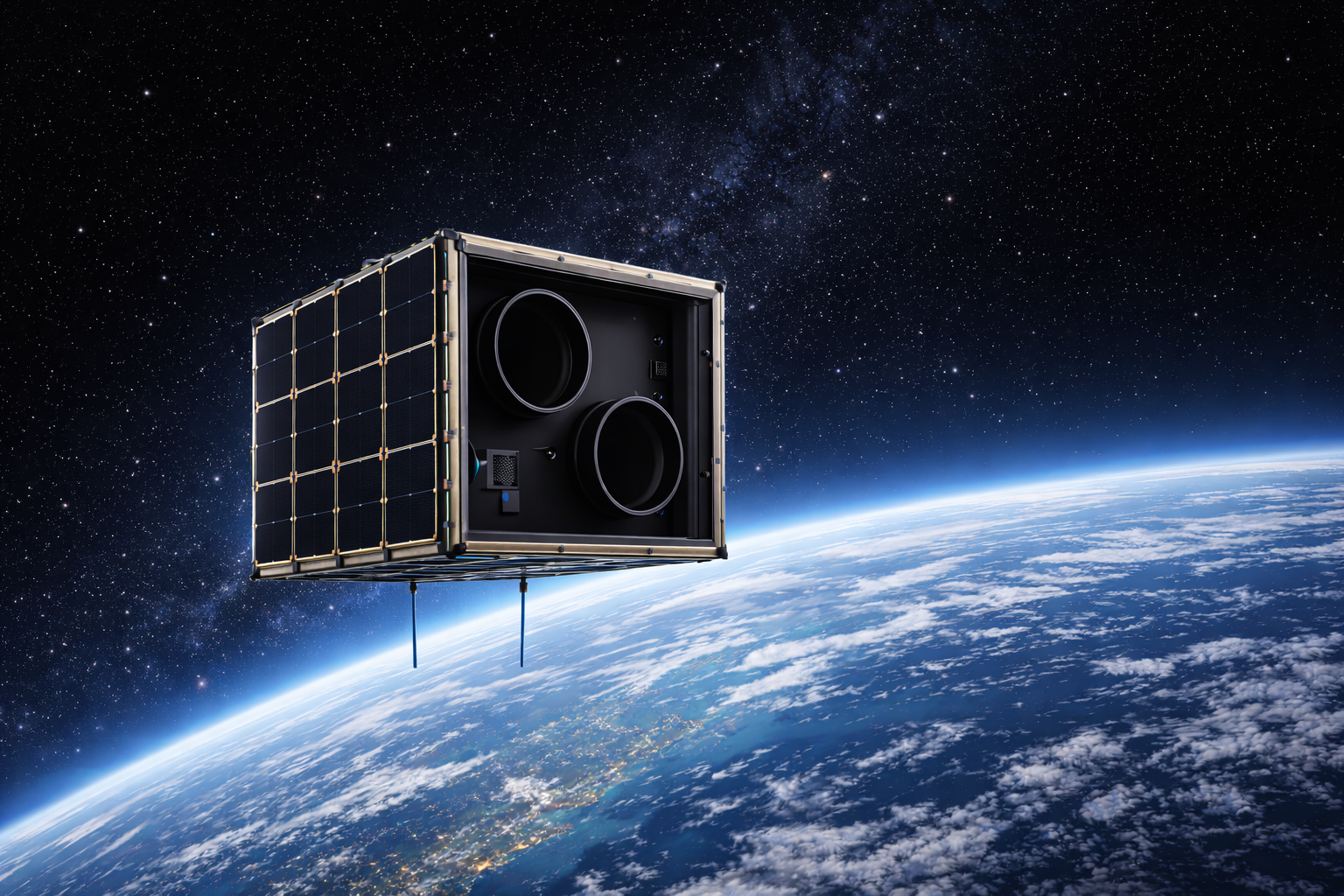
AI-generated visualisation of a 16U CubeSat with AtmOCube payload: AtmOCube uses a so-called 16U CubeSat as a platform for the optical payload. For the mission, the small satellite is launched into space at an altitude of around 500 kilometres // Photo Martin Kaufmann, source ChatGPT/OpenAI
The University of Wuppertal is participating in the AtmOCube mission together with Forschungszentrum Jülich and partners from the University of Colorado. The university is thus expanding its existing profile in atmospheric research - airborne measurement campaigns and laboratory studies as well as instrument development - to include a space-based view of the middle and upper atmosphere.
Together with colleagues from Forschungszentrum Jülich, atmospheric physicists from the University of Wuppertal are working on the optical payload of a small satellite that is to be launched into space at an altitude of around 500 kilometres as part of the AtmoCube mission. The optical payload is the centrepiece of the satellite, which measures the natural infrared radiation in the atmosphere. The university is contributing its experience in instrument development, laboratory analysis and data evaluation.
Why AtmOCube is important
The ionosphere is an area of the upper atmosphere above an altitude of around 80 kilometres where sunlight converts part of the air into electrically charged particles. It is closely coupled with the largely neutral atmosphere below and is influenced by processes that act upwards from there. Disturbances in this system can affect satellite orbits and impair the transmission of communication and navigation signals (GPS). A key driver for these disturbances are so-called atmospheric gravity waves, which are generated in the lower atmosphere and transport energy and momentum up to high altitudes.
"The selection by NASA is a big step for our team and our partners. AtmOCube combines innovative measurement technology with clear social relevance: We want to better understand how processes in the atmosphere influence near-Earth space," says Prof Dr Michaela I. Hegglin Shepherd. The atmospheric physicist from the University of Wuppertal and Director at the FZJ Institute of Climate and Energy Systems is responsible for the project. "On the one hand, the scientific data helps us to make predictions for future satellite operations more reliable. On the other hand, climate change also plays a role. As the lower atmosphere warms, weather and circulation patterns change - effects that can continue into near-Earth space via waves and cause disturbances there," explains Dr Martin Kaufmann, project manager for AtmOCube and coordinator of the AtmoLab laboratory network, in which the University of Wuppertal and Forschungszentrum Jülich are pooling their cooperation at the Wuppertal site. AtmOCube is the highlight of this joint development to date.
Looking into the atmosphere
"Once in the atmosphere, the satellite looks in the opposite direction to its flight direction and with a slightly downward inclined beam of vision along the altitude layers to be observed. This enables a particularly good altitude resolution of the data," says Kaufmann.
AtmOCube uses its instruments to observe the natural infrared radiation of oxygen in the atmosphere. Temperature profiles are obtained from the collected data. This in turn allows the properties of the gravity waves to be derived - such as their propagation and spatial structure - as well as insights into their energy and momentum flows. These are crucial for determining how strongly gravity waves influence air currents at high altitudes and can trigger wave-like disturbances right into the upper atmosphere and ionosphere.
From CRISTA to AtmOCube
AtmOCube builds on BUW's earlier successes: from the CRISTA space experiments to the renewed collaboration with the Jülich Research Centre in this field around ten years ago. Since then, several rocket and satellite projects have been jointly realised, with the active involvement of students.
The selection marks the start of a six-month concept and planning phase for AtmOCube. During this time, mission details and requirements are further concretised and feedback from the assessment is incorporated. The final stage is an evaluation, on the basis of which NASA approves the next funding and implementation phase.
AtmOCube in brief
- Mission: Atmospheric Oxygen CubeSat Mission (AtmOCube)
- Programme: NASA H-FORT (Heliophysics Flight Opportunities for Research and Technology)
- Goal: Better understanding of the dynamics of the upper atmosphere and ionosphere; more reliable prediction of future effects on satellite operations, communication and navigation
- Measurement principle: Observation of O₂ emissions in limb geometry
- Optical payload: Two compact spatial heterodyne interferometers
- BUW contributions: Measurement principle (developed jointly with Jülich), student participation, long-term data and established evaluation methods, construction and calibration of the instruments within the framework of AtmoLab
- Partners: University of Wuppertal, Jülich Research Centre, University of Colorado Boulder (LASP)
- Planned launch: 2029 (subject to mission planning and launch opportunity)