Astroparticle physics: Nature publication
KATRIN tightens the net around the elusive sterile neutrino
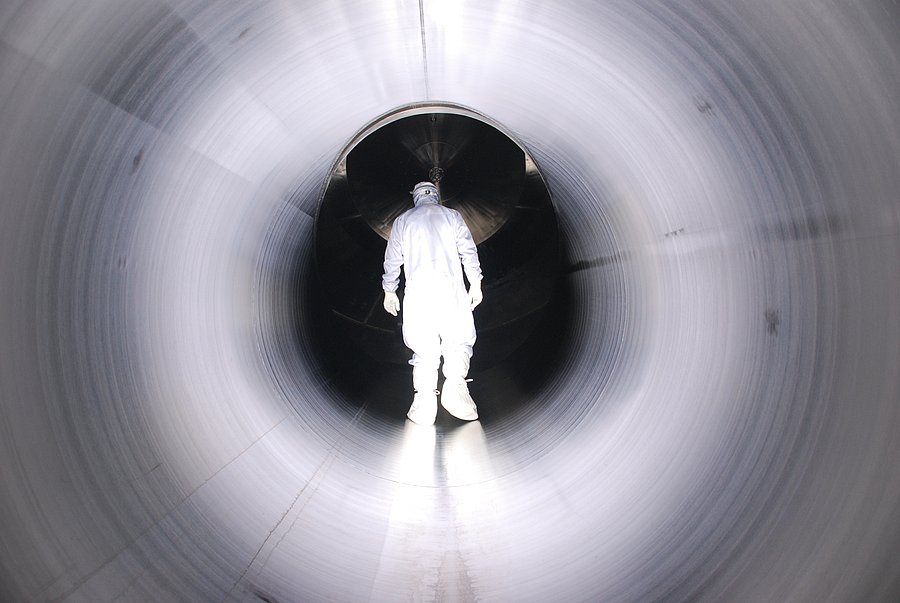
Employees in the entrance to the main spectrometer // Photo KATRIN Collaboration
Neutrinos are among the most mysterious particles in the universe. They almost completely elude direct observation and occupy an important special position due to their tiny mass - they give rise to the assumption that physical processes exist beyond the previously known theories. The standard model currently recognises three types of neutrinos. The international KATRIN experiment, in which around 20 institutions from seven countries are involved - including the University of Wuppertal (BUW) - has now searched with unprecedented precision for a possible fourth type of neutrino, the sterile neutrino. Its discovery would revolutionise the current understanding of particle physics. The researchers have now published their results in the current issue of the renowned scientific journal Nature.
The KATRIN experiment based at the Karlsruhe Institute of Technology (KIT) has been investigating the beta decay of tritium since 2019 in order to determine fundamental properties of neutrinos - including their mass. The energy spectrum of the electrons produced during this decay could reveal whether this additional sterile neutrino exists. This would produce a characteristic distortion, a small "kink", in the spectrum.
In their current analysis, the KATRIN collaboration analysed 36 million electrons from 259 measurement days and achieved a measurement accuracy in the sub-percent range. No such kink was observed. The existence of sterile neutrinos can therefore not be confirmed at this time.
Wuppertal high-tech components ensure precision
The university of Wuppertal contributes crucial elements to the exceptional measurement accuracy of KATRIN. A special instrument developed by Wuppertal researchers is integrated into the 70-metre-long high-tech structure, which determines the decay rate of tritium with an accuracy of one per mille every second. "Our technology works in an almost perfect vacuum, has to control moving components with sub-millimetre precision and at the same time withstand a strong superconducting magnetic field and temperatures just above absolute zero," explains Dr Enrico Ellinger from the Physics Department at the University of Wuppertal.
The Wuppertal team is also currently working on eliminating interfering signals in the data set. These originate from highly excited atoms in the system. To do this, the researchers are breaking new ground: they are testing the use of terahertz radiation to specifically suppress these sources of interference. "This is a completely new technique," explains Prof Dr Klaus Helbing, head of the Experimental Neutrino Physics working group at BUW.
Outlook: Wuppertal develops key components for the next upgrade
The scientific outlook continues to look ahead: by the end of 2025, KATRIN will have registered a total of more than 220 million electrons - a six-fold increase on previous data sets. This will be followed in 2026 by a comprehensive upgrade of the experiment with the new TRISTAN detector, which will record the entire electron spectrum with enormous statistics.
For this upgrade, Dr Ellinger is developing a high-precision X-ray source to calibrate the energy measurement - a central building block to further refine the search for sterile neutrinos and thus a potential key to expanding our understanding of particle physics.
Further information
KATRIN Website: www.katrin.kit.edu
Nature Publication: DOI: 10.1038/s41586-025-09739-9
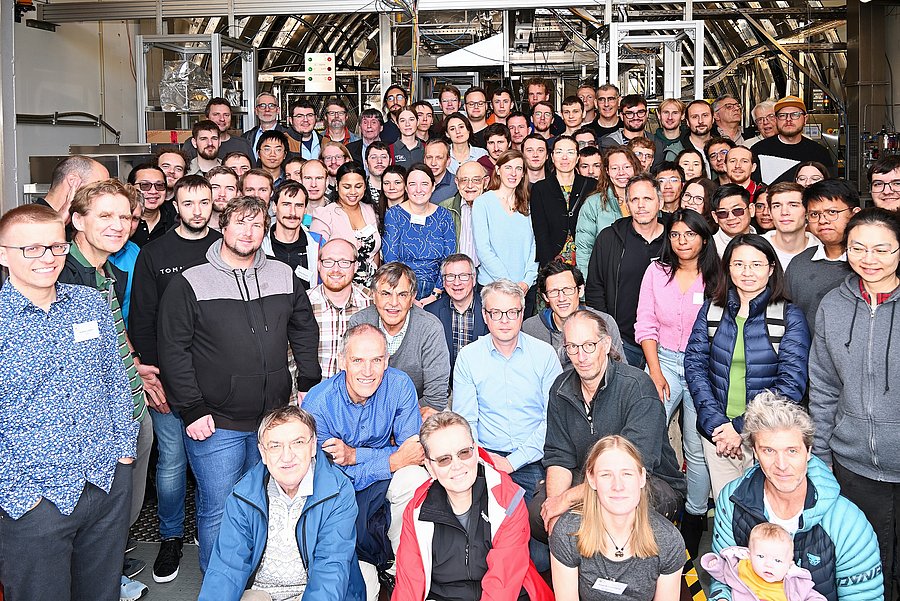
The KATRIN Collaboration, at a meeting in October 2024 // Photo J. Wolf/KATRIN Collaboration