Three years of the rectorate in retrospect
The University of Wuppertal on course: An interview with Birgitta Wolff
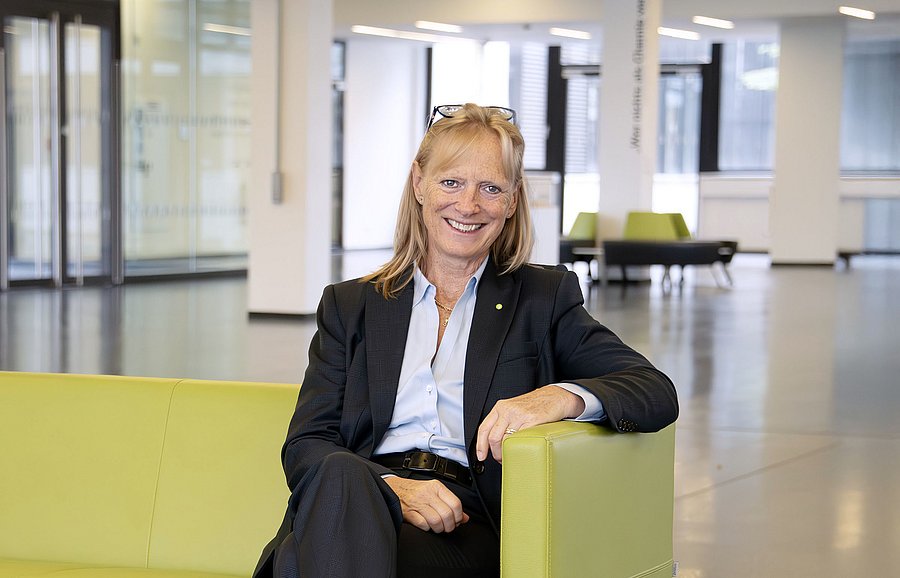
Rector Prof Dr Birgitta Wolff in a mid-term interview: "I am always pleased to see how many people at this university and beyond are willing to get involved." // Photo Friederike von Heyden
Professor Wolff, you have been rector of the University of Wuppertal for three years now. How do you look back on this first half of your term of office?
They have been very intensive years, with a lot of teamwork. Years with many exciting projects and also some major challenges. I am very pleased with what we have been able to achieve together. At the same time, I am full of energy for the tasks ahead.
In your opinion, what were the biggest milestones or successes during this time?
We have made great progress in research: We have sharpened our profile and developed four fields of activity on emissions and resource reduction (Technology Towards Zero-Waste and Zero-Carbon), learning of the future (Next Generation Learning, Teaching, Knowledge Transfer), social change (Shaping Sustainable Societal Transformation) and artificial intelligence (AI for Empowering the Future), which we will use to describe our endeavours in the future. With FORIS, we have established a new internal research funding programme that has been very well received. One particular success is that we have been able to acquire a DFG Collaborative Research Centre as a host university. The recent successful application for four ERC grants - with which the European Research Council promotes excellence in science - also shows how strong our researchers have become.
Together with the two sustainability initiatives Humboldtn and NAW.NRW, we are embarking on a major experiment this week together with state politicians and the other NRW universities: the NRW Future Conference. It can help to ensure that scientific expertise is utilised even more effectively for the sustainable transformation in NRW in a previously unusual way. Manfred Fischedick, President of the Wuppertal Institute, and I came up with the concept for this, which means that we have also intensified our cooperation with the Wuppertal Institute once again.
What tasks have been particularly challenging for you?
The further development of our study programmes was and remains a major task. Several faculties have developed new degree programmes with a strong focus on sustainability - some of them in English. With the sustainability teaching workshop, we were also able to network lecturers who are particularly involved in this area. This resulted in a project to develop a new interdisciplinary degree programme. The expansion of teacher training places and the joint primary school teacher training programme with RWTH Aachen University, which was launched this semester, were particularly challenging. Not least because we were and are closely dependent on the intensive dialogue with the state and its support.
To what extent do you think the University of Wuppertal is even better positioned for the future today?
Our links with partners in science, business and society have been intensified and expanded in recent years. There are new co-operation agreements with the city and the Bergisch Chamber of Industry and Commerce. We have moved into the former Federal Railway Headquarters in the centre of the city and are therefore more present in the cityscape. We have concluded cooperation agreements with major research institutions for the first time or intensified our existing collaboration. New partners include the Leibniz Institute for Economic Research (RWI) in Essen, the German Institute for Adult Education/Leibniz Centre for Lifelong Learning (DIE) in Bonn and the Helmholtz Centre for Heavy Ion Research (GSI) in Darmstadt.
Our cooperation with the Jülich Research Centre and CERN in Geneva has been and will continue to be intensified. Our mechanical engineering network has grown, the number of German scholarships has increased and our FABU funding organisation has picked up speed again following a relaunch. It's also great to see that our expertise is often integrated into political processes - for example in the state parliament's commission of enquiry on artificial intelligence.
Where do you still see a need for action?
At the top of the agenda is the promotion of young scientists. We have changed doctoral scholarships to graduation scholarships and introduced FORIS, a separate funding line for early-career researchers. As a result, we are also finding out much more about the sensational projects that our younger colleagues are developing. As a next step, we want to reorganise the Centre for Graduate Studies in order to provide even better interdisciplinary support for doctoral students and postdocs. This is also a topic in our university development plan. The elephant in the room at the moment is the cuts imposed by the state. We were able to "negotiate down" more than half of the originally announced sum, but we are currently fighting for the rest with our combined forces.
What topics or projects are you focussing on in the second half of your term of office?
Following the adoption of the new university mission statement and the mission statement for teaching, we presented the draft text for our university development plan to the Senate at the end of October. At the end of the month, the text, which was revised again after the meeting, will be on the agenda of the University Council for approval. The major topics addressed there will characterise the second half of my term of office. I would like us to position ourselves as an open and tolerant university that combines excellent research and innovative teaching with a lively campus culture - and that becomes more visible both regionally and internationally.
In close cooperation with the Chancellor, specific topics include the further digitalisation of internal processes and the further development of the campus. There are now plans for a dedicated sports hall and a "place of silence". The latter should even be completed during my term of office.
And finally: What motivates you, especially in difficult moments?
Clearly the people here and the wonderful teamwork. I have a wonderful Rectorate team and great support. The enthusiasm of the students, the passion of the teaching staff, the creativity and commitment of the employees - these are the moments that always give me new energy and perspectives. I am always delighted to see how many people at this university and beyond are willing to get involved. This became clear, for example, in the processes of the mission statements and the university development plan, in the new research initiatives and teaching innovations through to campus festivals and new communication formats such as the AStA and Studierendenwerk Jour Fixe. The wide variety of perspectives and topics characterises and enriches my everyday life.