Authorisation
DFG funds cutting-edge research in Wuppertal on the fundamental force of nature more
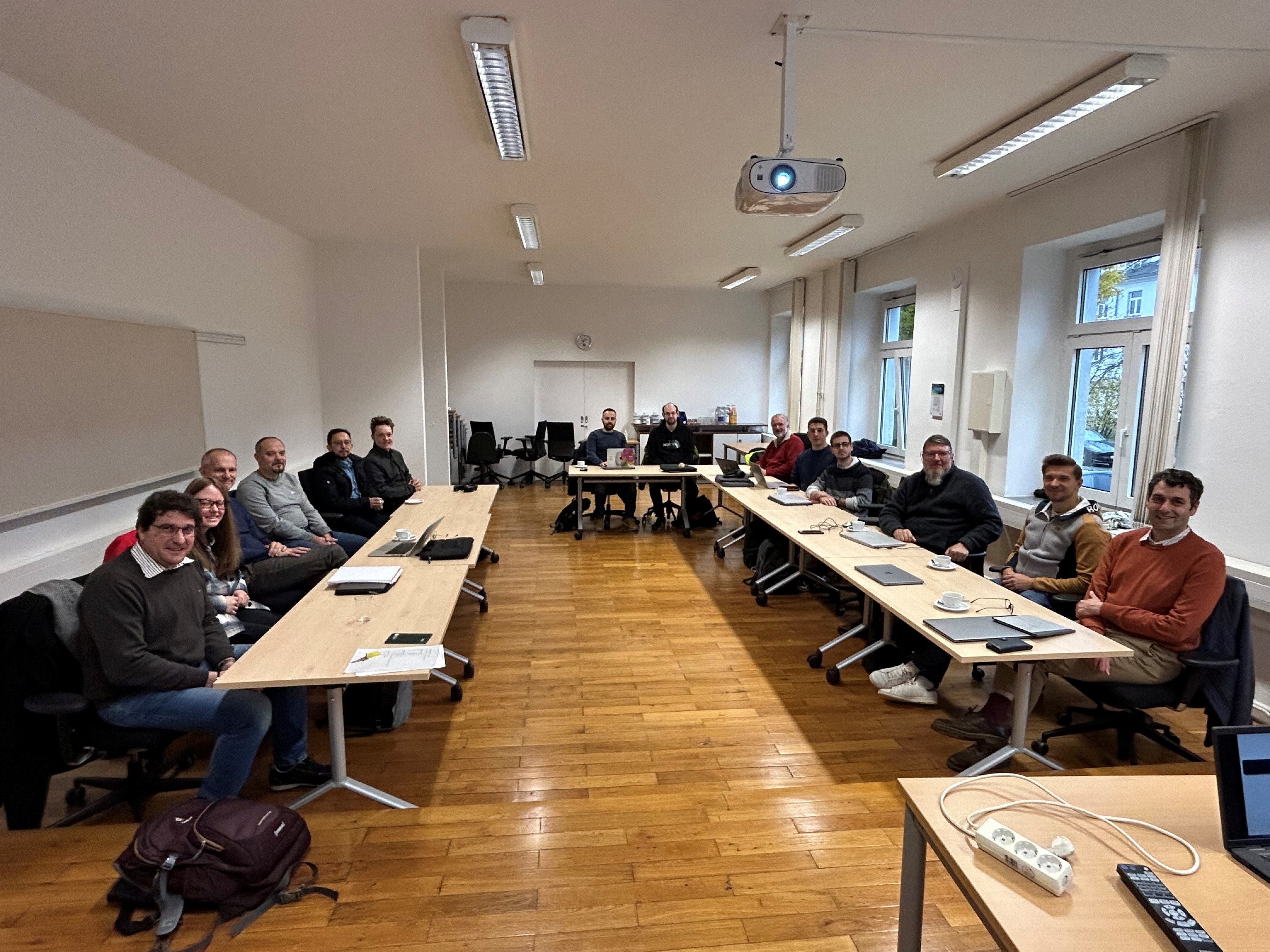
The research group led by Prof Dr Francesco Knechtli (left) at a joint workshop in Wuppertal // Photo BUW
At the centre of the research group is one of the most fundamental questions in physics: how does the so-called strong interaction, one of the four fundamental forces of nature, work? In the standard model of particle physics, it is described as quantum chromodynamics. It ensures that the building blocks of protons and neutrons - the quarks - are held firmly together. This force is mediated by particles called gluons. Despite their central role, there are properties of these gluons that are still poorly understood.
A special feature of the strong interaction is that gluons and quarks can never be observed individually. Metaphorically speaking, the gluons are the "glue" that holds the quarks together, which means that they are always enclosed in larger particles - a phenomenon that physicists call "confinement". The research group is focussing precisely on these confined gluons and their properties.
Unexpected results
The focus is on so-called glueballs - theoretically predicted particles that consist almost exclusively of gluons and hardly any quarks. The researchers want to find out whether they really exist and what they look like, thereby contributing to a fundamental understanding of the force. In addition, experiments at particle accelerators since the early 2000s have discovered previously unknown, so-called exotic particles. With their internal structure, gluons could not only act as "glue", but could also be in excited states of motion and thus help determine the properties of these particles. "World-leading research facilities such as CERN in Geneva or particle accelerator centres in China and Japan repeatedly deliver measurement data, the interpretation of which poses a major challenge. They don't really fit in with what was previously expected. We want to find out more about the unexpected particle states and thus help to better understand and classify the observations," explains Prof Dr Francesco Knechtli.
To achieve this, the researchers are relying on highly developed computer simulations and powerful computing methods, which they are developing as part of their work. In doing so, they combine theoretical physics with modern applied mathematics - a unique selling point, according to the research group. The new mathematical methods are intended to make the simulations more accurate and efficient. With their approach, the scientists not only want to advance the answers to today's questions, but also pave the way for future research.
The next generation also benefits
In addition to Prof Dr Francesco Knechtli, Dr Tomasz Korzec, Prof Dr Michael Günther, Prof Dr Andreas Frommer and Dr Karsten Kahl from the University of Wuppertal are also involved in the research group. Other partners come from DESY Zeuthen, the University of Regensburg and Trinity College Dublin. The close collaboration not only strengthens international networking, but also offers exciting training and exchange opportunities for young scientists.
The second funding phase will run from 2026 to 2030. The total funding from the DFG amounts to around 2.5 million euros, of which 1.6 million euros will go to the University of Wuppertal.
Further information can be found on the website of the School of Mathematics and Natural Sciences.