Third Mission Honour Award
Bergische Uni honours three initiatives for outstanding social commitment
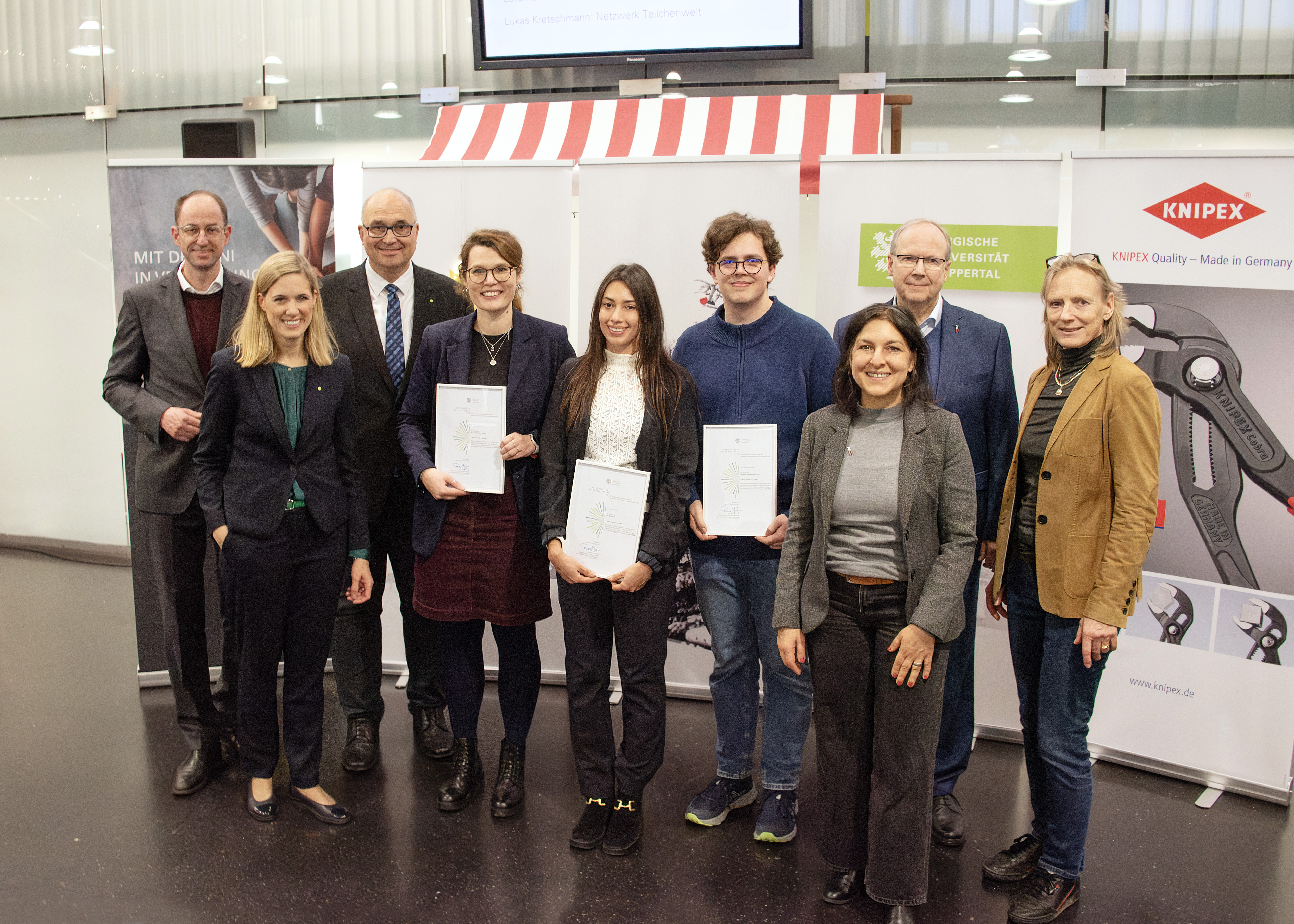
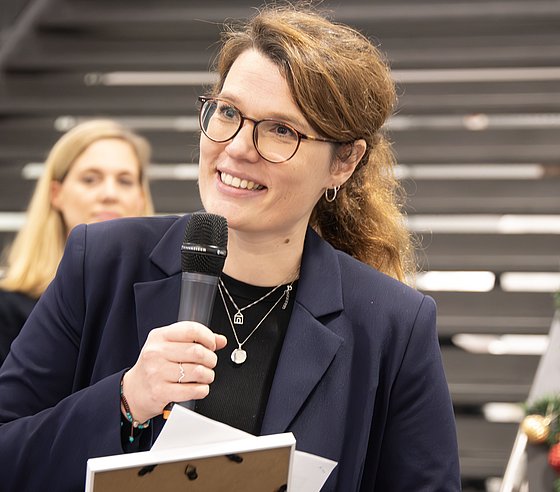
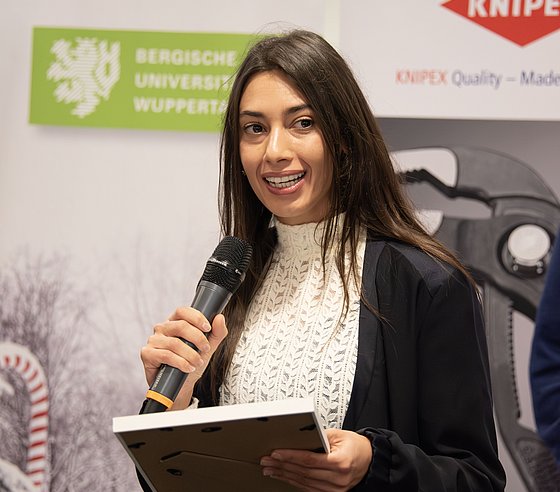
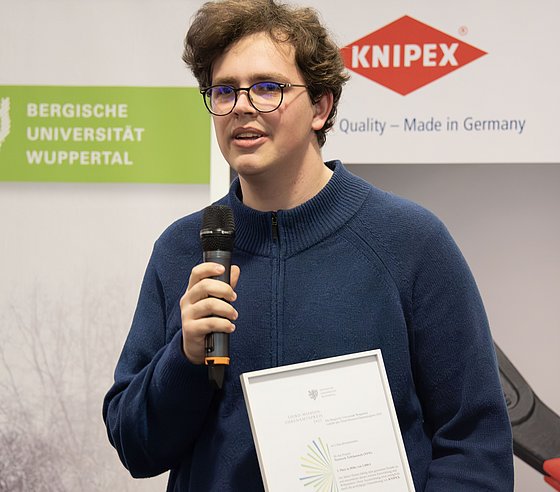
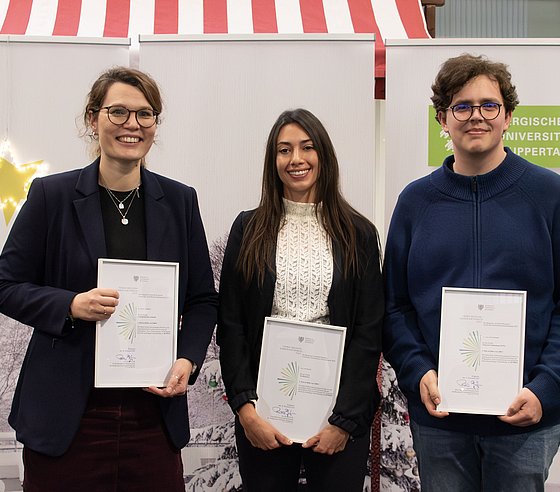
Prof Dr Juliane Schlesier (4th from left), Leila Rudzki (5th from left) and Lukas Kretschmann (4th from right) were awarded the first "Third Mission Honorary Award" of the University of Wuppertal. Among the first well-wishers were Jens Schmidt (left, Chairman of Freunde und Alumni der Bergischen Universität Wuppertal e.V.), Christina Semke (2nd from left, Head of UniService Third Mission), Prof Dr Peter Gust (3rd from left, Peter Gust (3rd from left, Vice-Rector for Third Mission and International Affairs), Asal Tayouri (3rd from right, KNIPEX Management Assistant), Ralf Putsch (2nd from right, KNIPEX Managing Director) and Prof Dr Birgitta Wolff (right, University Rector). // Photo Friederike von Heyden
"With the new honorary award, the University of Wuppertal is setting a visible sign of social responsibility and recognising people who sustainably strengthen the connection between science and society through their own initiative," says Professor Peter Gust, Vice-Rector for Third Mission and International Affairs.
A total of 13 nominations were received from various faculties and areas of activity. A jury made up of representatives from the university, the KNIPEX foundation and the Friends and Alumni of the University of Wuppertal scrutinised all proposals based on defined criteria such as effectiveness, degree of innovation, continuity/sustainability of the project, scalability, transfer potential and impact.
Three projects were ultimately recommended for the award. They impressed with their ambitious, inspiring and transferable commitments that create tangible added value for society:
With her "Primary School of the Future" project, Juliane Schlesier combines the areas of teacher training, school development and social commitment in an exemplary manner. In the project, which runs from 2023 to 2025 and is partially funded by the Barthel/EWE Foundation, around 150 student teachers worked together with around 400 primary school children in inclusive "heroine teams" on sustainable, charitable measures for schools and communities.
These included the construction of raised beds, the design of school playgrounds and renovation work. The results achieved remain permanently visible at the schools and are sometimes used in lessons.
The jury particularly emphasised the high social relevance, the strong transfer potential and the exemplary character: "The project is an example of how cooperation between the university, schools, local authorities and parents can generate direct social added value. At the same time, it strengthens the self-efficacy of the children and students involved, promotes social participation and demonstrably improves the school climate," reads the explanatory statement. Teacher training also benefits significantly, which has already been confirmed by several awards and excellent evaluations.
Leila Rudzki initiated and managed "StraßenOase!", a participatory urban and research project in the Wichlinghausen neighbourhood of Wuppertal. The original plan was to temporarily calm a 50-metre stretch of road and transform it into a green neighbourhood oasis with seating, shaded areas and cultural activities. Although local politicians prohibited the use of the area at short notice, the project turned into an innovative, self-organised festival on the BOB campus thanks to a high level of resilience and volunteer support.
With the involvement of over 80 participants - including students, residents, initiatives such as "Platz für alle", local businesses, administration and politicians - a diverse programme was created: with workshops, music, planting activities and a bicycle demonstration along Wichlinghauser Straße.
The jury particularly praised the strong social participation, the effectiveness of the project despite adverse circumstances and its anchoring in the neighbourhood. The project gave rise to new planning groups, permanent plant sponsorships, material concepts for reuse and requests for advice from other neighbourhoods. "The "StraßenOase!" has attracted widespread media attention and is now regarded as an exemplary urban laboratory for democratic negotiation processes and climate-resilient urban development," said the jury.
For several years, student Lukas Kretschmann has been involved in the "Netzwerk Teilchenwelt", a nationwide association of over 30 universities and research institutions such as the European Organisation for Nuclear Research (CERN) and the German Electron Synchrotron (DESY). The aim of the network is to get young people interested in particle physics and the natural sciences and to give them a direct experience of scientific work.
Kretschmann supervises masterclasses on particle physics, in which pupils analyse real data from the ATLAS experiment and learn about the basics of research. He is also the national spokesperson for the Netzwerk Teilchenwelt Fellow programme with around 250 committed pupils and students and organises formats that bring renowned scientists - including Nobel Prize winners - into direct contact with young people.
The jury particularly recognised his high individual influence, his extraordinary commitment to promoting young talent and the great transfer potential for other STEM fields, i.e. mathematics, computer science, natural sciences and technology: "Lukas Kretschmann makes a special contribution to the social acceptance of basic research and at the same time strengthens the visibility of Wuppertal as a research location."
Award ceremony
The award ceremony for the first-ever Third Mission Honourary Awards took place as part of the Campus Christmas Market. The prize money is to be used for the further development of the honoured projects; in the case of student initiatives, it can also be used personally on a pro rata basis.
More impressions