Promotion of young talent
Honoured: Wuppertal junior professor becomes a member of the Young Academy
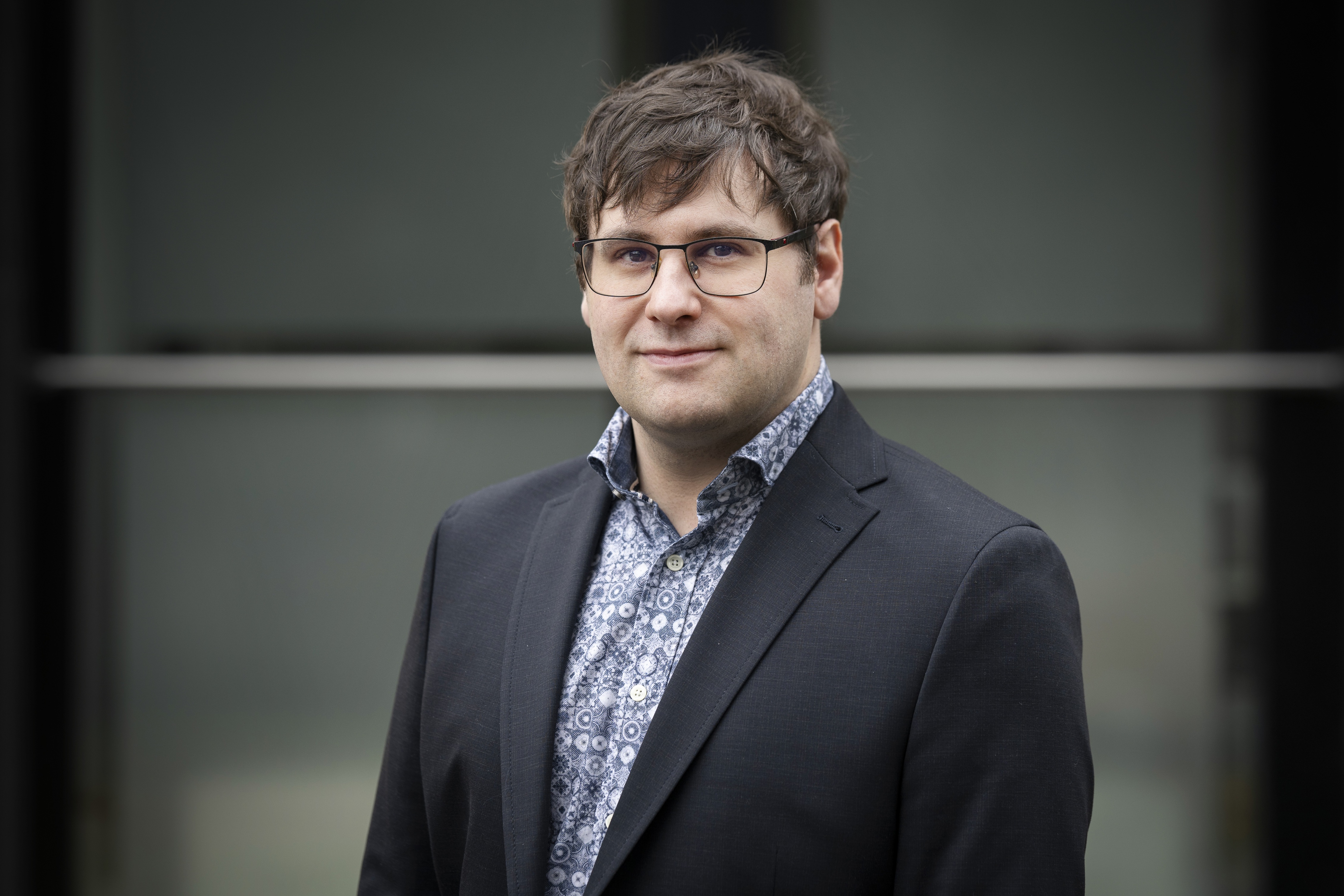
Junior Professor Dr Hannes Gernandt // Photo AWK NRW/Engel-Albustin
Hannes Gernandt uses applied mathematical methods to model and optimise dynamic systems, i.e. processes that change over time. In order to avoid modelling errors, data-based methods such as machine learning are becoming increasingly important. However, there is a catch: although purely data-driven models often deliver good results, they frequently do not take into account physical laws such as the conservation of energy. In his research, Gernandt therefore utilises an approach that has become increasingly important in recent years: so-called Port Hamiltonian systems combine physical knowledge with data-based methods.
As a member of the Collaborative Research Centre 1701 at the University of Wuppertal, he uses Port Hamiltonian methods to develop new optimisation procedures and control methods. Hannes Gernandt is currently working at the Fraunhofer Research Institution for Energy Infrastructures and Geotechnologies (IEG) on the simulation and optimisation of complex energy networks, in particular hydrogen and district heating infrastructures.
Important honour
For the new members, acceptance is an important honour: the Young Academy offers both financial freedom for their own research and art in the form of an annual grant of 10,000 euros and the opportunity to exchange ideas with other excellent researchers and artists. The programme brings together some of the best in their fields, young and established academics and artists whose paths would not otherwise cross. The humanities, natural sciences and medicine, engineering and economics are all represented - as well as the arts, a speciality of the academy.
"Being accepted into the Junge Kolleg is a unique opportunity to broaden my academic horizons and engage in dialogue with numerous young academics from a wide range of disciplines. I am very much looking forward to contributing my expertise in applied mathematics and in the field of renewable energies and to integrating the topic of sustainability even more strongly and specifically into my research as part of the Humboldtn initiative," says Hannes Gernandt.
Three of the scholarship places, including Hannes Gernandt's, are being made possible this year through the Academy's cooperation with the State Rectors' Conference under the umbrella of the Humboldtn sustainability initiative: The cooperation agreement between the universities of a federal state and its academy of sciences in the field of promoting young academics, which is unique in Germany, provides for up to twelve additional scholarship holders to be accepted into the Young Academy to provide new impetus on issues of sustainability in the context of research and university organisation.
The academy has been supporting young academics in North Rhine-Westphalia with the Young Academy for 20 years and now has around 200 active, associated and former scholarship holders. The Young Academy is open to doctoral candidates and outstanding artistic talents who are no older than 36.